. 2012 Jul 1;11(13):2538-44.
doi: 10.4161/cc.20919. Epub 2012 Jul 1.

A novel ubiquitin mark at the N-terminal tail of histone H2As targeted by RNF168 ubiquitin ligase

Affiliations

A novel ubiquitin mark at the N-terminal tail of histone H2As targeted by RNF168 ubiquitin ligase

Marco Gatti et al. Cell Cycle. .

Abstract

Ubiquitination of histones plays a critical role in the regulation of several processes within the nucleus, including maintenance of genome stability and transcriptional regulation. The only known ubiquitination site on histones is represented by a conserved Lys residue located at the C terminus of the protein. Here, we describe a novel ubiquitin mark at the N-terminal tail of histone H2As consisting of two Lys residues at positions 13 and 15 (K13/K15). This "bidentate" site is a target of the DNA damage response (DDR) ubiquitin ligases RNF8 and RNF168. Histone mutants lacking the K13/K15 site impair RNF168- and DNA damage-dependent ubiquitination. Conversely, inactivation of the canonical C-terminal site prevents the constitutive monoubiquitination of histone H2As but does not abolish the ubiquitination induced by RNF168. A ubiquitination-defective mutant is obtained by inactivating both the N- and the C-terminal sites, suggesting that these are unique, non-redundant acceptors of ubiquitination on histone H2As. This unprecedented result implies that RNF168 generates a qualitatively different Ub mark on chromatin.


Figures
None
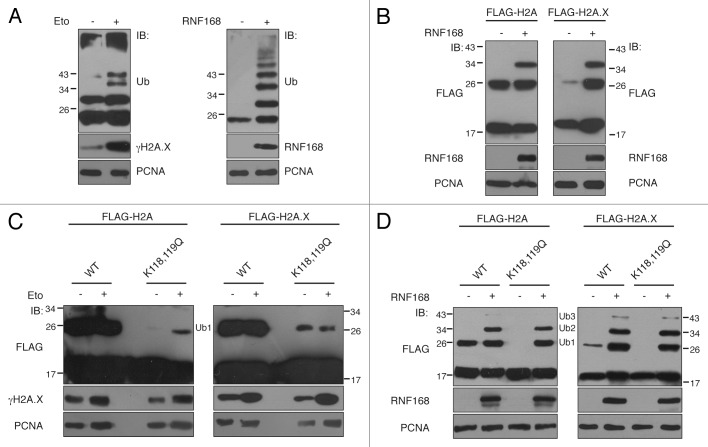
Figure 1. K118/K119 is not the sole ubiquitination site on histones H2A and H2A.X. (A) 293T cells were either treated with etoposide (30 μM) for one hour (left panel) or transfected with cDNA encoding RNF168 or the vector alone (right panel). Three hours after etoposide treatment or 48 h post-transfection, cells were subjected to acid extraction and the histone component was analyzed by SDS-PAGE and immunodecorated with anti-Ub antibody. The induction of DNA damage and expression of RNF168 were verified by phospho-H2A.X (γH2A.X) and RNF168 immunoblotting (IB), respectively; (B) 293T cells were co-transfected with a vector coding RNF168 or the empty vector together with FLAG-tagged histones H2A (left panel) and H2A.X (right panel). Lysates were subjected to acid extraction, analyzed by SDS-PAGE and immunodecorated with anti-FLAG antibody. IB with RNF168 revealed the ectopic expression of the E3 ligase. (C and D) 293T cells expressing the FLAG-tagged forms of histones H2A, H2A.X and their C-terminal mutants K118,119Q were either treated with etoposide (as described in A) or co-transfected with empty vector or RNF168 and immunodecorated with anti-FLAG antibody to evaluate the level of histone ubiquitination. In all cases, an aliquot of cells (1/10) was lysed in LAEMMLI buffer and immunoblotted with PCNA antibody to verify equal loading (lower panels). (Ub1, Ub2, Ub3) indicates the number of Ub moieties appended to histones.
None
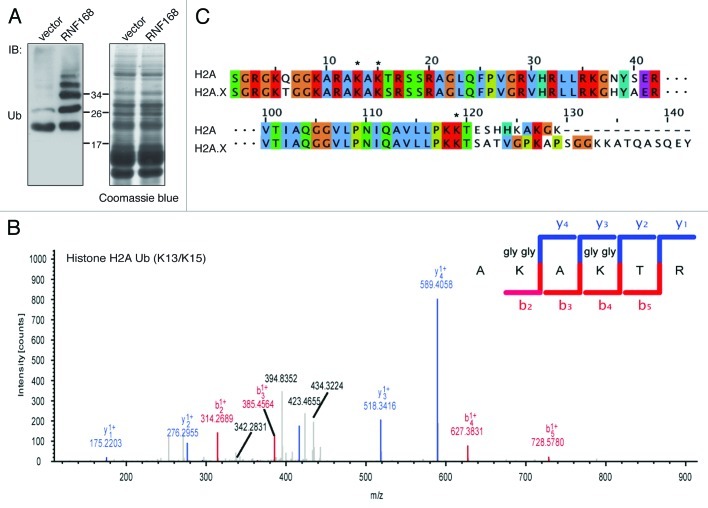
Figure 2. Identification of new ubiquitination mark on histone H2As. (A) Acidic extraction of 293T cells, transfected with a vector encoding RNF168 or with the empty vector, were analyzed by SDS-PAGE followed by either Ub immunoblotting (left panel) or Coomassie brilliant blue staining (right panel). Protein bands corresponding to ubiquitinated histones were excised, subjected to trypsin digestion and processed as described in Material and Methods. (B) Mass spectrometry analysis revealed the presence of ubiquitinated peptides corresponding to the N-terminal sequence of histone H2A. The peptide sequence encompassing the ubiquitinated Lys residues in position 13 and 15 are indicated. (C) Sequence alignment of the N-terminal and C-terminal tails of histones H2A and H2A.X, using the Clustalw program and edited with the Jalview software, is shown. ClustalX colors (reflecting the chemical properties of the amino acids) are applied.
None
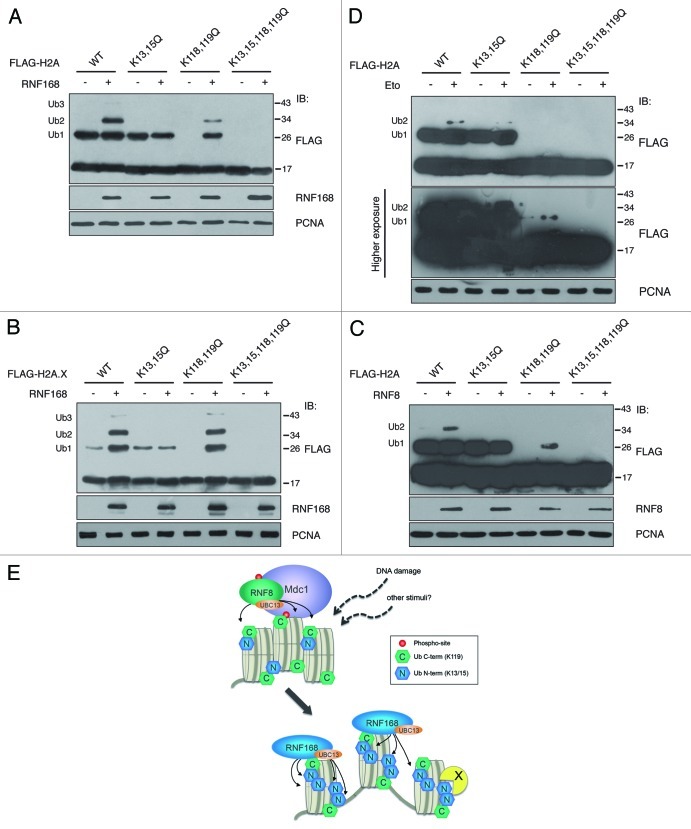
Figure 3. Ubiquitination of histones H2A and H2A.X depends on K13 and K15. (A) and (B) In vivo ubiquitination of histones H2A and H2A.X and their mutant forms were evaluated in cells co-transfected with a vector encoding RNF168 or with the empty vector together with FLAG-tagged histones, as indicated. After acidic extraction, samples were analyzed by SDS-PAGE. Immunoblot with anti-FLAG antibodies revealed the presence of higher molecular weight proteins compatible with mono- (Ub1), di- (Ub2) and tri- (Ub3) ubiquitinated forms of the histones. (C) Cells have been co-transfected with cDNA coding for FLAG-RNF8, together with the indicated histone mutants. The experimental procedure is the same as in A. (D) 293T cells expressing the indicated forms of FLAG-tagged histone H2A were treated with etoposide (30 μM) for one hour, and three hours later processed as in A and B. Cell loading was normalized by PCNA immunoblotting as described in Figure 1. (E) Model representing the RNF8 and RNF168-dependent ubiquitination on histone H2As. In addition to amplification of histone ubiquitination initiated by RNF8, RNF168 promotes multi-ubiquitination on different sites, thereby translating upstream post-translational modifications into specific DNA damage-response signals. X represents possible K13/15-specific binding protein.

Comment in

References

    1. Bannister AJ, Kouzarides T. Regulation of chromatin by histone modifications. Cell Res. 2011;21:381–95. doi: 10.1038/cr.2011.22. - DOI - PMC - PubMed
    1. Campos EI, Reinberg D. Histones: annotating chromatin. Annu Rev Genet. 2009;43:559–99. doi: 10.1146/annurev.genet.032608.103928. - DOI - PubMed
    1. Weake VM, Workman JL. Histone ubiquitination: triggering gene activity. Mol Cell. 2008;29:653–63. doi: 10.1016/j.molcel.2008.02.014. - DOI - PubMed
    1. Xu Y, Price BD. Chromatin dynamics and the repair of DNA double-strand breaks. Cell Cycle. 2011;10:261–7. doi: 10.4161/cc.10.2.14543. - DOI - PMC - PubMed
    1. Woelk T, Sigismund S, Penengo L, Polo S. The ubiquitination code: a signalling problem. Cell Div. 2007;2:11. doi: 10.1186/1747-1028-2-11. - DOI - PMC - PubMed

Publication types