Randomized Controlled Trial
. 2012 Jul;117(1):22-37.
doi: 10.1097/ALN.0b013e31825a2a4e.

Aversive and reinforcing opioid effects: a pharmacogenomic twin study

Affiliations
Randomized Controlled Trial

Aversive and reinforcing opioid effects: a pharmacogenomic twin study

Martin S Angst et al. Anesthesiology. 2012 Jul.

Abstract

Background: The clinical utility of opioids is limited by adverse drug effects including respiratory depression, sedation, nausea, and pruritus. In addition, abuse of prescription opioids is problematic. Gaining a better understanding of the genetic and environmental mechanisms contributing to an individual's susceptibility to adverse opioid effects is essential to identify patients at risk.

Methods: A classic twin study paradigm provided estimates for the genetic and familial (genetic and/or shared environment) contribution to acute adverse and affective opioid responses, all secondary outcomes of a larger dataset. One hundred twenty-one twin pairs were recruited in a single occasion, randomized, double-blind, and placebo-controlled study. The μ-opioid receptor agonist alfentanil and saline placebo were administered as target-controlled infusions under carefully monitored laboratory conditions. Measured outcomes included respiratory depression, sedation, nausea, pruritus, drug liking, and drug disliking. Demographic information was collected, and aspects of mood and sleep were evaluated.

Results: Significant heritability was detected for respiratory depression (30%), nausea (59%), and drug disliking (36%). Significant familial effects were detected for sedation (29%), pruritus (38%), dizziness (32%), and drug liking (26%). Significant covariates included age, sex, race, ethnicity, education, mood, and depression. Covariates affected sedation, pruritus, drug liking and disliking, and dizziness.

Conclusions: This study demonstrates that large-scale efforts to collect quantitative and well-defined opioid response data are not only feasible but also produce data that are suitable for genetic analysis. Genetic, environmental, and demographic factors work together to control adverse and reinforcing opioid responses, but contribute differently to specific responses.


Conflict of interest statement

Conflict of Interest

The authors do not have any conflict of interest.

Figures
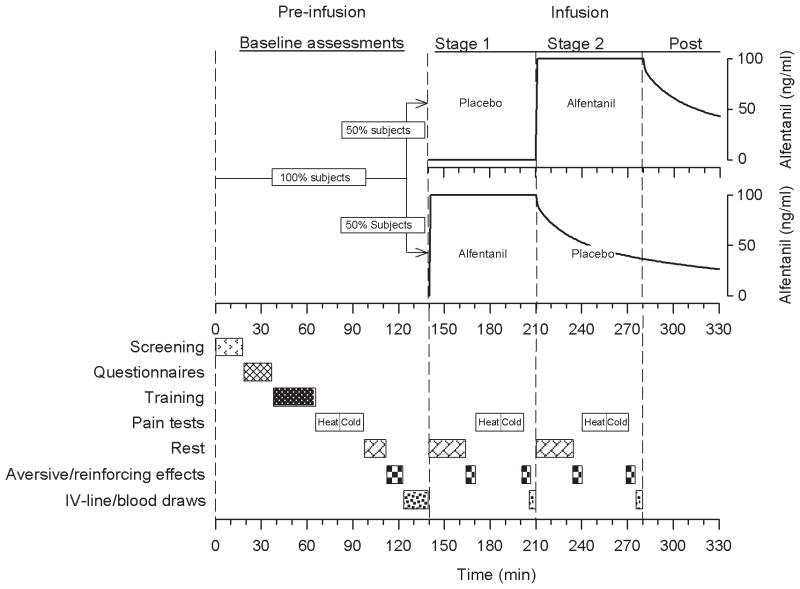
Figure 1
Figure 1
Two hundred and twenty eight monozygotic and dizygotic twins successfully underwent a computer-controlled infusion with the μ-opioid agonist alfentanil in a single occasion, randomized, double-blinded and placebo-controlled study paradigm. Baseline assessments included respiratory parameters (transcutaneous carbon dioxide and respiratory rate), cognitive speed, pain tests (reported elsewhere), covariates potentially affecting measured opioid effects (demographics, psychometric tests, sleep quality), vital signs, and blood draws. Fifty percent of twin pairs were allocated to receive alfentanil first and saline placebo second, while the other 50% of twin pairs received alfentanil and saline placebo in reversed order. The alfentanil target concentrations for both treatment sequences are depicted in the graph. A concentration of 100 ng/ml produces significant analgesic and aversive opioid effects in patients suffering from postoperative pain. Respiratory parameters, cognitive speed, subjective aversive effects (nausea, dizziness, sedation, pruritus), reinforcing effects (drug liking and disliking), analgesic effects (reported elsewhere), and vital signs were assessed in identical fashion during both stages of the infusion protocol. Blood draws for assaying alfentanil plasma concentrations were also obtained. This figure has been reproduced with permission of the International Association for the Study of Pain® (IASP®). The figure may not be reproduced for any other purpose without permission.
Figure 2
Figure 2
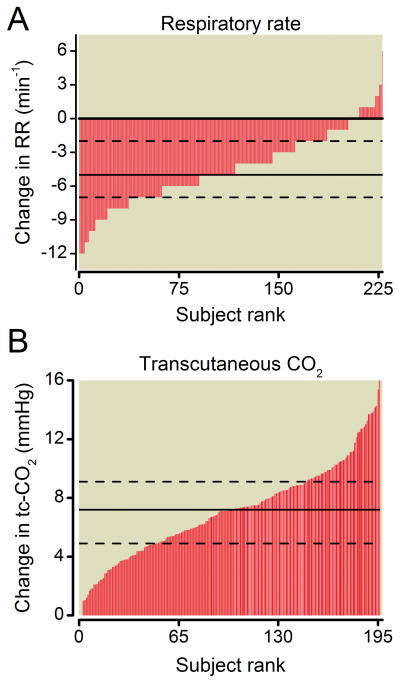
Respiratory depression was assessed by measuring opioid-induced decreases in respiratory rate and increases in transcutaneous carbon dioxide (tc-CO2). Results are ranked from smallest to largest along the x-axis. The inter-individual differences in drug-induced changes in respiratory rate (A) varied widely and ranged from −12 to 3 breaths/min. Similarly, the increase in tc-CO2 varied widely (B), being absent in some and increasing by up to 18.6 mmHg in others. The solid and dashed lines indicate the median and the interquartile range, respectively.
Figure 3
Figure 3
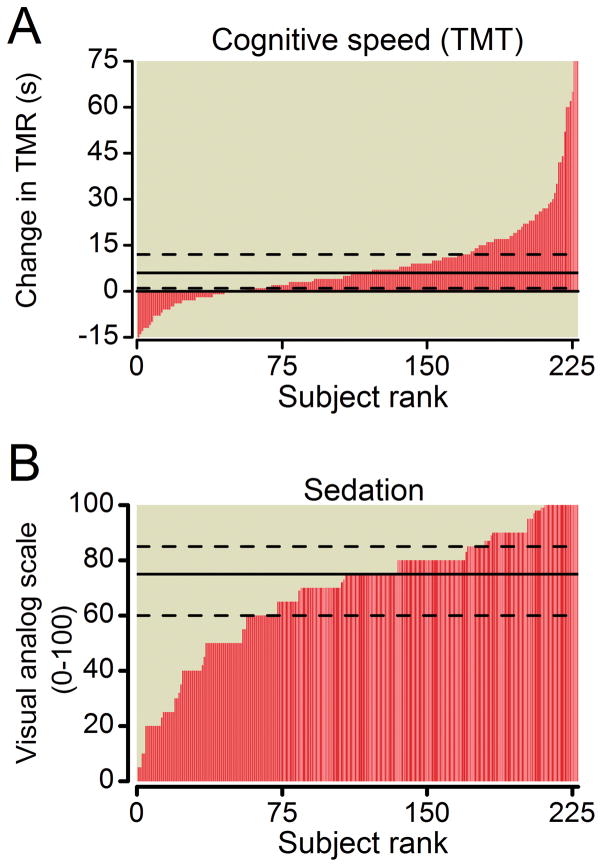
Sedation was assessed by measuring cognitive speed and by asking participants to indicate on a 100 mm visual analog scale (VAS) how sedated they felt. Results are ranked from smallest to largest along the x-axis. Drug mediated slowing in cognitive speed (A) varied widely in participants being unaffected in some and being modestly affected in most participants. Subjective sedation scores (B) increased in all participants, but the magnitude of such increase varied remarkably. The solid and dashed lines indicate the median and the interquartile range, respectively.
Figure 4
Figure 4
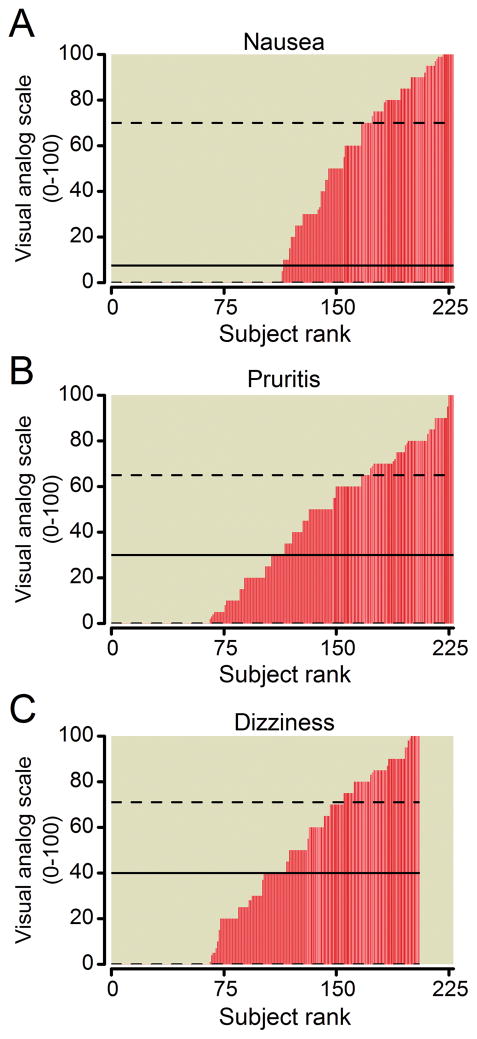
Subjective aversive opioid effects were all assessed on a 100 mm visual analog scale (VAS). Participants were asked at the end of the infusion phase to provide ratings for average and maximum nausea, pruritus and dizziness. Average and maximum ratings correlated tightly (R = 0.89–0.92). Maximum scores are displayed in the figure. Results are ranked from smallest to largest along the x-axis. The VAS scores for nausea (A), pruritus (B) and dizziness (C) varied widely among participants, being absent in many but ranking close to the maximum in others. The solid and dashed lines indicate the median and the interquartile range, respectively.
Figure 5
Figure 5
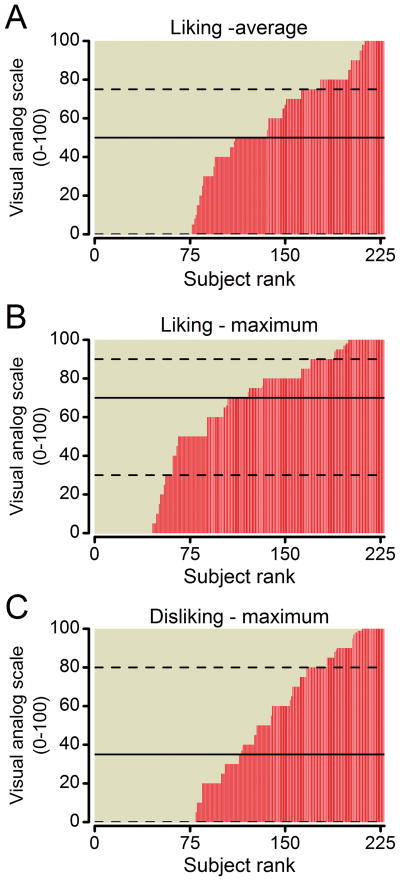
Reinforcing drug effects were assessed on a 100 mm visual analog scale (VAS). Participants were asked at the end of the infusion phase to provide ratings for average (A) and maximum drug liking (B), and maximum drug disliking (C). Results are ranked from smallest to largest along the x-axis. The VAS scores for drug liking and disliking varied widely among participants, being absent in many but ranking close to the maximum in others. The solid and dashed lines indicate the median and the interquartile range, respectively.
Figure 6
Figure 6
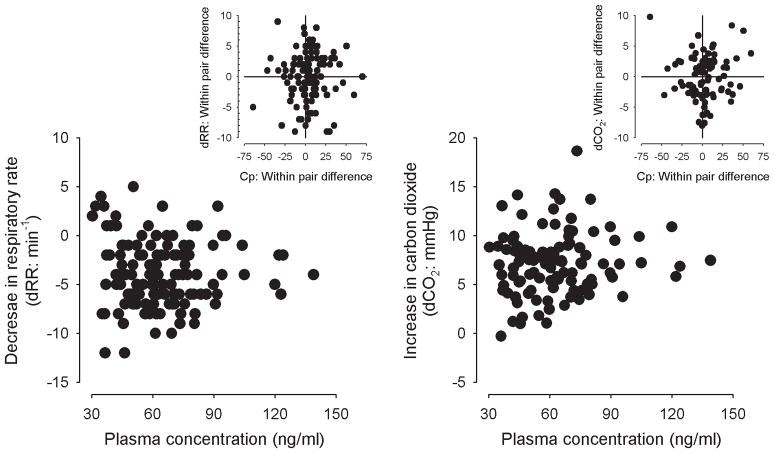
The figure depicts changes in respiratory parameters during the infusion of alfentanil. The graph on the left illustrates that the reduction in respiratory rate was not related to the plasma concentration within the range of studied plasma concentrations (r2 < 0.01). The inset graph demonstrates that within twin pair differences in the reduction of respiratory rate were not related to within pair differences in plasma concentrations (r2 < 0.01). The graph on the right illustrates that the increase in carbon dioxide was not related to the plasma concentration within the range of studied plasma concentrations (r2 < 0.01). The inset graph demonstrates that within twin pair differences in the increase of carbon dioxide was not related to within-pair differences in plasma concentrations (r2 < 0.01). These findings indicate that plasma concentrations were not a relevant factor affecting estimates of heritability and familial aggregation.

Comment in

References

    1. Angst MS, Chu LF, Tingle MS, Shafer SL, Clark JD, Drover DR. No evidence for the development of acute tolerance to analgesic, respiratory depressant and sedative opioid effects in humans. Pain. 2009;142:17–26. - PubMed
    1. Dolin SJ, Cashman JN. Tolerability of acute postoperative pain managemen: Nausea, vomiting, sedation, pruritus, and urinary retention. Evidence from published data. Br J Anaesth. 2005;95:584–91. - PubMed
    1. Cashman JN, Dolin SJ. Respiratory and haemodynamic effects of acute postoperative pain management: evidence from published data. Br J Anaesth. 2004;93:212–23. - PubMed
    1. Dahan A, Aarts L, Smith TW. Incidence, Reversal, and Prevention of Opioid-induced Respiratory Depression. Anesthesiology. 2010;112:226–38. - PubMed
    1. Hagle ME, Lehr VT, Brubakken K, Shippee A. Respiratory depression in adult patients with intravenous patient-controlled analgesia. Orthop Nurs. 2004;23:18–27. - PubMed

Publication types