


Review
doi: 10.1002/dev.20531.
Epub 2012 Jun 19.
Human amygdala development in the absence of species-expected caregiving
Affiliations
- PMID: 22714586
- PMCID: PMC3404246
- DOI: 10.1002/dev.20531
Item in Clipboard
Review
Human amygdala development in the absence of species-expected caregiving
Dev Psychobiol.
2012 Sep.
Abstract
In altricial species, like the human, caregiver presence is necessary for typical emotional development. Children who have been raised in institutional care early in life experience caregiver deprivation and are at significantly elevated risk for emotional difficulties. The current manuscript examines the non-human and human literatures on amygdala development following caregiver deprivation and presents an argument that in the absence of the species-expected caregiver presence, human amygdala development exhibits rapid development and perhaps premature engagement that results in some of the emotional phenotypes observed following early institutional care.
Copyright © 2012 Wiley Periodicals, Inc.
Figures
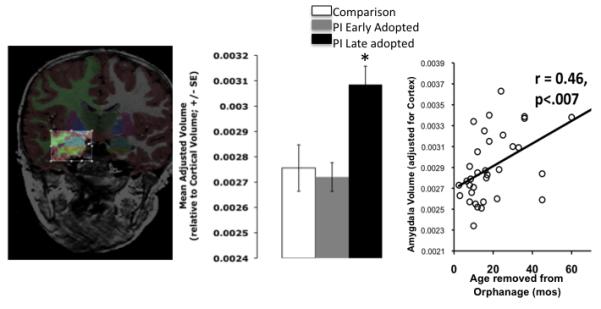
Amygdala Volume following Early Caregiver Deprivation. (Left) Amygdala segmentation highlighted in blue. (Middle) Post-institutionalized (PI) children who had been adopted later in life showed significant increases in amygdala volume. (Right) Longer periods of orphanage care were associated with larger amygdala volumes. PI = previously-institutionalized. Adapted from Tottenham et al., 2010.
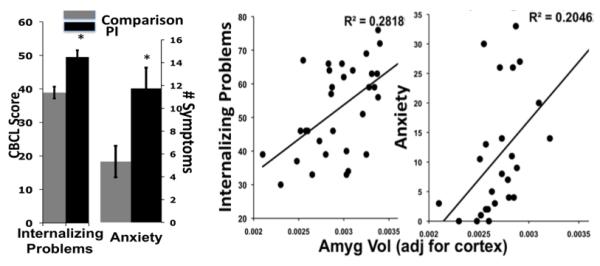
(left) PI children show more internalizing problems as measured by the Child Behavior Checklist (CBCL) & anxiety symptoms as measured by the SCARED-(Right 2 panels) Amygdala volume is positively associated with internalizing problems and continuous anxiety symptoms. PI = previously-institutionalized. Adapted from Casey et al., 2009 & Tottenham et al., 2010.
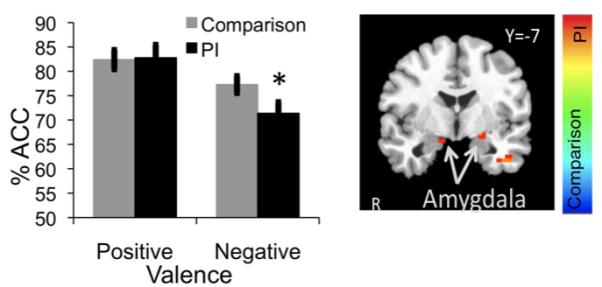
(Left) During performance on the Emotional Face Go/Nogo task, behavioral performance is more impaired by negatively valenced faces in the PI group. (Right) Direct group contrast show that PI children (orange) show heightened amygdala activity in response to fear faces. PI = previously-institutionalized. Adopted from Tottenham et al., 2010 and Tottenham et al., in press
References
-
- Ainsworth MD. Object relations, dependency, and attachment: a theoretical review of the infant-mother relationship. Child Dev. 1969;40(4):969–1025. - PubMed
-
- Akirav I, Raizel H, Maroun M. Enhancement of conditioned fear extinction by infusion of the GABA(A) agonist muscimol into the rat prefrontal cortex and amygdala. Eur J Neurosci. 2006;23(3):758–764. - PubMed
-
- Amaral DG, J.L. P, A P, Carmichael ST. Anatomical organization of the primate amygdaloid complex. In: Aggleton JP, editor. The Amygdala: Neurobiological Aspects of Emotion, Memory, and Mental Dysfunction. Wiley; New York: 1992. pp. 1–66.
-
- Armony JL, Corbo V, Clement MH, Brunet A. Amygdala response in patients with acute PTSD to masked and unmasked emotional facial expressions. Am J Psychiatry. 2005;162(10):1961–1963. - PubMed
-
- Ashman SB, Dawson G, Panagiotides H, Yamada E, Wilkinson CW. Stress hormone levels of children of depressed mothers. Dev Psychopathol. 2002;14(2):333–349. - PubMed
Publication types
MeSH terms
Grants and funding
LinkOut - more resources
Full Text Sources
Medical
