A midurethral sling to reduce incontinence after vaginal prolapse repair
- PMID: 22716974
- PMCID: PMC3433843
- DOI: 10.1056/NEJMoa1111967
A midurethral sling to reduce incontinence after vaginal prolapse repair
Abstract
Background: Women without stress urinary incontinence undergoing vaginal surgery for pelvic-organ prolapse are at risk for postoperative urinary incontinence. A midurethral sling may be placed at the time of prolapse repair to reduce this risk.
Methods: We performed a multicenter trial involving women without symptoms of stress incontinence and with anterior prolapse (of stage 2 or higher on a Pelvic Organ Prolapse Quantification system examination) who were planning to undergo vaginal prolapse surgery. Women were randomly assigned to receive either a midurethral sling or sham incisions during surgery. One primary end point was urinary incontinence or treatment for this condition at 3 months. The second primary end point was the presence of incontinence at 12 months, allowing for subsequent treatment for incontinence.
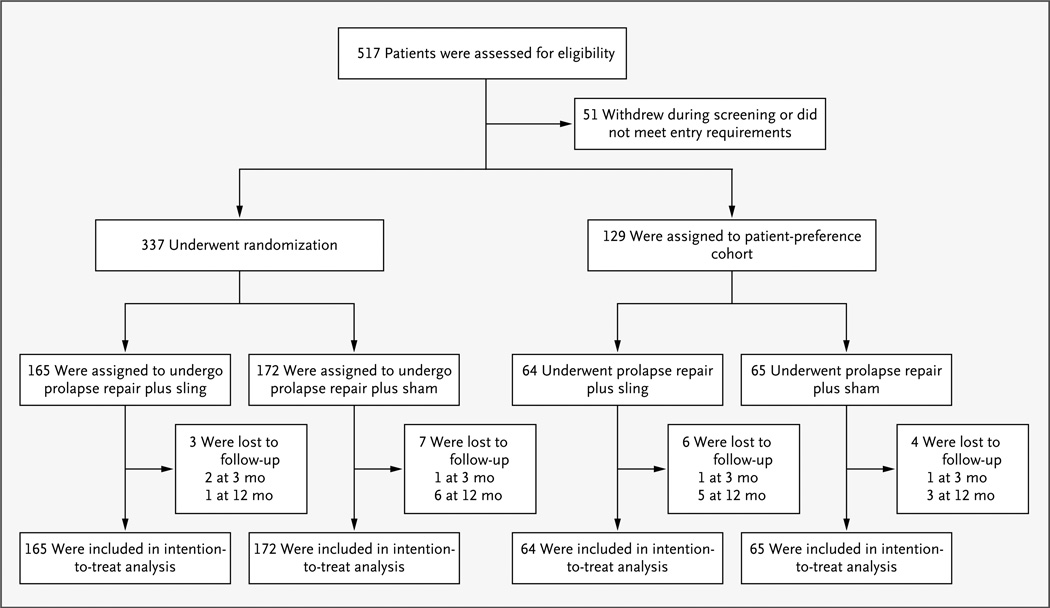
Results: Of the 337 women who underwent randomization, 327 (97%) completed follow-up at 1 year. At 3 months, the rate of urinary incontinence (or treatment) was 23.6% in the sling group and 49.4% in the sham group (P<0.001). At 12 months, urinary incontinence (allowing for subsequent treatment of incontinence) was present in 27.3% and 43.0% of patients in the sling and sham groups, respectively (P=0.002). The number needed to treat with a sling to prevent one case of urinary incontinence at 12 months was 6.3. The rate of bladder perforation was higher in the sling group than in the sham group (6.7% vs. 0%), as were rates of urinary tract infection (31.0% vs. 18.3%), major bleeding complications (3.1% vs. 0%), and incomplete bladder emptying 6 weeks after surgery (3.7% vs. 0%) (P≤0.05 for all comparisons).
Conclusions: A prophylactic midurethral sling inserted during vaginal prolapse surgery resulted in a lower rate of urinary incontinence at 3 and 12 months but higher rates of adverse events. (Funded by the Eunice Kennedy Shriver National Institute of Child Health and Human Development and the National Institutes of Health Office of Research on Women's Health; OPUS ClinicalTrials.gov number, NCT00460434.).
Figures
Comment in
-
Vaginal prolapse repair--place midurethral sling now or later?N Engl J Med. 2012 Jun 21;366(25):2422-4. doi: 10.1056/NEJMe1204042. N Engl J Med. 2012. PMID: 22716981 No abstract available.
-
Re: a midurethral sling to reduce incontinence after vaginal prolapse repair.J Urol. 2013 Apr;189(4):1445. doi: 10.1016/j.juro.2012.12.075. Epub 2013 Jan 2. J Urol. 2013. PMID: 23561358 No abstract available.
References
-
- Smith FJ, Holman CD, Moorin RE, Tsokos N. Lifetime risk of undergoing surgery for pelvic organ prolapse. Obstet Gynecol. 2010;116:1096–1100. - PubMed
-
- Brubaker L, Cundiff GW, Fine P, et al. Abdominal sacrocolpopexy with Burch colposuspension to reduce urinary stress incontinence. N Engl J Med. 2006;354:1557–1566. - PubMed
-
- Fatton B. Is there any evidence to advocate SUI prevention in continent women undergoing prolapse repair? An overview. Int Urogynecol J Pelvic Floor Dysfunct. 2009;20:235–245. - PubMed
-
- Meschia M, Pifarotti P, Spennacchio M, Buonaguidi A, Gattei U, Somigliana E. A randomized comparison of tension-free vaginal tape and endopelvic fascia plication in women with genital prolapse and occult stress urinary incontinence. Am J Obstet Gynecol. 2004;190:609–613. - PubMed
Publication types
MeSH terms
Associated data
Grants and funding
- U10 HD041261/HD/NICHD NIH HHS/United States
- U01 HD041249/HD/NICHD NIH HHS/United States
- U10 HD054215/HD/NICHD NIH HHS/United States
- 1U10 HD54215/HD/NICHD NIH HHS/United States
- U10 HD041267/HD/NICHD NIH HHS/United States
- 2U10 HD41250/HD/NICHD NIH HHS/United States
- 1U10 HD54136/HD/NICHD NIH HHS/United States
- 2U10 HD41267/HD/NICHD NIH HHS/United States
- U10 HD054241/HD/NICHD NIH HHS/United States
- U10 HD041250/HD/NICHD NIH HHS/United States
- 1U10 HD54241/HD/NICHD NIH HHS/United States
- 2U10 HD41261/HD/NICHD NIH HHS/United States
- 2U01 HD41249/HD/NICHD NIH HHS/United States
- U10 HD054214/HD/NICHD NIH HHS/United States
- 1U10 HD54214/HD/NICHD NIH HHS/United States
- U10 HD054136/HD/NICHD NIH HHS/United States
LinkOut - more resources
Full Text Sources
Other Literature Sources
Medical