


Vitamin D deficiency in pregnancy and gestational diabetes mellitus
- PMID: 22717271
- PMCID: PMC3432741
- DOI: 10.1016/j.ajog.2012.05.022
Vitamin D deficiency in pregnancy and gestational diabetes mellitus
Abstract
Objective: We examined the association of second-trimester maternal plasma 25-hydroxyvitamin D (25[OH]D) during pregnancy with gestational diabetes mellitus (GDM).
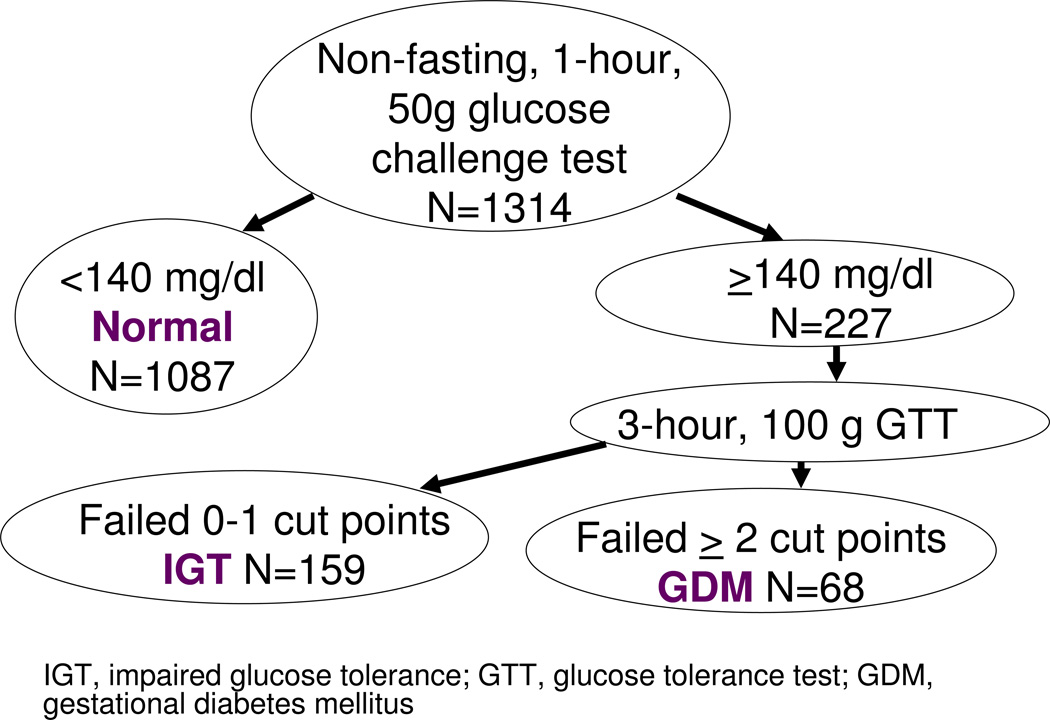
Study design: Among 1314 pregnant women who participated in Project Viva, a birth cohort study, we measured 25(OH)D levels at 26-28 weeks gestation during GDM screening using a 1-hour 50-g glucose challenge test.
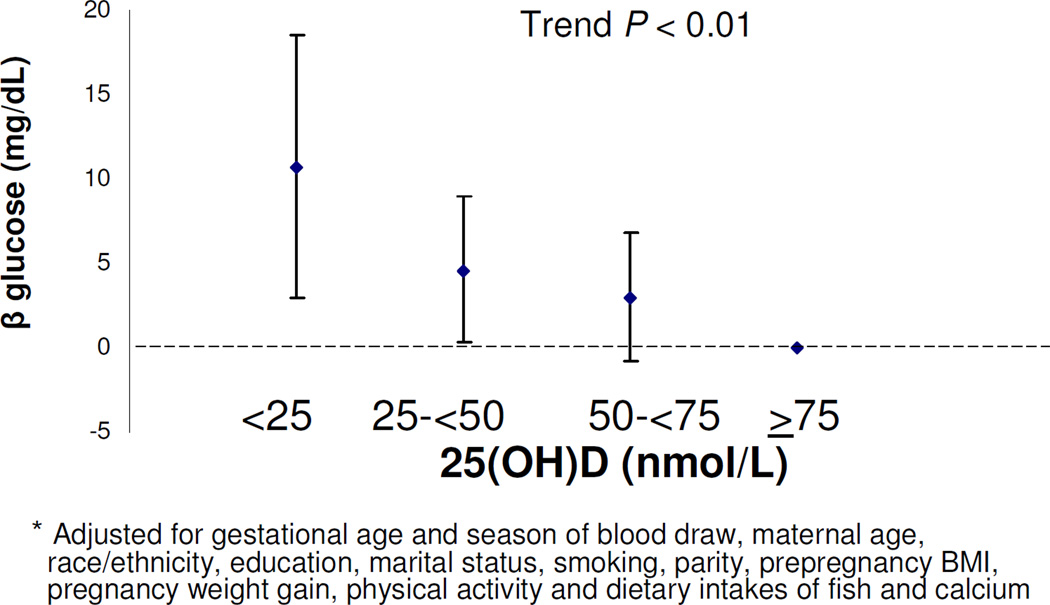
Results: We found 25(OH)D levels of <25 nmol/L in 44 of 1087 women (4.0%) with normal glucose tolerance, 9 of 159 women (5.7%) with impaired glucose tolerance, and 9 of 68 women (13.2%) with GDM. Analyses that were adjusted for sociodemographics, season, maternal body mass index, gestational weight gain, and dietary factors suggested that women with 25(OH)D levels of <25 vs ≥25 nmol/L may have higher odds of experiencing GDM (odds ratio, 2.2; 95% confidence interval, 0.8-5.5). Glucose levels after the glucose challenge test were associated inversely with 25(OH)D levels (P < .01).
Conclusion: Second-trimester 25(OH)D levels were associated inversely with glucose levels after 1-hour 50-g glucose challenge test; low 25(OH)D levels may be associated with increased risk of GDM.
Copyright © 2012 Mosby, Inc. All rights reserved.
Conflict of interest statement
“Disclosure: None of the authors have a conflict of interest.”
Figures
Comment in
-
Discussion: 'vitamin D deficiency in pregnancy and gestational diabetes,' by Burris et al.Am J Obstet Gynecol. 2012 Sep;207(3):e1-3. doi: 10.1016/j.ajog.2012.07.019. Epub 2012 Jul 16. Am J Obstet Gynecol. 2012. PMID: 22939732
References
-
- Jovanovic L, Pettitt DJ. Gestational diabetes mellitus. JAMA. 2001;286:2516–2518. - PubMed
-
- Ferrara A, Kahn HS, Quesenberry CP, Riley C, Hedderson MM. An increase in the incidence of gestational diabetes mellitus: Northern California, 1991–2000. Obstet Gynecol. 2004;103:526–533. - PubMed
-
- Kjos SL, Buchanan TA. Gestational diabetes mellitus. N Engl J Med. 1999;341:1749–1756. - PubMed
-
- Harlev A, Wiznitzer A. New insights on glucose pathophysiology in gestational diabetes and insulin resistance. Curr Diab Rep. 2010;10:242–247. - PubMed
-
- Dror DK. Vitamin D status during pregnancy: maternal, fetal, and postnatal outcomes. Curr Opin Obstet Gynecol. 2011;23:422–426. - PubMed
