Case Reports
. 2012 Nov;33(11):1589-98.
doi: 10.1002/humu.22139. Epub 2012 Jul 16.

Absence of FKBP10 in recessive type XI osteogenesis imperfecta leads to diminished collagen cross-linking and reduced collagen deposition in extracellular matrix

Affiliations
Case Reports

Absence of FKBP10 in recessive type XI osteogenesis imperfecta leads to diminished collagen cross-linking and reduced collagen deposition in extracellular matrix

Aileen M Barnes et al. Hum Mutat. 2012 Nov.

Abstract

Recessive osteogenesis imperfecta (OI) is caused by defects in genes whose products interact with type I collagen for modification and/or folding. We identified a Palestinian pedigree with moderate and lethal forms of recessive OI caused by mutations in FKBP10 or PPIB, which encode endoplasmic reticulum resident chaperone/isomerases FKBP65 and CyPB, respectively. In one pedigree branch, both parents carry a deletion in PPIB (c.563_566delACAG), causing lethal type IX OI in their two children. In another branch, a child with moderate type XI OI has a homozygous FKBP10 mutation (c.1271_1272delCCinsA). Proband FKBP10 transcripts are 4% of control and FKBP65 protein is absent from proband cells. Proband collagen electrophoresis reveals slight band broadening, compatible with ≈10% over-modification. Normal chain incorporation, helix folding, and collagen T(m) support a minimal general collagen chaperone role for FKBP65. However, there is a dramatic decrease in collagen deposited in culture despite normal collagen secretion. Mass spectrometry reveals absence of hydroxylation of the collagen telopeptide lysine involved in cross-linking, suggesting that FKBP65 is required for lysyl hydroxylase activity or access to type I collagen telopeptide lysines, perhaps through its function as a peptidylprolyl isomerase. Proband collagen to organics ratio in matrix is approximately 30% of normal in Raman spectra. Immunofluorescence shows sparse, disorganized collagen fibrils in proband matrix.


Figures

Figure 1
Figure 1
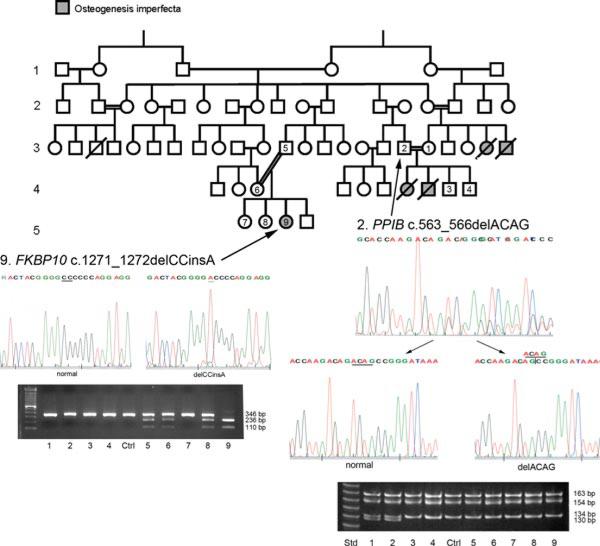
Extended Palestinian pedigree with Types IX and XI OI. Pedigree of extended Palestinian family members, including probands 1–9, with a history of lethal OI in one branch of the family (probands 1–4) and moderately severe OI (probands 5–9) in another branch. Proband 2 is a heterozygous carrier of a PPIB c.563_566delACAG mutation in exon 5 of the gene. A HpaII restriction enzyme digest confirms that parents 1 and 2 are both carriers and unaffected siblings 3 and 4 are not carriers of the PPIB mutation. Proband 9 has a homozygous FKBP10 c.1271_1272delCCinsA mutation, leading directly to a PTC and a null allele. This mutation was confirmed to be heterozygous in parents 5 and 6 and unaffected sibling 8 by AvaII restriction enzyme digestion.
Figure 2
Figure 2
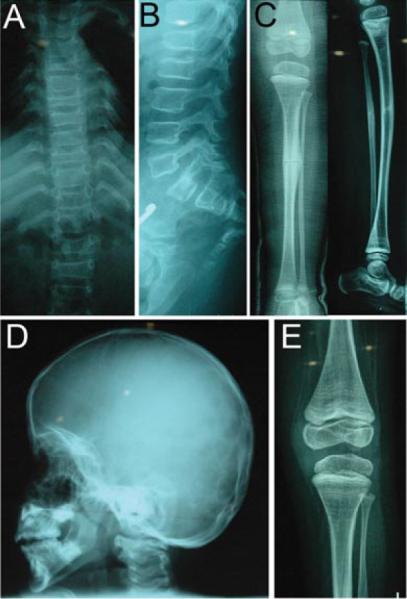
Radiographs of child with FKBP10 mutation. A: Spine radiograph showing minimal curvature. B: Vertebrae are osteoporotic but height is well preserved with minimal central compression. C: Tibiae are osteoporotic with reduced cortical thickness and mild bowing, but are well modeled. D: Skull is undermineralized without wormian bones. E: Knee radiographs reveal open growth plates without popcorn formation, sclerotic bands from multiple cycles of bisphosphonate treatment are evident.
Figure 3
Figure 3
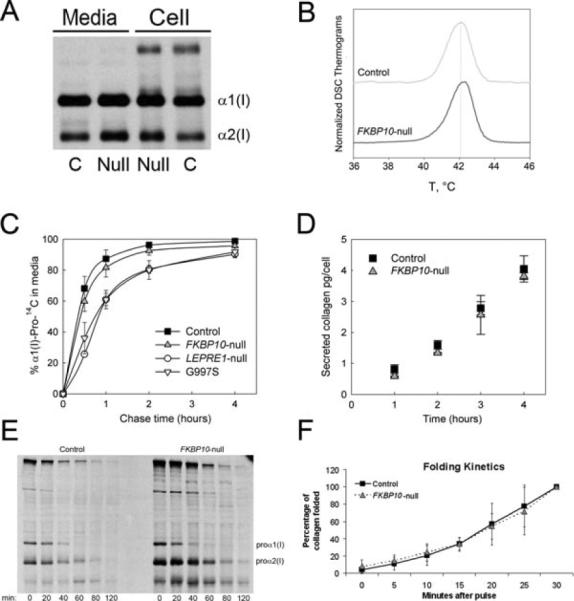
FKBP10-null mutation causes minimal changes in type I collagen. A: Steady-state collagen electrophoretic analysis, showing slight broadening of α1(I) and α2(I) bands of proband, suggestive of minimal delay in collagen folding. B: Thermal stability of type I collagen, measured by differential scanning calorimetry (DSC). Collagen melting temperature (Tm) was normal. C: On pulse-chase assay, secretion of proband collagen from cultured fibroblasts is minimally delayed versus control, and less delayed than collagen with LEPRE1 or a COL1A1 structural mutation (n = 2). D: Collagen secretion rate per cell was similar between control and proband 9 at all time points (n = 2). E: Chain incorporation assay shows free proα1(I) was incorporated into trimers at a similar rate as control. F: Collagen folding rate was measured after digestion with trypsin and chymotrypsin at various timepoints. Proband collagen folded at a normal rate (n = 3).
Figure 4
Figure 4
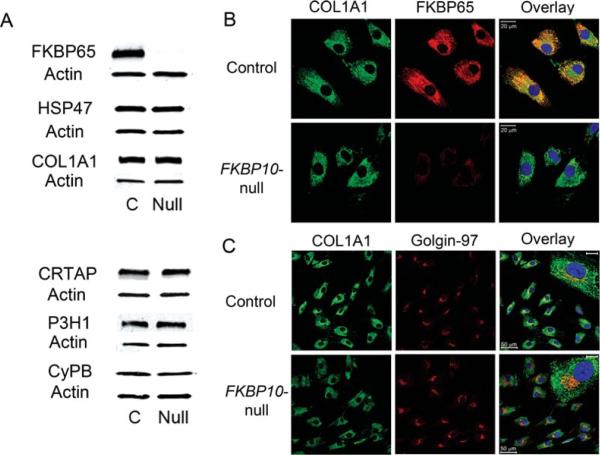
Effects of FKBP10 mutation on collagen and collagen chaperone levels. A: Western blots of FKBP10-null fibroblast lysates confirm the absence of FKBP65 protein, and demonstrate normal levels of type I procollagen (COL1A1) and the collagen chaperones HSP47, CRTAP, P3H1, and CyPB (See also Table 2). B: Immunofluorescence staining of control fibroblasts shows FKBP65 is localized to the ER. Collagen antibody staining revealed a similar pattern in proband and control, with absence of collagen aggregation in the proband samples. C: Immunofluorescence of control fibroblasts shows more structured Golgi (Golgin-97) with increased overlap with type I collagen (COL1A1), as reflected by the yellow color in the overlay panel. Proband fibroblasts showed less overlap of collagen with the Golgi, and the Golgi appeared more fragmented or condensed (see inset). Scale bars on inset = 10 μm.
Figure 5
Figure 5
Collagen is sparse and disorganized in extracellular matrix deposited by fibroblasts. A: Collagen content of extracellular matrix deposited by FKBP10-null and control fibroblasts was examined. The collected matrix was extracted into three fractions: neutral salt (NS, newly incorporated collagen without cross-links), acetic acid (AA, immaturely cross-linked collagen), and pepsin digested (P, mature cross-linked collagen), and compared with collagen secreted in the media. Thirty-fold more sample was loaded for the proband to get an equivalent signal in the maturely cross-linked collagen fraction, with a loss of collagen cross-linked β-forms (n = 2). B: The extracellular matrix deposited by cultured control and FKBP10-null fibroblasts was stained with a collagen antibody (LF-68, an α1[I] C-telopeptide antibody) and DAPI, then imaged using a confocal microscope at 20× (left) or 63× (right, z-stacked images). Control matrix has abundant long fibrillar collagen strands, while collagen in proband matrix appears mesh-like, branched, thinner, and more sparse. Matrix from a patient with classical OI has abnormal fibrils, but they are as abundant as control (n = 2, representative panels shown). C: Matrix collagen to cell organics ratio in cultures measured by Raman microspectroscopy at locations where matrix and cell cytoplasm overlap. The ratios were measured in the spectral regions of amide III, CH-stretching or proline A bands. Consistent reduction in collagen of the FKBP10-null culture was also found using proline-B band, CH-bending band of all organic molecules, or amide I band of all proteins. The error bars represent the standard errors. *** P < 0.0005.

References

    1. Alanay Y, Avaygan H, Camacho N, Utine GE, Boduroglu K, Aktas D, Alikasifoglu M, Tuncbilek E, Orhan D, Bakar FT, Zabel B, Superti-Furga A, et al. Mutations in the gene encoding the RER protein FKBP65 cause autosomal-recessive osteogenesis imperfecta. Am J Hum Genet. 2010;86:551–559. - PMC - PubMed
    1. Arvan P, Zhao X, Ramos-Castaneda J, Chang A. Secretory pathway quality control operating in Golgi, plasmalemmal, and endosomal systems. Traffic. 2002;3:771–780. - PubMed
    1. Bailey AJ, Wotton SF, Sims TJ, Thompson PW. Biochemical changes in the collagen of human osteoporotic bone matrix. Connect Tissue Res. 1993;29:119–132. - PubMed
    1. Barnes AM, Carter EM, Cabral WA, Weis M, Chang W, Makareeva E, Leikin S, Rotimi CN, Eyre DR, Raggio CL, Marini JC. Lack of cyclophilin B in osteogenesis imperfecta with normal collagen folding. N Engl J Med. 2010;362:521–528. - PMC - PubMed
    1. Barnes AM, Chang W, Morello R, Cabral WA, Weis M, Eyre DR, Leikin S, Makareeva E, Kuznetsova N, Uveges TE, Ashok A, Flor AW, et al. Deficiency of cartilage-associated protein in recessive lethal osteogenesis imperfecta. N Engl J Med. 2006;355:2757–2764. - PMC - PubMed

Publication types

MeSH terms

Supplementary concepts