


An exploratory study of the variables impacting preterm birth rates in New Mexico
- PMID: 22720802
- PMCID: PMC3411409
- DOI: 10.1186/1471-2393-12-53
An exploratory study of the variables impacting preterm birth rates in New Mexico
Abstract
Background: Preterm birth (PTB) is a substantial health problem that accounts for significant infant morbidity and mortality and poses an economic burden to both individuals and the state of residence. The goal of this study was to identify maternal risk factors for PTB in New Mexico, a poor state with a unique ethnic background, in order to identify populations at increased risk that would benefit from intervention.
Methods: This was a cross-sectional retrospective exploratory analysis of 377,770 singleton live births in the state of New Mexico from 1991-2005. Gestational age of less than 37 weeks was defined as PTB. The Kotelchuck Index was used as a measure for level of prenatal care described as inadequate, intermediate, adequate, and intensive.
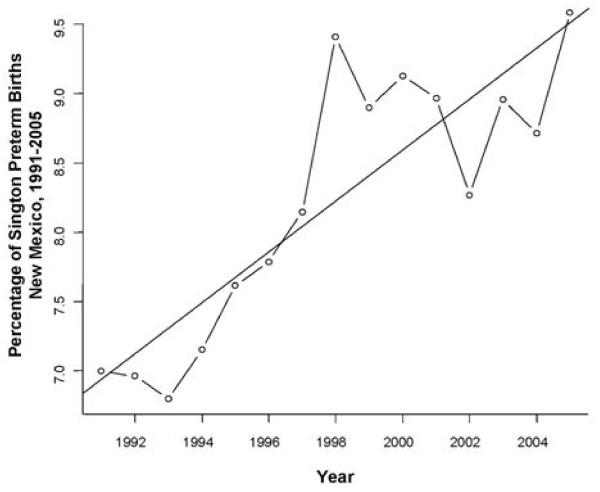
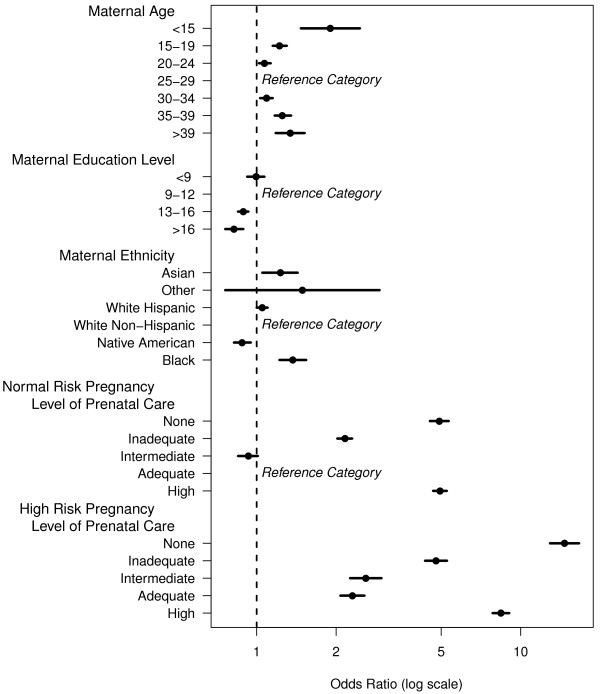
Results: Of the live births analyzed, 28,036 of these were preterm (7.4%). Overall the PTB rate rose at a rate of 0.18% per year from 1991-2005. Among patients with medical risk factors, the absence of prenatal care was associated with higher odds for PTB as compared to adequate prenatal care. Other risk factors were unmarried status, education less than high school, tobacco/alcohol use, black, Asian, and white Hispanic ethnicity, and the presence of one or more medical risk factors. Statistically significant protective factors for PTB were age 25-29, education surpassing high school, and Native American race.
Conclusions: This study identified several factors that correlate with increased PTB in New Mexico, in particular ethnicity and level of prenatal care. The finding that Native American patients have a lower PTB rate compared to other groups, even though this group is traditionally one of low socioeconomic status in New Mexico, signifies that other factors yet to be identified affect PTB.
Figures
References
-
- Anderson RN, Smith BL. Deaths: leading causes for 2002. Natl Vital Stat Rep. 2005;53(17):1–90. Hyattsville, Maryland: National Center for Health Statistics. - PubMed
-
- Birth and mortality monograph. 2004 preliminary data. New Mexico Department of Health, Bureau of Vital Records and Health Statistics, Epidemiology and Response Division. NMDH, BVRHS, Santa Fe, New Mexico; 2005.
-
- Caughey A. Definition, incidence, significance, and demographic characteristics of preterm birth. Up To Date, In; 2006.
-
- Meis PJ, Michielutte R, Peters TJ, Wells HB, Sands RE, Coles EC, Johns KA. Factors associated with preterm birth in Cardiff. Wales. II. Indicated and spontaneous preterm birth. Am J Obstet Gynecol. 1995;173(2):597–602. - PubMed
-
- Mercer BM, Goldenberg RL, Moawad AH, Meis PJ, Iams JD, Das AF, Caritis SN, Miodovnik M, Menard MK, Thurnau GR. et al.The preterm prediction study: effect of gestational age and cause of preterm birth on subsequent obstetric outcome. National Institute of Child Health and Human Development Maternal-Fetal Medicine Units Network. Am J Obstet Gynecol. 1999;181(5 Pt 1):1216–1221. - PubMed
Publication types
MeSH terms
Grants and funding
LinkOut - more resources
Full Text Sources
Medical
