. 2012 May 27;486(7403):410-4.
doi: 10.1038/nature11059.

Astrocyte glypicans 4 and 6 promote formation of excitatory synapses via GluA1 AMPA receptors

Affiliations

Astrocyte glypicans 4 and 6 promote formation of excitatory synapses via GluA1 AMPA receptors

Nicola J Allen et al. Nature. .

Abstract

In the developing central nervous system (CNS), the control of synapse number and function is critical to the formation of neural circuits. We previously demonstrated that astrocyte-secreted factors powerfully induce the formation of functional excitatory synapses between CNS neurons. Astrocyte-secreted thrombospondins induce the formation of structural synapses, but these synapses are postsynaptically silent. Here we use biochemical fractionation of astrocyte-conditioned medium to identify glypican 4 (Gpc4) and glypican 6 (Gpc6) as astrocyte-secreted signals sufficient to induce functional synapses between purified retinal ganglion cell neurons, and show that depletion of these molecules from astrocyte-conditioned medium significantly reduces its ability to induce postsynaptic activity. Application of Gpc4 to purified neurons is sufficient to increase the frequency and amplitude of glutamatergic synaptic events. This is achieved by increasing the surface level and clustering, but not overall cellular protein level, of the GluA1 subunit of the AMPA (α-amino-3-hydroxy-5-methyl-4-isoxazole propionic acid) glutamate receptor (AMPAR). Gpc4 and Gpc6 are expressed by astrocytes in vivo in the developing CNS, with Gpc4 expression enriched in the hippocampus and Gpc6 enriched in the cerebellum. Finally, we demonstrate that Gpc4-deficient mice have defective synapse formation, with decreased amplitude of excitatory synaptic currents in the developing hippocampus and reduced recruitment of AMPARs to synapses. These data identify glypicans as a family of novel astrocyte-derived molecules that are necessary and sufficient to promote glutamate receptor clustering and receptivity and to induce the formation of postsynaptically functioning CNS synapses.


Figures
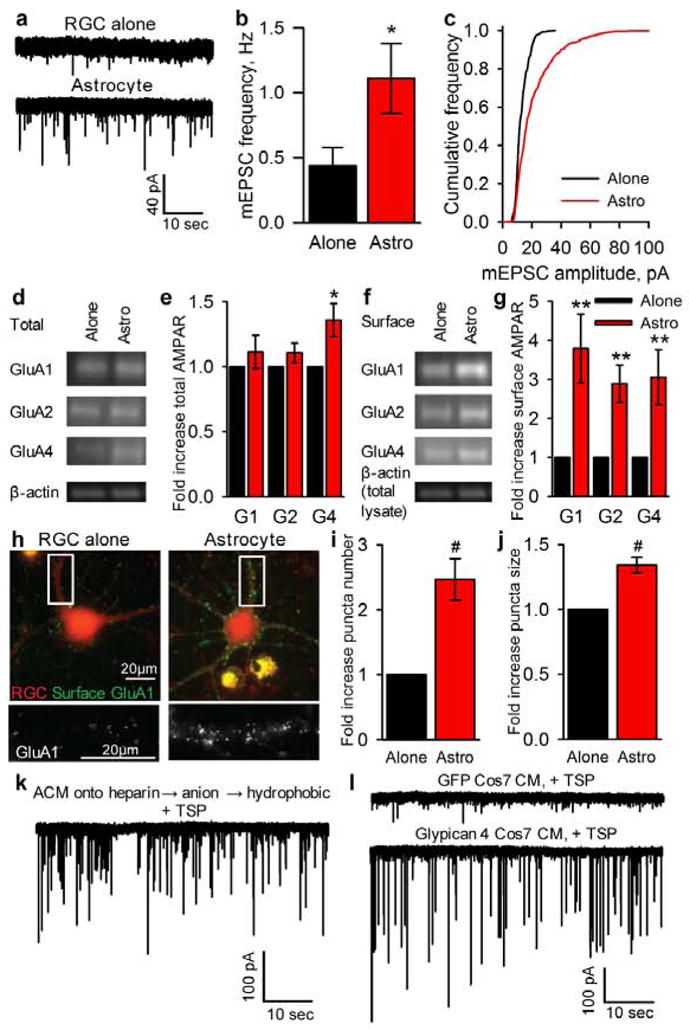
Figure 1
Figure 1. Astrocyte signals strengthen synapses by recruitment of surface AMPARs
a,b,c, Example mEPSC recordings (a) show frequency (b) & amplitude (c) are sig increased in RGCs cultured with astrocytes. Average mEPSC amplitude (RGC alone = 12.2±0.5pA, astrocyte = 20.4±1.7pA p<0.0002). N = 13 cells RGC alone, 14 astrocyte. d,e, Astrocytes do not alter total AMPAR levels in RGCs. Western blots (d) of RGC lysates for AMPAR subunits GluA1-4 & β-actin loading control, quantification (e). N = 7 expts. f,g, Astrocytes increase surface AMPARs in RGCs. Western blots (f) of surface AMPAR subunits GluA1-4 & β-actin loading control from total lysate (same expt as (d)), quantification (g). N = 16 expts. h,i,j, Astrocytes cluster GluA1-containing AMPARs on the RGC surface. Example images (h) of surface GluA1 (green) and RGC processes (red), bottom panel zoom of GluA1 (white). Quantification of number (i) and size (j) of GluA1 clusters. N = 10 expts. k, Total synaptic activity induced by final protein fraction from column fractionation of ACM. l, Total synaptic activity in RGCs cultured in Cos7 CM transfected with a control protein (GFP) or Gpc4. * p<0.05, ** p<0.01, # p<0.001, error bars ±S.E.M.
Figure 2
Figure 2. Gpc4 is sufficient to strengthen glutamatergic synapses & increase surface GluA1-containing AMPARs
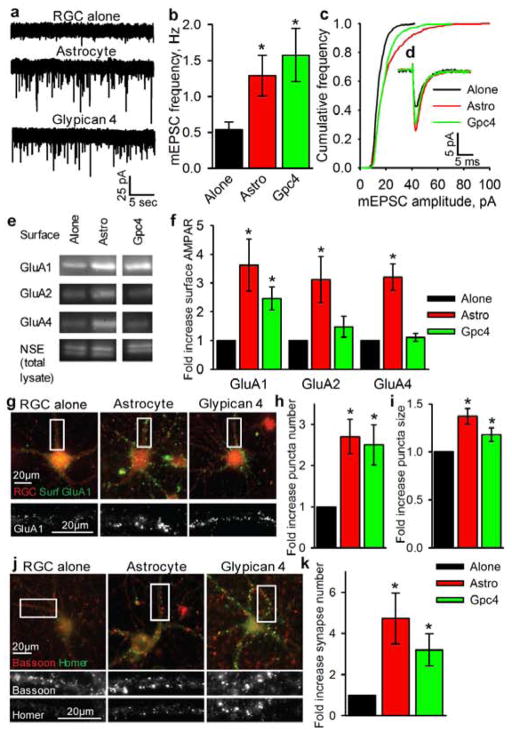
a,b,c,d Example mEPSC recordings (a) show frequency (b) & amplitude (c) are sig increased in RGCs cultured with Gpc4, average traces aligned by rise-time (d). Average mEPSC amplitude (RGC alone = 13.8±0.7pA, astrocyte = 20.0±1.2pA p<0.05, Gpc4 = 17.8±1.4pA p<0.05). N = 16 cells RGC alone, 16 astrocyte, 13 Gpc4. e,f, Gpc4 increases surface GluA1 AMPARs in RGCs. Western blots (e) of surface AMPAR subunits GluA1-4 & NSE (neuron specific enolase loading control from total lysate), quantification (f), full blot Fig S9. N = 6 expts GluA1,2; 3 expts GluA4. g,h,i, Gpc4 clusters GluA1-containing AMPARs on the RGC surface. Example images (g) of surface GluA1 (green) and RGC processes (red), bottom panel zoom showing GluA1 (white). Quantification of number (h) and size (i) of GluA1 clusters. N = 7 expts. j,k, Gpc4 induces structural synapses. Example images (j) of pre- (bassoon, red) & postsynaptic (homer, green) staining, bottom panels zoom each marker (white). Quantification of synapse number (k) (colocalisation of pre & postsynaptic puncta). N = 6 expts. * p<0.05, error bars ±S.E.M.
Figure 3
Figure 3. Gpc4&6 are necessary for ACM to cluster surface GluA1, & mechanism of action
a,b,c, Reduction of Gpc4&6 levels in ACM reduces its ability to increase mEPSC amplitude in RGCs. Example mEPSC recordings (a), cumulative amplitude plot (b), and average traces aligned by rise-time (c). Average amplitude of mEPSCs (RGC alone = 14.6±0.6pA, siCon ACM = 20.6±0.9pA p<0.05, siGpc4+6 ACM = 16.0±1.0pA p=0.3). N = 8 cells RGC alone, 10 siCon ACM, 11 siGpc4+6 ACM. d, Reduction of Gpc4&6 levels in ACM prevents GluA1 surface clustering, which is rescued by expression of siRNA resistant Gpc4. N = 30 cells per condition. e, Reduction of Gpc4&6 levels in ACM does not prevent ACM-induced structural synapse formation. N = 3 expts. f, Time course of Gpc4-induced surface clustering of GluA1 shows 18 hours treatment is required. Dashed line 6 day data from fig 2h. N = 3 expts 4 hours, 4 expts 18 hours. g, Gpc4 does not rapidly induce structural synapse formation and requires 3 days treatment. N = 5 expts 1d, 3 expts 2d, 6 expts 3d, 3 expts 6d. h, Surface clustering of GluA1 is necessary for Gpc4 induced synapse formation, shown by the inability of Gpc4 to induce synapse formation in RGCs lacking GluA1. N = 5 expts. * p<0.05, # p<0.0001, error bars ±S.E.M.
Figure 4
Figure 4. Mice deficient in Gpc4 have weaker excitatory synapses in vivo
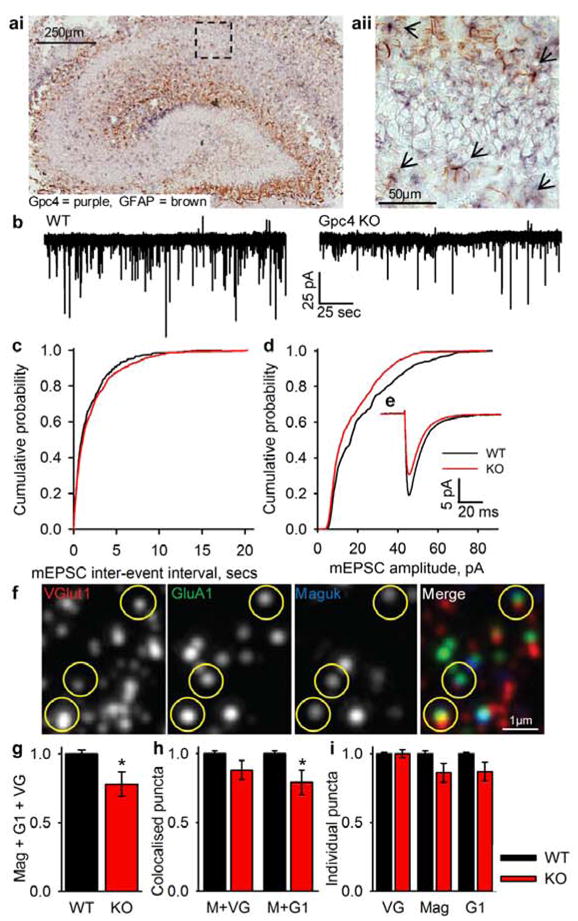
a, In situ hybridisation of Gpc4 mRNA in P6 mouse hippocampus. ai, Gpc4 (purple) is expressed in synaptic regions and colocalises with astrocytes (GFAP, brown) (aii, zoom of ai), arrows mark Gpc4 positive astrocytes. b,c,d,e, Mice lacking Gpc4 have weaker excitatory synapses in CA1 pyramidal neurons at P12. Example mEPSC recordings (b), cumulative probability plot of mEPSC inter-event interval (c) (no sig dif frequency; WT 0.88±0.25Hz, KO 0.55±0.08Hz p=0.16), cumulative probability plot of mEPSC amplitude (d) (sig decrease in amplitude; WT 20.67±2.16pA, KO 16.07±0.96pA p<0.05), average traces aligned by rise-time (e). N = 9 cells Gpc4 KO 5 mice, 6 cells WT 5 mice. f,g,h,i, Mice lacking Gpc4 recruit fewer GluA1 AMPARs to synaptic sites in hippocampal CA1 at P12. Example array tomography image (f) from WT; VGlut1 (red), GluA1 (green), Maguk (blue), yellow circles mark triple colocalisation. There is a sig decrease in triple colocalisation of VGlut1+Maguk+GluA1 in Gpc4 KO mice (g). There is no sig difference in structural synapse number (VGlut1+Maguk) but a sig decrease in GluA1 association with Maguk in Gpc4 KO mice, and no difference in individual synaptic markers (i). N = 10 arrays per genotype from 4 WT & 4 Gpc4 KO mice. * p<0.05, error bars ±S.E.M.

References

    1. Ullian EM, Sapperstein SK, Christopherson KS, Barres BA. Control of synapse number by glia. Science. 2001;291:657–661. - PubMed
    1. Christopherson KS, et al. Thrombospondins are astrocyte-secreted proteins that promote CNS synaptogenesis. Cell. 2005;120:421–433. - PubMed
    1. Traynelis SF, et al. Glutamate Receptor Ion Channels: Structure, Regulation, and Function. Pharmacological Reviews. 2010;62:405–496. - PMC - PubMed
    1. Kucukdereli H, et al. Control of excitatory CNS synaptogenesis by astrocyte-secreted proteins Hevin and SPARC. Proc Natl Acad Sci U S A. 2011;108:E440–449. - PMC - PubMed
    1. Foo LC, et al. Development of a method for the purification and culture of rodent astrocytes. Neuron. 2011;71:799–811. - PMC - PubMed

Publication types

MeSH terms