


Autophagy across the eukaryotes: is S. cerevisiae the odd one out?
- PMID: 22722653
- PMCID: PMC3429559
- DOI: 10.4161/auto.20527
Autophagy across the eukaryotes: is S. cerevisiae the odd one out?
Abstract
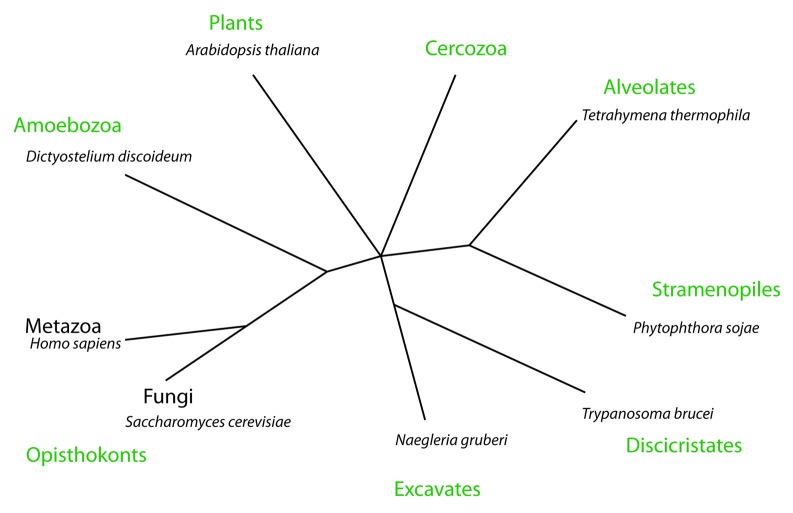
Autophagy is conserved throughout the eukaryotes and for many years, work in Saccharomyces cerevisiae has been at the forefront of autophagy research. However as our knowledge of the autophagic machinery has increased, differences between S. cerevisiae and mammalian cells have become apparent. Recent work in other organisms, such as the amoeba Dictyostelium discoideum, indicate an autophagic pathway much more similar to mammalian cells than S. cerevisiae, despite its earlier evolutionary divergence. S. cerevisiae therefore appear to have significantly specialized, and the autophagic pathway in mammals is much more ancient than previously appreciated, which has implications for how we interpret data from organisms throughout the eukaryotic tree.
Keywords: Dictyostelium; S. cerevisiae; Saccharomyces; autophagy; evolution; omegasomes.
Figures
References
-
- Axe EL, Walker SA, Manifava M, Chandra P, Roderick HL, Habermann A, et al. Autophagosome formation from membrane compartments enriched in phosphatidylinositol 3-phosphate and dynamically connected to the endoplasmic reticulum. J Cell Biol. 2008;182:685–701. doi: 10.1083/jcb.200803137. - DOI - PMC - PubMed
MeSH terms
Substances
LinkOut - more resources
Full Text Sources
Molecular Biology Databases
