. 2012 Jun 20;32(25):8560-8.
doi: 10.1523/JNEUROSCI.1346-12.2012.

NKCC1 upregulation disrupts chloride homeostasis in the hypothalamus and increases neuronal activity-sympathetic drive in hypertension

Affiliations

NKCC1 upregulation disrupts chloride homeostasis in the hypothalamus and increases neuronal activity-sympathetic drive in hypertension

Zeng-You Ye et al. J Neurosci. .

Abstract

Hypertension is a major risk factor for coronary artery disease, stroke, and kidney failure. However, the etiology of hypertension in most patients is poorly understood. Increased sympathetic drive emanating from the hypothalamic paraventricular nucleus (PVN) plays a major role in the development of hypertension. Na(+)-K(+)-2Cl(-) cotransporter-1 (NKCC1) in the brain is critically involved in maintaining chloride homeostasis and in neuronal responses mediated by GABA(A) receptors. Here we present novel evidence that the GABA reversal potential (E(GABA)) of PVN presympathetic neurons undergoes a depolarizing shift that diminishes GABA inhibition in spontaneously hypertensive rats (SHRs). Inhibition of NKCC1, but not KCC2, normalizes E(GABA) and restores GABA inhibition of PVN neurons in SHRs. The mRNA and protein levels of NKCC1, but not KCC2, in the PVN are significantly increased in SHRs, and the NKCC1 proteins on the plasma membrane are highly glycosylated. Inhibiting NKCC1 N-glycosylation restores E(GABA) and GABAergic inhibition of PVN presympathetic neurons in SHRs. Furthermore, NKCC1 inhibition significantly reduces the sympathetic vasomotor tone and augments the sympathoinhibitory responses to GABA(A) receptor activation in the PVN in SHRs. These findings suggest that increased NKCC1 activity and glycosylation disrupt chloride homeostasis and impair synaptic inhibition in the PVN to augment the sympathetic drive in hypertension. This information greatly improves our understanding of the pathogenesis of hypertension and helps to design better treatment strategies for neurogenic hypertension.


Figures
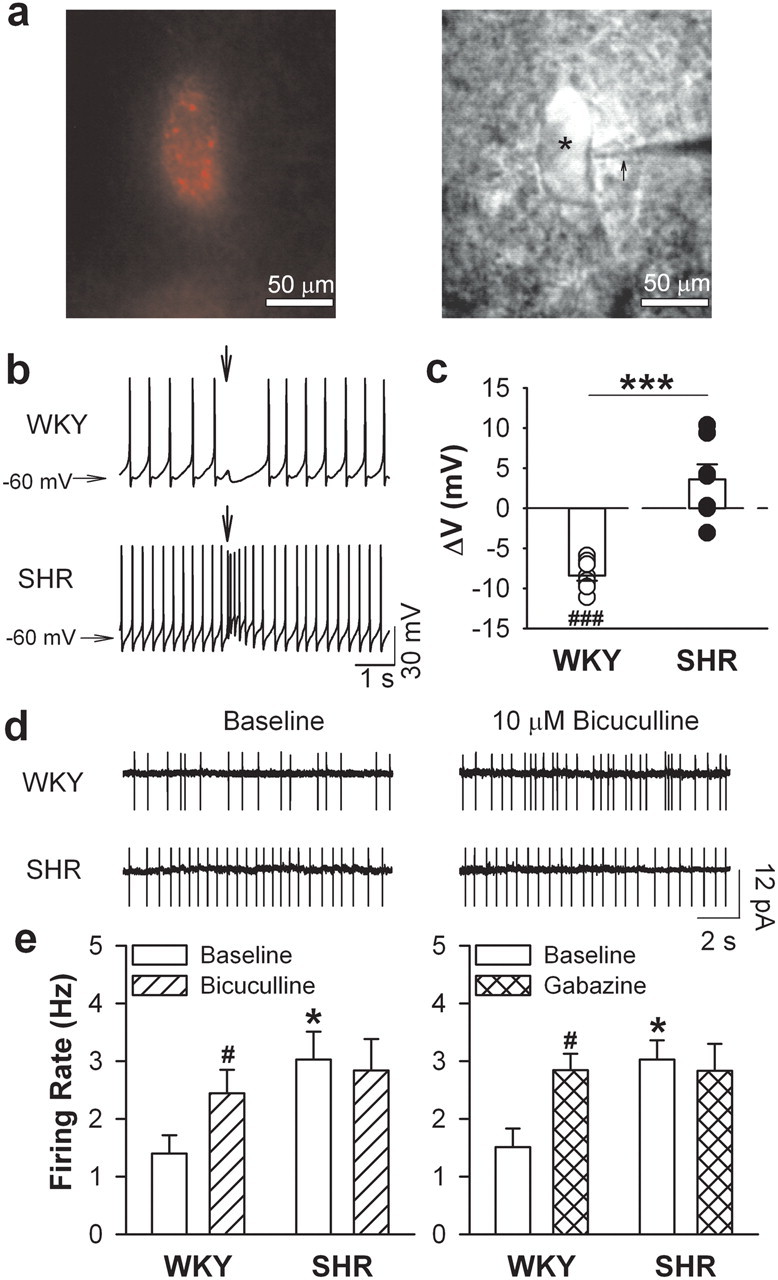
Figure 1.
Figure 1.
GABA inhibition of PVN presympathetic neurons is diminished in hypertension. a, A FluoSphere-labeled PVN neuron (*) viewed with fluorescence illumination (left) and infrared differential interference contrast optics (right) in the live brain slice of an SHR. The recording electrode was marked with an arrow. b, Original recordings show changes of membrane potentials (ΔV) induced by GABA puff application to labeled PVN neurons from 1 WKY rat and 1 SHR. The arrows show the time of GABA (300 μm) puff application. c, Mean changes of ΔV induced by GABA application to labeled PVN neurons from WKY rats (n = 8 neurons) and SHRs (n = 9 neurons). d, The firing activity of labeled PVN neurons before and during bath application of bicuculline in 1 WKY rat and 1 SHR. e, Mean firing activity of PVN neurons before and during application of bicuculline (WKY, n = 6 neurons; SHR, n = 9 neurons) or gabazine (WKY, n = 6 neurons; SHR, n = 9 neurons). *p < 0.05, ***p < 0.001, compared with the value in WKY group. #p < 0.05, ###p < 0.001, compared with the respective baseline value.
Figure 2.
Figure 2.
Depolarizing shift of the EGABA and diminished GABA inhibition of PVN presympathetic neurons in hypertension. a, b, Original perforated recordings (a) and I–V plots (b) show the EGABA of GABA currents of spinally projecting PVN neurons from 1 WKY rat and 1 SHR. c, Mean changes in the EGABA and derived [Cl]i of spinally projecting PVN neurons in WKY rats (n = 8 neurons) and SHRs (n = 7 neurons). d, Linear relationship between changes in the EGABA and GABA-induced membrane potentials (ΔV) of spinally projecting PVN neurons in WKY rats and SHRs. e, I–V plots show GABA currents recorded at different holding potentials of RVLM-projecting PVN neurons from WKY rats and SHRs (n = 7 neurons in each group). f, Mean changes in EGABA and ΔV induced by puff GABA application to RVLM-projecting PVN neurons from WKY rats and SHRs (n = 7 neurons in each group). **p < 0.05, ***p < 0.001, compared with the WKY group.
Figure 3.
Figure 3.
Lowering blood pressure with celiac ganglionectomy does not affect the EGABA of PVN presympathetic neurons in hypertension. a, Original blood pressure recordings and mean ABP in SHRs that underwent CGx or sham surgery (n = 6 rats in each group). b, c, I–V plots (b) and bar graph (c) show the EGABA of spinally projecting PVN neurons from SHRs that underwent CGx or sham surgery (n = 7 neurons in each group). #p < 0.05, compared with the corresponding value in sham-operated SHRs.
Figure 4.
Figure 4.
Increased NKCC1 activity contributes to the depolarizing shift in the EGABA of PVN presympathetic neurons in hypertension. a, Original traces of GABA currents recorded using the perforated patch-clamp technique at different holding potentials. b, I–V plots and mean changes show the EGABA of labeled PVN neurons treated with vehicle (n = 8 neurons), bumetanide (20 μm for 2–4 h, n = 7 neurons) or furosemide (200 μm for 2–4 h, n = 8 neurons) from SHRs. c, Original recordings and mean membrane potential changes induced by GABA puff application of labeled PVN neuron treated with vehicle (n = 8 neurons), bumetanide (n = 8 neurons) or furosemide (n = 9 neurons) from SHRs. The downward arrows indicate the time of puff GABA application. d, Cell-attached recordings and the mean firing activity of labeled PVN neurons before and during application of bicuculline (n = 9 neurons) or gabazine (n = 8 neurons) in bumetanide-treated brain slices from SHRs. BUM, Bumetanide; FURO, furosemide. **p < 0.01, ***p < 0.001, compared with the value in vehicle-treated SHRs; ## p < 0.01, compared with the corresponding baseline value.
Figure 5.
Figure 5.
NKCC1 is upregulated in the PVN in hypertension. a, Immunoblots of NKCC1 and KCC2 proteins in the PVN from WKY rats and SHRs. b, c, Quantification of NKCC1 (b) and KCC2 (c) protein levels in the PVN from WKY rats and SHRs (n = 4 samples in each group). d, Quantification of NKCC1 and KCC2 mRNA levels in the PVN from WKY rats and SHRs (n = 4 samples in each group). The molecular weight is indicated to the right of the gel images. Gly, Glycosylated NKCC1; Non-Gly, nonglycosylated NKCC1. Four samples, each consisting of PVN tissues from 3 rats, were used in each group. *p < 0.05, compared with the WKY group.
Figure 6.
Figure 6.
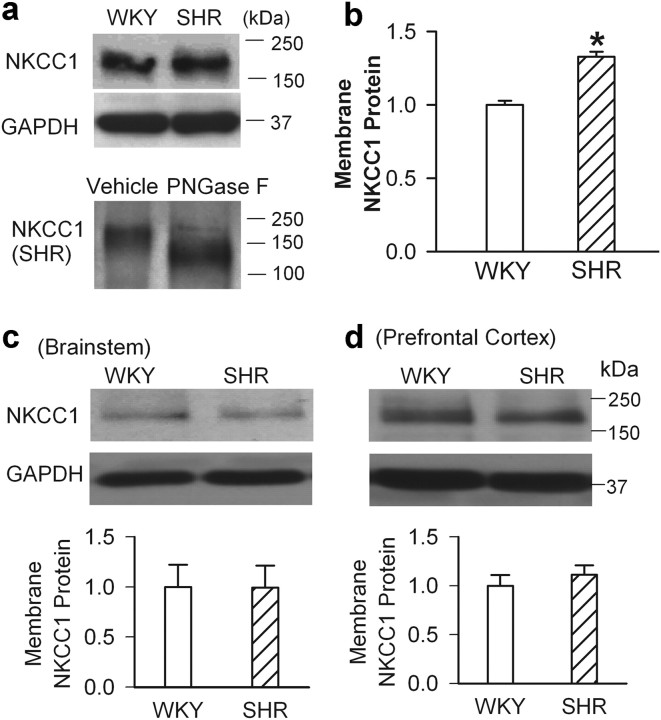
Membrane NKCC1 is highly glycosylated in the PVN in hypertension. a, Western blots of NKCC1 membrane proteins in the PVN from WKY rats and SHRs (top) andNKCC1 membrane protein in SHRs treated with vehicle and PNGase F (bottom). b, Quantification of the NKCC1 membrane protein level in the PVN in WKY rats and SHRs (n = 4 samples in each group). c, d, Western blots and quantification show the membrane protein levels of NKCC1 in the brainstem (c) and prefrontal cortex (d) in SHRs and WKY rats (n = 4 samples in each group). The molecular weight markers are indicated to the right of the gel. In these the protein assays, 4 samples, each consisting of PVN tissues from 3 rats, were used in each group. *p < 0.05, compared with the WKY group. Error bars represent SEM.
Figure 7.
Figure 7.
Inhibition of N-glycosylation of NKCC1 normalizes GABA inhibition and the EGABA of PVN presympathetic neurons in hypertension. a, b, Changes in GABA currents recorded at different holding potentials (a) and the EGABA (b) of labeled PVN neurons in SHR brain slices treated with vehicle (n = 7 neurons), tunicamycin (n = 7 neurons), or tunicamycin plus bumetanide (n = 6 neurons). c, d, Original recordings (c) and mean changes in the membrane potential (d) induced by puff GABA application to labeled PVN neurons of SHRs. TM, Tunicamycin. ***p < 0.001, compared with the vehicle-treated group.
Figure 8.
Figure 8.
NKCC1 inhibition reduces sympathetic vasomotor tone and enhances sympathoinhibitory responses to GABAA receptor activation in the PVN in hypertension. a, b, Representative recordings show the effect of bumetanide (0.1 nmol, 2 μl, i.c.v.) and bilateral microinjection of muscimol (1.0 nmol, 50 nl) into the PVN on the ABP, HR, and LSNA in SHRs. c–e, Changes in the mean ABP (c), LSNA (d), and HR (e) in response to microinjection of muscimol into the PVN after treatment with bumetanide (BUM, n = 11 rats) or vehicle (Veh, n = 9 rats). f, Schematic drawings show the location of muscimol (MUS) microinjection sites in the PVN of SHRs treated with vehicle (○) or bumetanide (●). Ctrl, Control; 3V, third ventricle; AH, anterior hypothalamus. **p < 0.01, ***p < 0.001, compared with the baseline control in each group. ##p < 0.01, compared with the corresponding value in the vehicle group.

References

    1. Allen AM. Inhibition of the hypothalamic paraventricular nucleus in spontaneously hypertensive rats dramatically reduces sympathetic vasomotor tone. Hypertension. 2002;39:275–280. - PubMed
    1. Anderson EA, Sinkey CA, Lawton WJ, Mark AL. Elevated sympathetic nerve activity in borderline hypertensive humans. Evidence from direct intraneural recordings. Hypertension. 1989;14:177–183. - PubMed
    1. Blaesse P, Guillemin I, Schindler J, Schweizer M, Delpire E, Khiroug L, Friauf E, Nothwang HG. Oligomerization of KCC2 correlates with development of inhibitory neurotransmission. J Neurosci. 2006;26:10407–10419. - PMC - PubMed
    1. Bormann J, Hamill OP, Sakmann B. Mechanism of anion permeation through channels gated by glycine and gamma-aminobutyric acid in mouse cultured spinal neurones. J Physiol. 1987;385:243–286. - PMC - PubMed
    1. Ciriello J. Forebrain mechanisms in neurogenic hypertension. Can J Physiol Pharmacol. 1987;65:1580–1583. - PubMed

Publication types

MeSH terms

Substances