Comparative performance of private and public healthcare systems in low- and middle-income countries: a systematic review
- PMID: 22723748
- PMCID: PMC3378609
- DOI: 10.1371/journal.pmed.1001244
Comparative performance of private and public healthcare systems in low- and middle-income countries: a systematic review
Abstract
Introduction: Private sector healthcare delivery in low- and middle-income countries is sometimes argued to be more efficient, accountable, and sustainable than public sector delivery. Conversely, the public sector is often regarded as providing more equitable and evidence-based care. We performed a systematic review of research studies investigating the performance of private and public sector delivery in low- and middle-income countries.
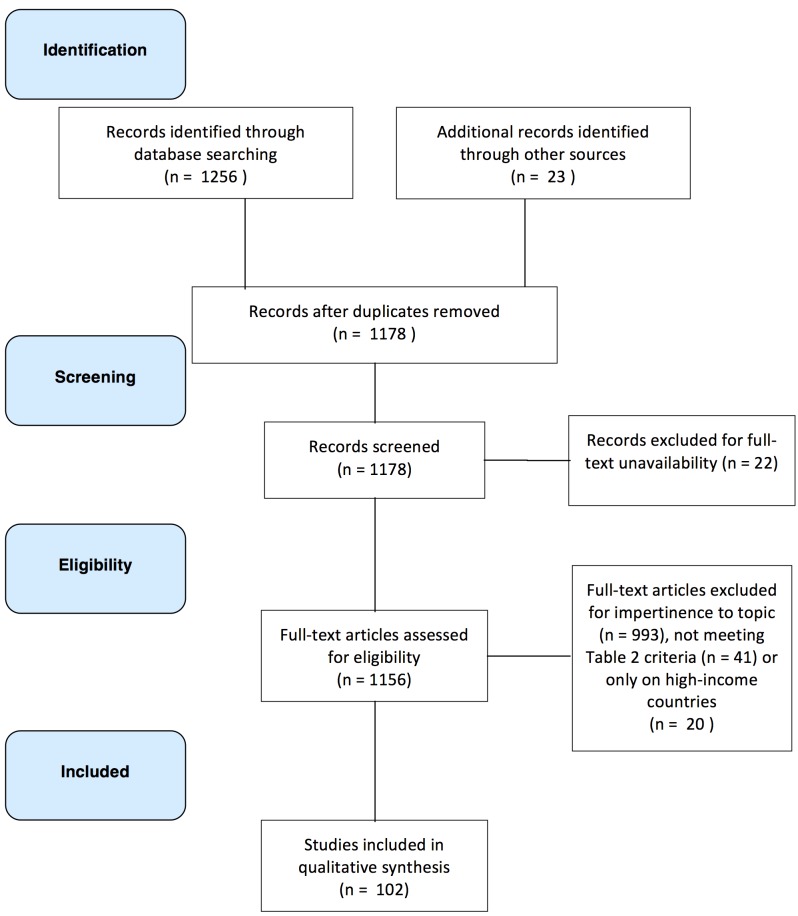
Methods and findings: Peer-reviewed studies including case studies, meta-analyses, reviews, and case-control analyses, as well as reports published by non-governmental organizations and international agencies, were systematically collected through large database searches, filtered through methodological inclusion criteria, and organized into six World Health Organization health system themes: accessibility and responsiveness; quality; outcomes; accountability, transparency, and regulation; fairness and equity; and efficiency. Of 1,178 potentially relevant unique citations, data were obtained from 102 articles describing studies conducted in low- and middle-income countries. Comparative cohort and cross-sectional studies suggested that providers in the private sector more frequently violated medical standards of practice and had poorer patient outcomes, but had greater reported timeliness and hospitality to patients. Reported efficiency tended to be lower in the private than in the public sector, resulting in part from perverse incentives for unnecessary testing and treatment. Public sector services experienced more limited availability of equipment, medications, and trained healthcare workers. When the definition of "private sector" included unlicensed and uncertified providers such as drug shop owners, most patients appeared to access care in the private sector; however, when unlicensed healthcare providers were excluded from the analysis, the majority of people accessed public sector care. "Competitive dynamics" for funding appeared between the two sectors, such that public funds and personnel were redirected to private sector development, followed by reductions in public sector service budgets and staff.
Conclusions: Studies evaluated in this systematic review do not support the claim that the private sector is usually more efficient, accountable, or medically effective than the public sector; however, the public sector appears frequently to lack timeliness and hospitality towards patients.
Conflict of interest statement
The authors have no competing financial interests. SB, JA, SK and RP are employed at academic medical centers, which receive public sector research finances but also receive revenue through private sector fee-for-service medical transactions and private foundation grants. RP serves on the board of a nonprofit organization (Tiyatien Health) that provides health services in Liberia with approval from and in collaboration with the government and through receipt of private foundation funding, but has received no compensation for this role. SB and JA serve on the board of a nonprofit organization (Nyaya Health) that provides health services in rural Nepal using funds received from both private foundations and the Nepali government; they have also not received compensation for these roles.
Figures
References
-
- Berendes S, Heywood P, Oliver S, Garner P. Quality of private and public ambulatory health care in low and middle income countries: systematic review of comparative studies. PLoS Med. 2011;8:e1000433. doi: 10.1371/journal.pmed.1000433. - DOI - PMC - PubMed
-
- Stuckler D, Basu S. The International Monetary Fund's effects on global health: before and after the 2008 financial crisis. Int J Health Serv. 2009;39:771–781. - PubMed
-
- Elliott L. (2009 October 1) Cut NHS costs to pay off debt, IMF warns Britain. The Guardian.
-
- Oxfam. Blind optimism: challenging the myths about private health care in poor countries. Oxford: Oxfam International. 2009.
Publication types
MeSH terms
LinkOut - more resources
Full Text Sources
Other Literature Sources
Medical