. 2012 Jun;3(3):280-90.
Epub 2012 Mar 14.

Thymus Size and Age-related Thymic Involution: Early Programming, Sexual Dimorphism, Progenitors and Stroma

Affiliations

Thymus Size and Age-related Thymic Involution: Early Programming, Sexual Dimorphism, Progenitors and Stroma

Jingang Gui et al. Aging Dis. 2012 Jun.

Abstract

Age-related thymic involution is characterized by a progressive regression in thymus size and a diminishment of thymic structure. A decrease in thymic compartments leads to the reduction of thymopoiesis. Thymic involution is closely associated with immunosenescence, a degeneration of the immune system primarily due to the alterations in T-cell composition. Strategies to improve the consequences of the aging thymus are currently under investigation. A wide array of knowledge has revealed a series of factors that are essential in the overall determination of thymic function and immune response. Evidence indicates that early programming of the thymus, sexual dimorphism, and the efficiency of specific T-cell progenitors and the thymic microenvironment are all crucial determinants of immune activity from early life through advanced ages. To fully understand the processes involved in age-related thymic involution, such determinants must be considered. The central purpose of this review is to emphasize previous and most recent evidence suggesting that these factors contribute to the influence of long-term immunity and ultimately shape the progression of thymic involution in advanced age.

Keywords: Age-related thymic involution; Early life programming; Sexual dimorphism; T-cell progenitor; Thymic stroma.


Figures
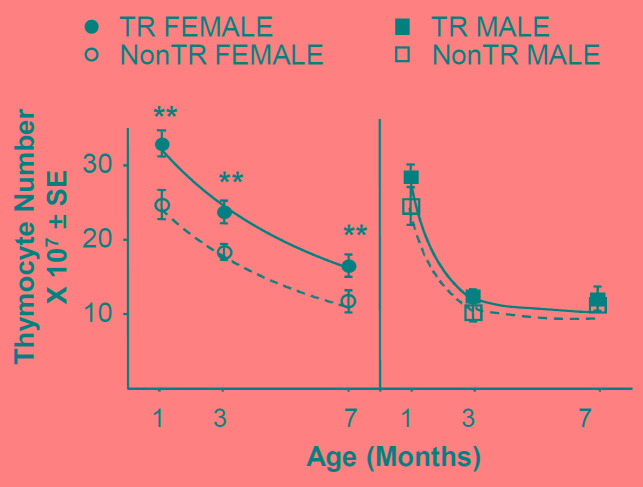
Figure 1,
Figure 1,
Females and males exhibit a differential pattern and rate of thymic involution. Total thymocyte number was compared among age- and sex-matched C57/BL6 mice in the presence or absence of the MCL1 transgene. Thymic cellularity in female mice shows a progressive declination with age whereas a biphasic pattern of decreasing cellularity is observed in male mice. From 1 to 3 months of age, the thymus in males exhibits a rapid loss of cellularity following with a relative slow loss afterwards. Sexual dimorphism is also manifested as a differential presentation of gene function as shown in the diagram where MCL1 only promotes an enlarged thymus in female but not in male mice. This diagram was adopted from a previous publication [25] to illustrate the influence of sexual dimorphism in thymic involution.
Figure 2,
Figure 2,
Females display a trend of higher-grade thymopoiesis in comparison to males. Levels of thymopoiesis between age-matched female and male C57/BL6 mice were compared by measuring sjTREC copy number per microgram of thymocyte DNA. Each circle represents one individual mouse. The sjTREC value for each individual mouse is variable; however, there is a higher frequency of greater sjTREC values in female mice. This is shown particularly in the 1-month and 3-month age groups. The sjTRECs values at 7-month of age are less variable with no obvious difference between the sexes.

References

    1. Yager EJ, Ahmed M, Lanzer K, Randall TD, Woodland DL, Blackman MA. Age-associated decline in T cell repertoire diversity leads to holes in the repertoire and impaired immunity to influenza virus. J Exp Med. 2008;205:711–723. - PMC - PubMed
    1. Nikolich-Zugich J. Ageing and life-long maintenance of T-cell subsets in the face of latent persistent infections. Nat Rev Immunol. 2008;8:512–522. - PMC - PubMed
    1. Haynes L, Swain SL. Why aging T cells fail: implications for vaccination. Immunity. 2006;24:663–666. - PMC - PubMed
    1. Aspinall R, Del Giudice G, Effros RB, Grubeck-Loebenstein B, Sambhara S. Challenges for vaccination in the elderly. Immun Ageing. 2007;4:9. - PMC - PubMed
    1. Cicin-Sain L, Smyk-Pearson S, Currier N, Byrd L, Koudelka C, Robinson T, Swarbrick G, Tackitt S, Legasse A, Fischer M, Nikolich-Zugich D, Park B, Hobbs T, Doane CJ, Mori M, Axthelm MK, Lewinsohn DA, Nikolich-Zugich J. Loss of naive T cells and repertoire constriction predict poor response to vaccination in old primates. J Immunol. 2010;184:6739–6745. - PMC - PubMed

LinkOut - more resources