


Effect of influenza on functional decline
- PMID: 22724499
- PMCID: PMC3526071
- DOI: 10.1111/j.1532-5415.2012.04048.x
Effect of influenza on functional decline
Abstract
Objectives: To examine the relationship between influenza and activity of daily living (ADL) decline and other clinical indicators in nursing home (NH) residents.
Design: Retrospective NH-aggregated longitudinal study.
Setting: Two thousand three hundred fifty-one NHs in 122 U.S. cities from 1999 to 2005.
Participants: Long-stay (>90 days) NH residents.
Measurements: Quarterly city-level influenza mortality and state-level influenza severity. Quarterly incidence of Minimum Data Set-derived ADL decline (≥ 4 points), weight loss, new or worsening pressure ulcers (PUs), and infections. Outcome variables chosen as clinical controls were antipsychotic use, restraint use, and persistent pain.
Results: City-level influenza mortality and state-level influenza severity were associated with higher rates of large (≥ 4 points) ADL decline (mortality β = 0.20, P < .001; severity β = 0.18, P < .001), weight loss (β = 0.19, P < .001; β = 0.24, P < .001), worsening PUs (β = 0.04, P = .08; β = 0.12, P < .001), and infections (β = 0.41, P < .001; β = 0.47, P < .001) but not with restraint use, antipsychotic use, or persistent pain. NH influenza vaccination rates were weakly associated with the outcomes (e.g., β = -0.009, P = .03 for ADL decline, β = 0.008, P = .07 for infections). Compared with the summer quarter of lowest influenza activity, the results for the other quarters translate to an additional 12,284 NH residents experiencing large ADL decline annually, 15,168 experiencing significant weight loss, 6,284 new or worsening PUs, and 29,753 experiencing infections due to influenza.
Conclusion: The results suggest a substantial and potentially costly effect of influenza on NH residents. The effect of influenza vaccination on preventing further ADL decline and other clinical outcomes in NH residents should be studied further.
© 2012, Copyright the Authors Journal compilation © 2012, The American Geriatrics Society.
Figures
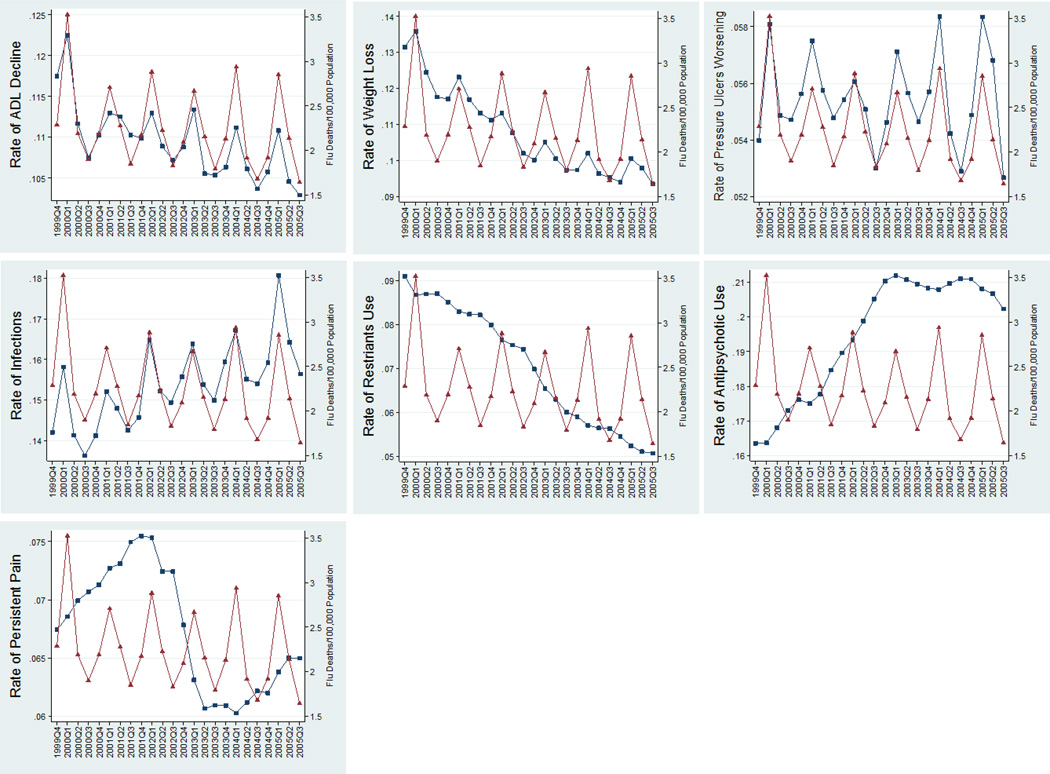
 ) versus Influenza City-Level Mortality (
 ) (functional outcomes rates (range 0–1) on the left vertical axis, influenza mortality (Deaths/100,000 population) on the right vertical axis) for long-stay (>90 days) nursing home residents in 122 CDC-monitored cities in the USA. The outcomes (from left to right and top to bottom) are prevalence rates of 1. Large ADL decline (>3 points in the 0–28 ADL scale); 2. Weight Loss; 3. Worsening Pressure Ulcers; 4. Infections; 5. Use of Restraints; 6. Use of Antipsychotics; 7. Persistent Pain.
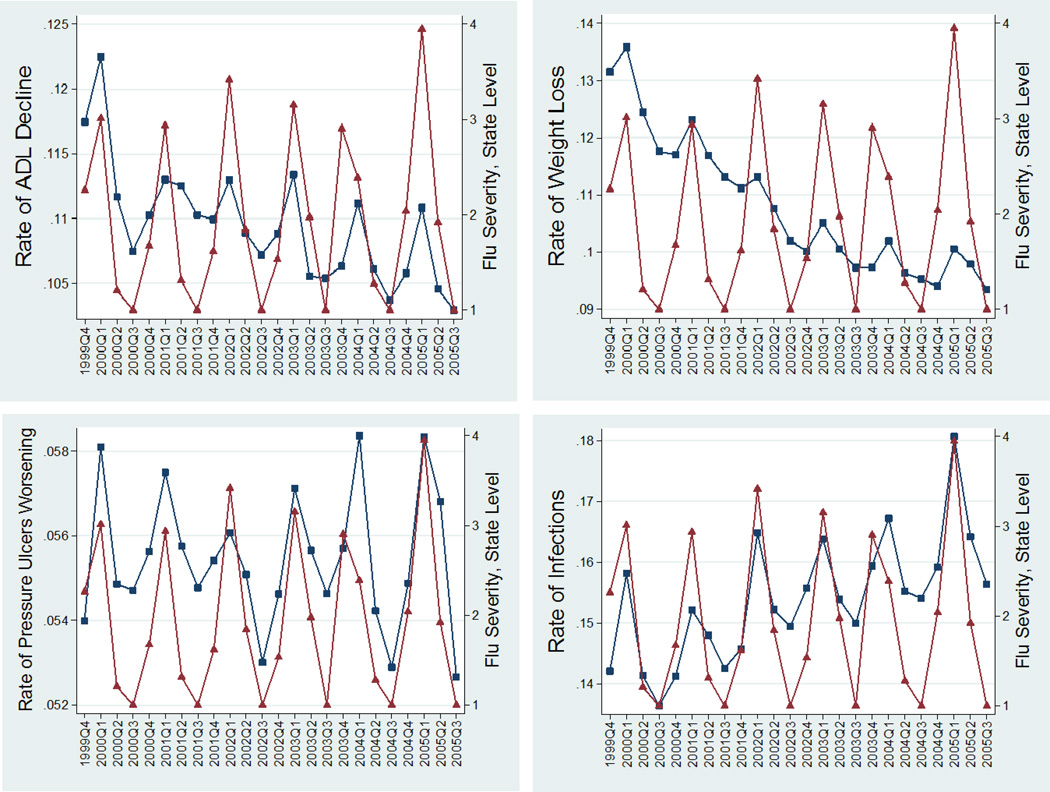 ) versus Influenza State-Level Severity () (functional outcomes rates (range 0–1) on the left vertical axis, influenza severity scales (range 1–5) on the right vertical axis). for long-stay (>90 days) nursing home residents in 122 CDC-monitored cities in the USA. The outcomes (from left to right and top to bottom) are prevalence rates of 1. Large ADL decline (>3 points in the 0–28 ADL scale); 2. Weight Loss; 3. Worsening Pressure Ulcers; 4. Infections.
Comment in
-
Increased city-level influenza mortality and state-level influenza severity is associated with greater functional decline among nursing home residents.Evid Based Nurs. 2013 Oct;16(4):122-3. doi: 10.1136/eb-2012-101049. Epub 2013 Jan 19. Evid Based Nurs. 2013. PMID: 23335601 Free PMC article. No abstract available.
References
-
- Thompson WW, Shay DK, Weintraub E, et al. Mortality associated with influenza and respiratory syncytial virus in the United States. JAMA. 2003;289:179–186. - PubMed
-
- Thompson WW, Shay DK, Weintraub E, et al. Influenza-associated hospitalizations in the United States. JAMA. 2004;292:1333–1340. - PubMed
-
- Nichol KL, Wuorenma J, von Sternberg T. Benefits of influenza vaccination for low-, intermediate-, and high-risk senior citizens. Arch Intern Med. 1998;158:1769–1776. - PubMed
-
- Bradley SF. Prevention of influenza in long-term-care facilities. Long-Term-Care Committee of the Society for Healthcare Epidemiology of America. Infect Control Hosp Epidemiol. 1999;20:629–637. - PubMed
Publication types
MeSH terms
Grants and funding
LinkOut - more resources
Full Text Sources
Medical
