


Architecture and active site of particulate methane monooxygenase
- PMID: 22725967
- PMCID: PMC3474877
- DOI: 10.3109/10409238.2012.697865
Architecture and active site of particulate methane monooxygenase
Abstract
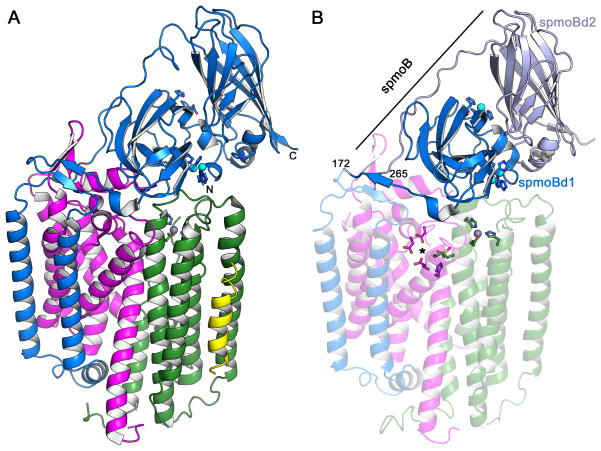
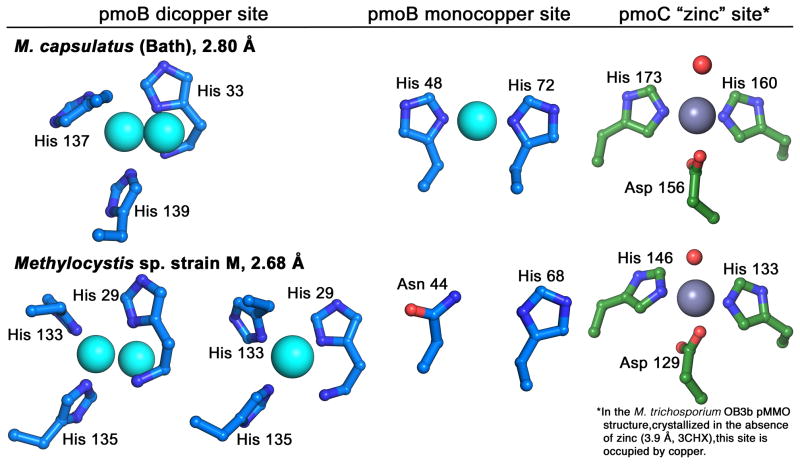
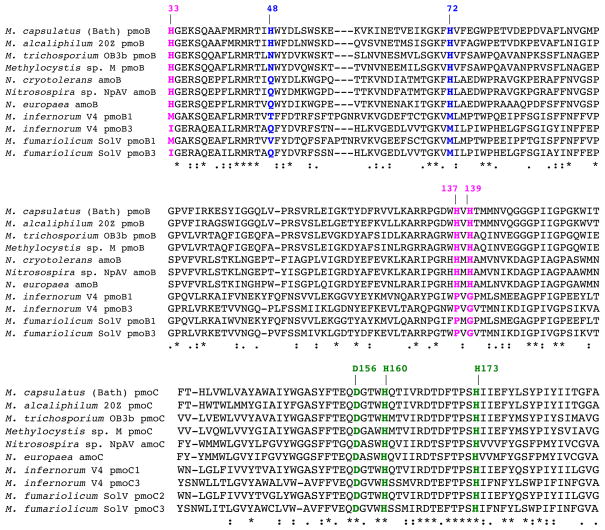
Particulate methane monooxygenase (pMMO) is an integral membrane metalloenzyme that oxidizes methane to methanol in methanotrophic bacteria, organisms that live on methane gas as their sole carbon source. Understanding pMMO function has important implications for bioremediation applications and for the development of new, environmentally friendly catalysts for the direct conversion of methane to methanol. Crystal structures of pMMOs from three different methanotrophs reveal a trimeric architecture, consisting of three copies each of the pmoB, pmoA, and pmoC subunits. There are three distinct metal centers in each protomer of the trimer, mononuclear and dinuclear copper sites in the periplasmic regions of pmoB and a mononuclear site within the membrane that can be occupied by copper or zinc. Various models for the pMMO active site have been proposed within these structural constraints, including dicopper, tricopper, and diiron centers. Biochemical and spectroscopic data on pMMO and recombinant soluble fragments, denoted spmoB proteins, indicate that the active site involves copper and is located at the site of the dicopper center in the pmoB subunit. Initial spectroscopic evidence for O(2) binding at this site has been obtained. Despite these findings, questions remain about the active site identity and nuclearity and will be the focus of future studies.
Figures

References
-
- Ali H, Murrell JC. Development and validation of promoter-probe vectors for the study of methane monooxygenase gene expression in Methylococcus capsulatus Bath. Microbiol. 2009;155:761–771. - PubMed
-
- Andrew CR, McKillop KP, Sykes AG. Kinetic studies on the reactions of separated a, b and c subunits of Panulirus interruptus deoxy-hemocyanin with hydrogen peroxide. Biochim Biophys Acta. 1993;1163:17–25. - PubMed
-
- Arakawa H, Aresta M, Armor JN, Barteau MA, Beckman EJ, Bell AT, Bercaw JE, Creutz C, Dinjus E, Dixon DA, Domen K, DuBois DL, Eckert J, Fujita E, Gibson DH, Goddard WA, Goodman DW, Keller J, Kubas GJ, Kung HH, Lyons JE, Manzer LE, Marks TJ, Morokuma K, Nicholas KM, Periana R, Que L, Rostrup-Nielson J, Sachtler WMH, Schmidt LD, Sen A, Somorjai GA, Stair PC, Stults BR, Tumas W. Catalysis research of relevance to carbon management: progress, challenges, and opportunities. Chem Rev. 2001;101:953–996. - PubMed
-
- Arp DJ, Sayavedra-Soto LA, Hommes NG. Molecular biology and biochemistry of ammonia oxidation by Nitrosomonas europaea. Arch Microbiol. 2002;178:250–255. - PubMed
-
- Balasubramanian R, Rosenzweig AC. Structural and mechanistic insights into methane oxidation by particulate methane monooxygenase. Acc Chem Res. 2007;40:573–580. - PubMed
Publication types
MeSH terms
Substances
Grants and funding
LinkOut - more resources
Full Text Sources
Other Literature Sources
Molecular Biology Databases
