


Agnoprotein of mammalian polyomaviruses
- PMID: 22726243
- PMCID: PMC7111918
- DOI: 10.1016/j.virol.2012.05.024
Agnoprotein of mammalian polyomaviruses
Abstract
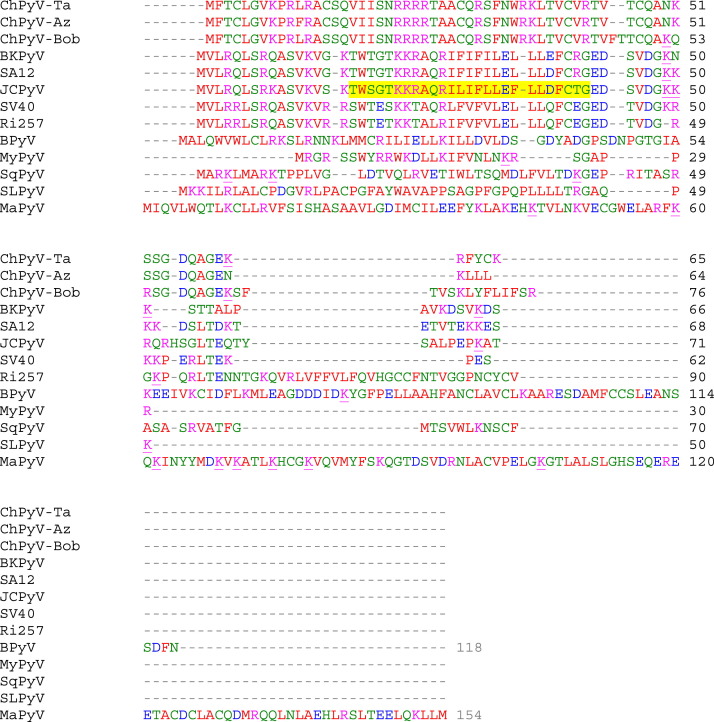
Polyomaviruses are naked viruses with an icosahedral capsid that surrounds a circular double-stranded DNA molecule of about 5000 base-pairs. Their genome encodes at least five proteins: large and small tumor antigens and the capsid proteins VP1, VP2 and VP3. The tumor antigens are expressed during early stages of the viral life cycle and are implicated in the regulation of viral transcription and DNA replication, while the capsid proteins are produced later during infection. Members of the Polyomaviridae family have been isolated in birds (Avipolyomavirus) and mammals (Orthopolyomavirus and Wukipolyomavirus). Some mammalian polyomaviruses encode an additional protein, referred to as agnoprotein, which is a relatively small polypeptide that exerts multiple functions. This review discusses the structure, post-translational modifications, and functions of agnoprotein, and speculates why not all polyomaviruses express this protein.
Copyright © 2012 Elsevier Inc. All rights reserved.
Figures
References
-
- Akan I., Sariyer I.K., Biffi R., Palermo V., Woolridge S., White M.K., Amini S., Khalili K., Safak M. Human polyomavirus JCV late leader peptide region contains important regulatory elements. Virology. 2006;349:66–78. - PubMed
Publication types
MeSH terms
Substances
LinkOut - more resources
Full Text Sources
Other Literature Sources
