


Mice with reduced NMDA receptor expression: more consistent with autism than schizophrenia?
- PMID: 22726567
- PMCID: PMC3808979
- DOI: 10.1111/j.1601-183X.2012.00816.x
Mice with reduced NMDA receptor expression: more consistent with autism than schizophrenia?
Abstract
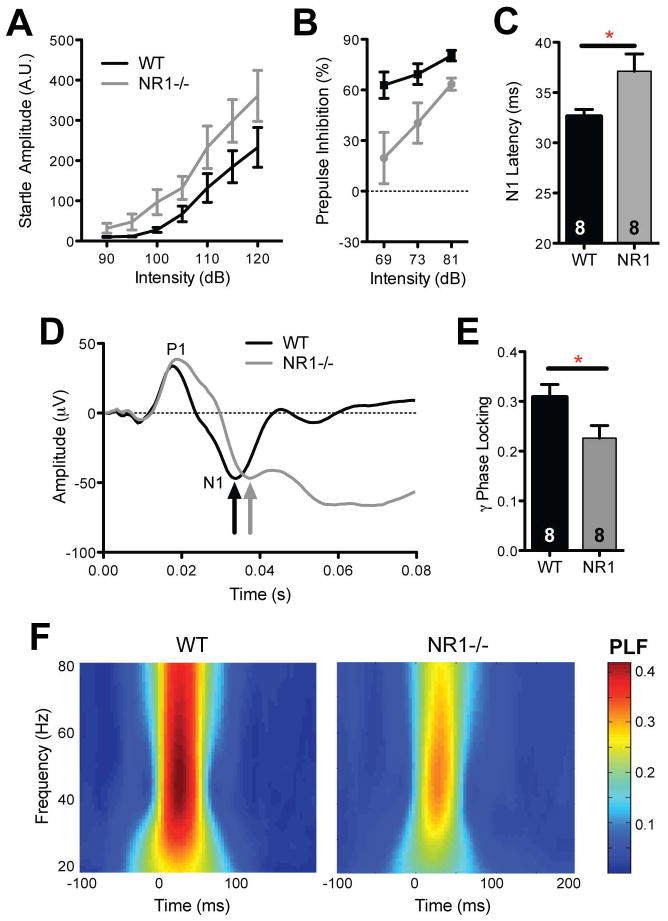
Reduced NMDA-receptor (NMDAR) function has been implicated in the pathophysiology of neuropsychiatric disease, most strongly in schizophrenia but also recently in autism spectrum disorders (ASD). To determine the direct contribution of NMDAR dysfunction to disease phenotypes, a mouse model with constitutively reduced expression of the obligatory NR1 subunit has been developed and extensively investigated. Adult NR1(neo-/-) mice show multiple abnormal behaviors, including reduced social interactions, locomotor hyperactivity, self-injury, deficits in prepulse inhibition (PPI) and sensory hypersensitivity, among others. Whereas such phenotypes have largely been interpreted in the context of schizophrenia, these behavioral abnormalities are rather non-specific and are frequently present across models of diseases characterized by negative symptom domains. This study investigated auditory electrophysiological and behavioral paradigms relevant to autism, to determine whether NMDAR hypofunction may be more consistent with adult ASD-like phenotypes. Indeed, transgenic mice showed behavioral deficits relevant to all core ASD symptoms, including decreased social interactions, altered ultrasonic vocalizations and increased repetitive behaviors. NMDAR disruption recapitulated clinical endophenotypes including reduced PPI, auditory-evoked response N1 latency delay and reduced gamma synchrony. Auditory electrophysiological abnormalities more closely resembled those seen in clinical studies of autism than schizophrenia. These results suggest that NMDAR hypofunction may be associated with a continuum of neuropsychiatric diseases, including schizophrenia and autism. Neural synchrony abnormalities suggest an imbalance of glutamatergic and GABAergic coupling and may provide a target, along with behavioral phenotypes, for preclinical screening of novel therapeutics.
© 2012 The Authors. Genes, Brain and Behavior © 2012 Blackwell Publishing Ltd and International Behavioural and Neural Genetics Society.
Conflict of interest statement
Dr. Roberts also discloses a financial medical advisory board relationship with Prism Clinical Imaging, which had no overlap with the present study. All other authors report no biomedical financial interests or potential conflicts of interest.
Figures


References
-
- Amann LC, Gandal MJ, Halene TB, Ehrlichman RS, White SL, McCarren HS, Siegel SJ. Mouse behavioral endophenotypes for schizophrenia. Brain Res Bull. 2010;83:147–161. - PubMed
-
- Bickel S, Lipp HP, Umbricht D. Impaired attentional modulation of auditory evoked potentials in N-methyl-D-aspartate NR1 hypomorphic mice. Genes Brain Behav. 2007;6:558–568. - PubMed
-
- Bickel S, Lipp HP, Umbricht D. Early auditory sensory processing deficits in mouse mutants with reduced NMDA receptor function. Neuropsychopharmacology. 2008;33:1680–1689. - PubMed
Publication types
MeSH terms
Substances
Grants and funding
LinkOut - more resources
Full Text Sources
Medical
Molecular Biology Databases
