Review
. 2012 Sep;13(3):154-9.
doi: 10.1016/j.prrv.2012.03.001. Epub 2012 May 27.

Bacterial biofilms in the upper airway - evidence for role in pathology and implications for treatment of otitis media

Affiliations
Review

Bacterial biofilms in the upper airway - evidence for role in pathology and implications for treatment of otitis media

Lauren O Bakaletz. Paediatr Respir Rev. 2012 Sep.

Abstract

Understanding the nature of the biofilm component in the pathogenesis of otitis media [OM] will likely have a meaningful influence on the development of novel strategies to prevent and/or treat this highly prevalent pediatric disease. The design of vaccine candidates for OM that currently focus on preventing colonization are predicated on the assumption that by reducing the burden of bacteria present in the pediatric nasopharynx, one could reduce or eliminate the likelihood of retrograde ascension of the Eustachian tube by bacteria from the nasopharynx to the middle ear. If effective, this strategy could prevent biofilms from ever forming in the middle ear. Additionally, gaining an improved understanding of the unique properties of bacteria resident within a biofilm and the proteins they express while growing as part of this organized community has the potential to identify novel and perhaps biofilm-specific molecular targets for the design of either therapeutic agents or vaccine candidates for the resolution of existing OM.


Figures

Figure 1
Figure 1
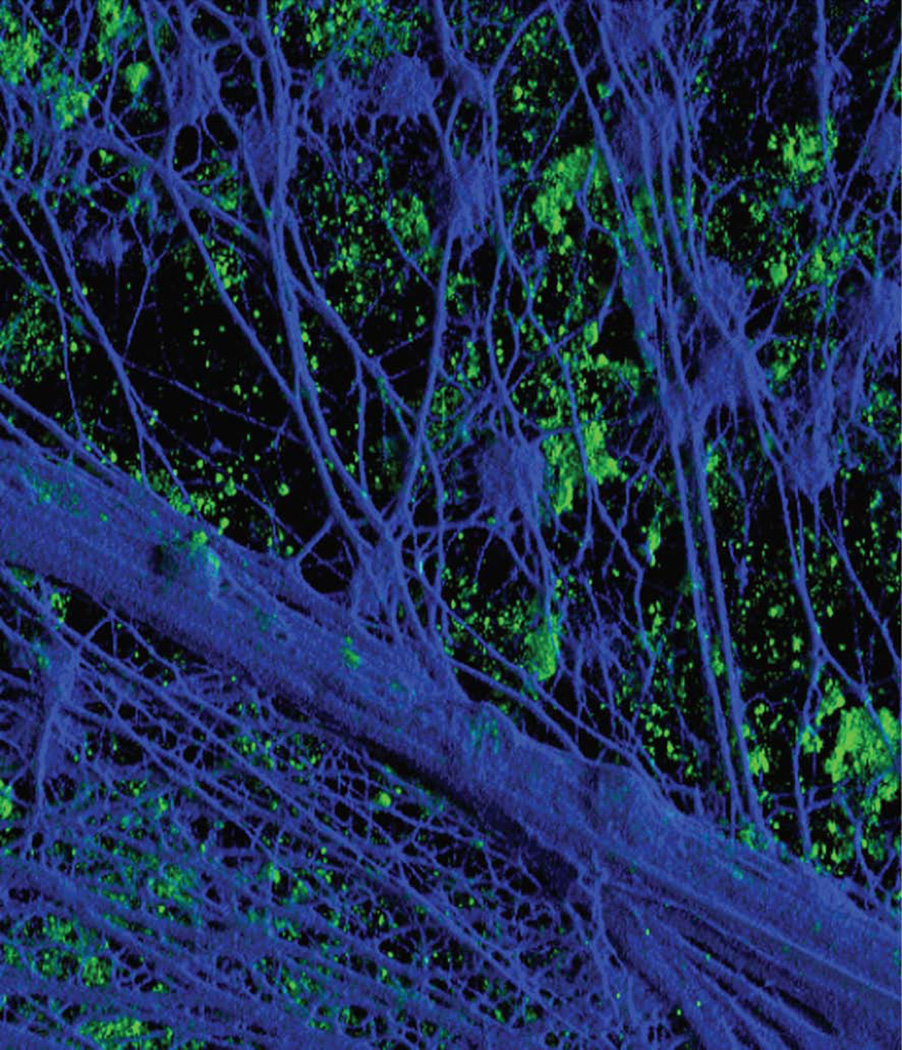
Three-dimensional reconstruction of z-stack images from a frozen section of a 21-day biofilm formed in the chinchilla middle ear by nontypeable Haemophilus influenzae and labeled for type IV pilin protein (green fluorescence) and with DAPI for detection of double-stranded DNA (dsDNA) (blue fluorescence). DAPI labeling of dsDNA that has formed a dense interwoven meshwork within the biofilm is evident. Pilin protein, or possibly bacteria expressing type IV pili, is seen as small aggregates in a plane that sits slightly below the meshwork of dsDNA strands. Reprinted with permission from the cover of J. Bacteriol 189(10), © American Society for Microbiology (2007).
Figure 2
Figure 2
A - Gross whole mount image of bulla recovered 5 days after direct challenge of the middle ear with H. influenzae. Bracketed area indicates presence of biofilm present in the middle ear space. B - Confocal microscopy image of a whole mount section of the biofilm shown in Panel A stained with a vital fluorescent dye. Long finger-like projections of viable bacteria (fluoresce green) extend from the mucosa (M) into the middle ear cavity. Reprinted with permission from Infection and Immunity 2005;73:3210–3218. © American Society for Microbiology (2005).
Figure 3
Figure 3
Relative percentage of middle ears with OM. The greatest incidence of OM was observed in the negative control cohort, which received anti-adjuvant serum (gray bars). In contrast, the greatest protection against the development of experimental NTHI-induced OM was achieved in the cohort administered antiserum against LB1 + AS04 (p < 0.001; yellow bars), as expected since this cohort served as the positive control. Further, significant protection against ascending NTHI-induced OM was conferred by receipt of either anti-rsPilA (p < 0.001; red bars) or anti-chimV4 serum pools (p < 0.001; blue-green bars). Reprinted from Vaccine, 28(1), Novotny LA, Adams LD, Kang DR, Wiet GJ, Cai X, Sethi S, Murphy TF, Bakaletz LO “Epitope mapping immunodominant regions of the PilA protein of nontypeable Haemophilus influenzae (NTHI) to facilitate the design of two novel chimeric vaccine candidates”, pp. 279–289. Copyright 2009, with permission from Elsevier.
Figure 4
Figure 4
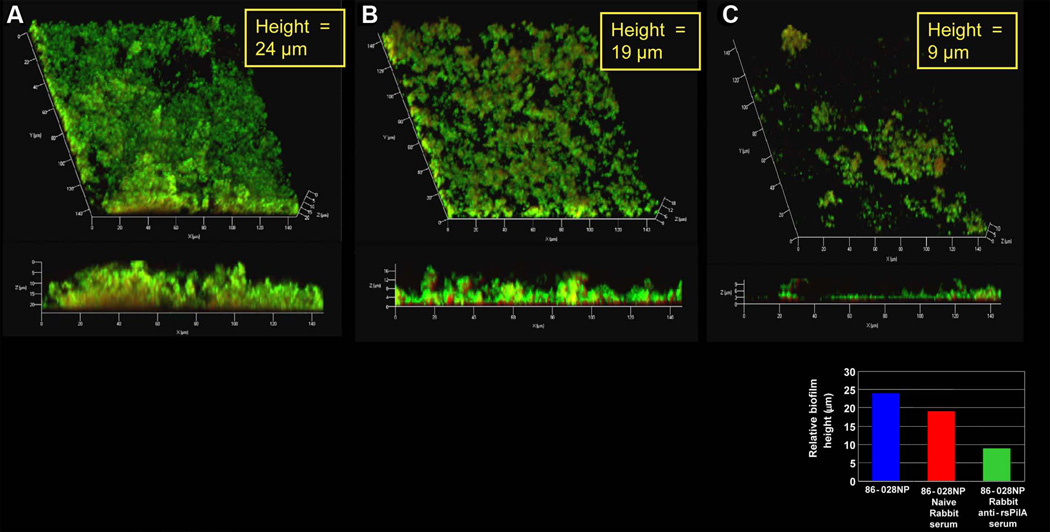
Rabbit anti-rsPilA ‘reversed’ an biofilm formed by NTHI. Whereas incubation of an established biofilm, (which had been allowed to form in a chamber slide in vitro for 24 hours prior to treatment) with either sterile medium (Panel A) or naïve rabbit serum (Panel B) had minimal effect on relative biofilm height, incubation with antiserum directed against rsPilA resulted in a marked diminution in biofilm height compared to controls.

References

    1. Akira S. Toll-like receptors: lessons from knockout mice. Biochem Soc Trans. 2000;28:551–556. - PubMed
    1. Cassell GH, Archer GL, Beam TR, et al. Report of the ASM Task Force on Antibiotic Resistance. Washington D.C: 1994.
    1. Infante-Rivard C, Fernandez A. Otitis media in children: frequency, risk factors, and research avenues. Epidemiol Rev. 1993;15:444–465. - PubMed
    1. Stool SE, Berg AO, Berman S, et al. AHCPR Publication No. 94-0622. Rockville, MD: Agency for Health Care Policy and Research, Public Health Service, U.S. Department of Health and Human Services; 1994. Otitis Media with Effusion in Young Children. Clinical Practice Guideline.
    1. Paap CM. Management of otitis media with effusion in young children. Ann Pharmacother. 1996;30:1291–1297. - PubMed

Publication types

Substances