. 2012 Jul 15:901:41-6.
doi: 10.1016/j.jchromb.2012.05.038. Epub 2012 Jun 7.

Bacterial volatile discovery using solid phase microextraction and comprehensive two-dimensional gas chromatography-time-of-flight mass spectrometry

Affiliations

Bacterial volatile discovery using solid phase microextraction and comprehensive two-dimensional gas chromatography-time-of-flight mass spectrometry

Heather D Bean et al. J Chromatogr B Analyt Technol Biomed Life Sci. .

Abstract

Bacteria produce unique volatile mixtures that could be used to identify infectious agents to the species, and possibly the strain level. However, due to the immense variety of human pathogens, and the close relatedness of some of these bacteria, the robust identification of the bacterium based on its volatile metabolome is likely to require a large number of volatile compounds for each species. We applied comprehensive two-dimensional gas chromatography-time-of-flight mass spectrometry (GC×GC-TOFMS) to the identification of the headspace volatiles of Pseudomonas aeruginosa PA14 grown for 24 h in lysogeny broth. This is the first reported use of GC×GC-TOFMS for the characterization of bacterial headspace volatiles. The analytical purity that is afforded by this chromatographic method facilitated the identification of 28 new P. aeruginosa-derived volatiles, nearly doubling the list of volatiles for this species.


Figures

Figure 1
Figure 1
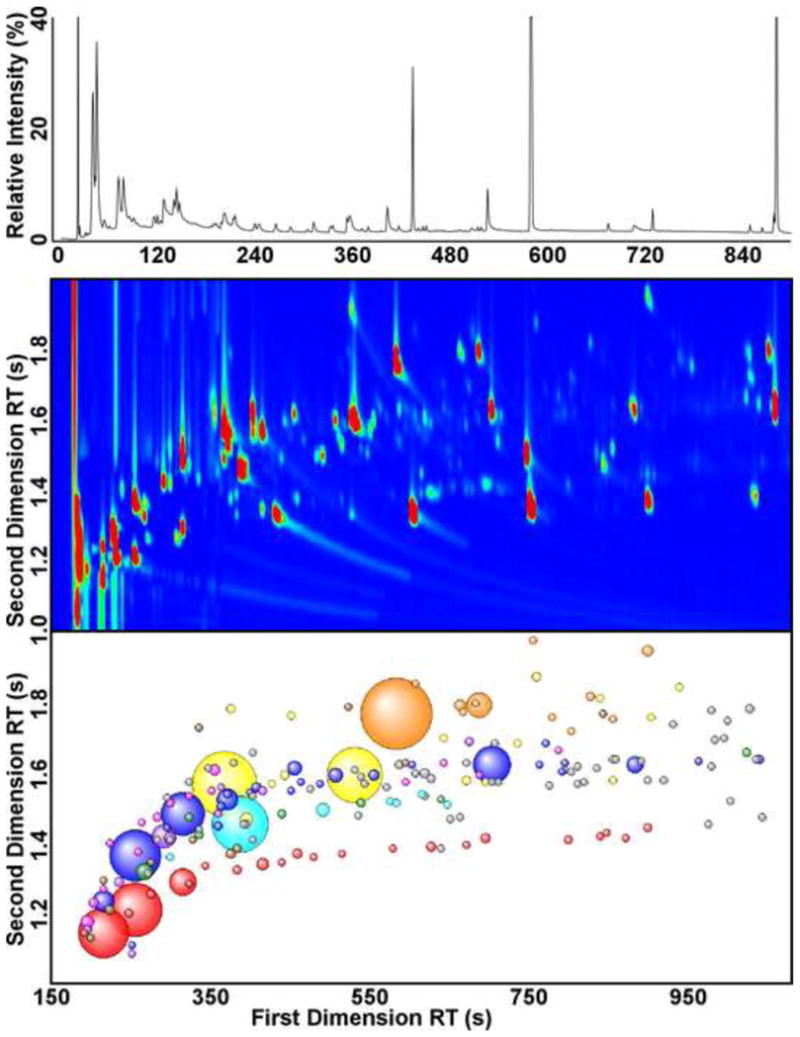
Gas chromatography of the headspace volatiles of P. aeruginosa PA14 grown aerobically in LB-Lennox. (Top) One-dimensional gas chromatogram (GC) of the headspace volatiles. (Middle) Two-dimensional gas chromatogram (GC×GC) of the headspace volatiles, excluding regions containing only column bleed (2nd RT < 1.0). The GC and GC×GC chromatograms were aligned using the measured retention indices of the headspace volatiles. (Bottom) Bubble plot of the GC×GC chromatogram, after chromatographic artifacts were removed. The colors reflect the compound classes detected for the sample and blank: aliphatic hydrocarbons (red), alcohols (pink), aldehydes (purple), ketones (blue), esters (green), aromatic hydrocarbons (cyan), heteroaromatics (yellow), functionalized benzenes (orange), and all other classes (brown). Unidentified compounds are shaded in gray. The radii of the bubbles correspond to the relative TIC peak intensities.
Figure 2
Figure 2
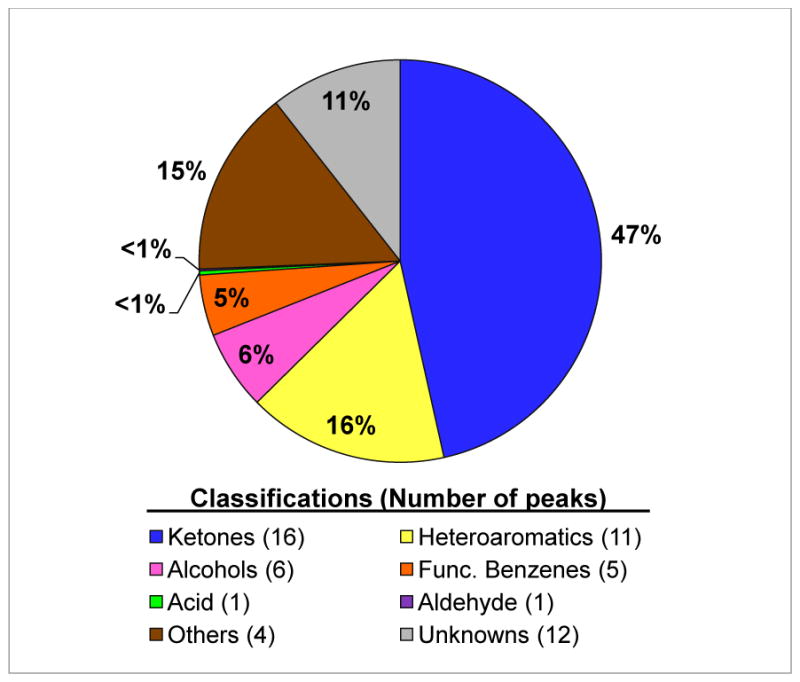
Classifications of P. aeruginosa PA14 headspace compounds, represented by their relative abundance in area percent.
Figure 3
Figure 3
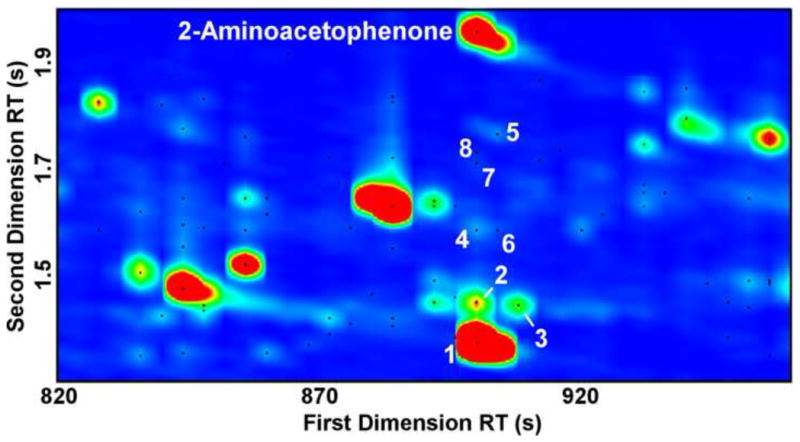
GC×GC chromatographic region containing the 2-aminoacetophenone (2-AA) peak. Each black dot marks a peak with a TIC S/N > 100. Eight other peaks co-elute with 2-AA in the first chromatographic dimension, but are separated from 2-AA in the second dimension. The co-eluting compounds are numbered in order of peak area, with dodecamethyl cyclohexasiloxane (peak 1, Sim.=842, S/N=79182) as the largest peak. The other compounds are unsaturated hydrocarbons (peaks 2 and 3, S/N=754 and 537, respectively), a heteroaromatic compound (peak 5, S/N=1010), and Unknowns (peaks 4, 6, 7, and 8, S/N = 585, 226, 185, and 131, respectively).
Figure 4
Figure 4
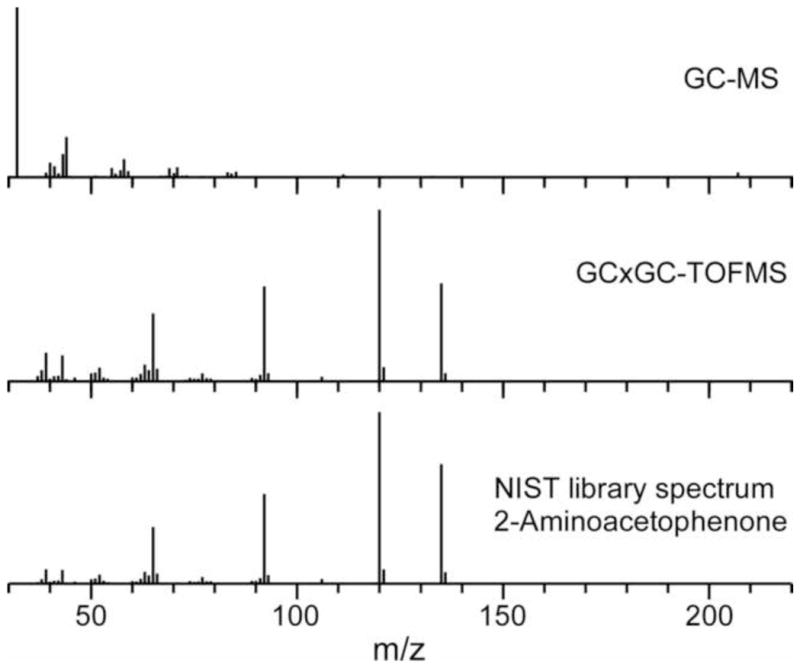
Mass spectra of the chromatographic regions containing 2-aminoacetophenone (2-AA; RI =1317) as acquired by GC-MS (Top) and GC×GC-TOFMS (Middle). Column bleed and co-eluting compounds in GC chromatography obscure the mass spectrum of the low-abundance compound 2-AA. GC×GC affords higher chromatographic purity, making it possible to identify low-abundance compounds by library matching. The NIST library spectrum of 2-AA is provided for reference (Bottom).

References

    1. Zhu J, Bean HD, Kuo YM, Hill JE. J Clin Microbiol. 2010;48:4426–4431. - PMC - PubMed
    1. Casalinuovo IA, Di Pierro D, Coletta M, Di Francesco P. Sensors. 2006;6:1428–1439. - PubMed
    1. Wilson AD, Baietto M. Sensors. 2011;11:1105–1176. - PMC - PubMed
    1. Borriello G, Werner E, Roe F, Kim AM, Ehrlich GD, Stewart PS. Antimicrob Agents Chemother. 2004;48:2659–2664. - PMC - PubMed
    1. Preti G, Thaler E, Hanson CW, Troy M, Eades J, Gelperin A. J Chromatogr B. 2009;877:2011–2018. - PubMed

Publication types

MeSH terms

Substances

LinkOut - more resources