Review
. 2012 Aug;23(6):693-700.
doi: 10.1016/j.semcdb.2012.06.002. Epub 2012 Jun 21.

Epigenetic regulation of pancreas development and function

Affiliations
Review

Epigenetic regulation of pancreas development and function

Dana Avrahami et al. Semin Cell Dev Biol. 2012 Aug.

Abstract

Multiple signaling systems and transcription factor cascades control pancreas development and endocrine cell fate determination. Epigenetic processes contribute to the control of this transcriptional hierarchy, involving both histone modifications and DNA methylation. Here, we summarize recent advances in the field that demonstrate the importance of epigenetic regulation in pancreas development, β-cell proliferation, and cell fate choice. These breakthroughs were made using the phenotypic analysis of mice with mutations in genes that encode histone modifying enzymes and related proteins; by application of activators or inhibitors of the enzymes that acetylate or methylate histones to fetal pancreatic explants in culture; and by genomic approaches that determined the patterns of histone modifications and chromatin state genome-wide.


Figures

Figure 1
Figure 1
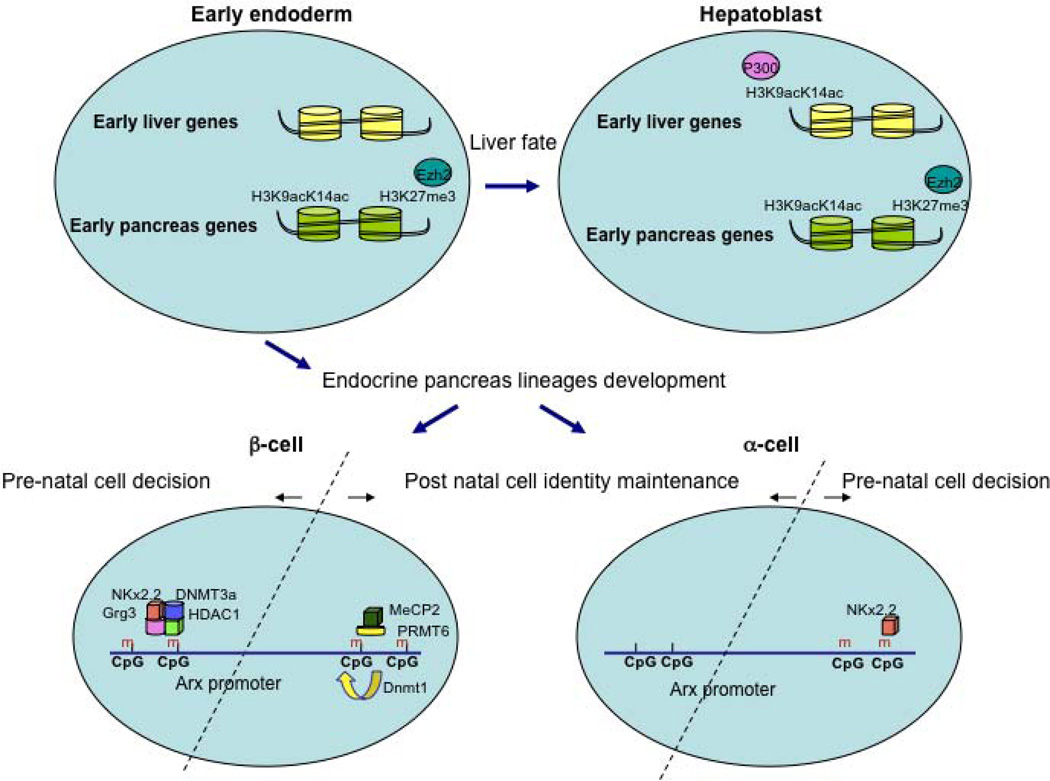
Epigenetic control in early pancreas development and endocrine cell fate allocation. During early endoderm development into liver and pancreas fates, liver-specific genes and pancreas-specific genes are differentially marked in multipotent cells. While PDX1, and early pancreatic gene, is bivalently marked with both the activation-associated H3K9acK14ac histone modification and H3K27me3, associated with gene silencing, liver-specific genes such as Alb1, Afp and Ttr carry none of these histone marks. Upon differentiation into hepatoblasts, the H3K9acK14ac mark increases on liver-specific promoters, while H3K27me3 remains low, whereas the PDX1 promoter remains hyperacetylated and enriched for H3K27me3. These cell fate programs are modulated by the histone acetyltransferase P300, and by Ezh2, a methyltransferase for H3K27me3. During pancreatic islet development, the α and β-cells fate decision is epigenetically regulated by the differentially recruitment of a repression complex (DNMT3a, Grg3 and HDAC1) by Nkx2.2, to the Arx gene promoter in β-cells, but not α–cells. This differential binding is influenced by the methylation state of the Arx promoter. In post-natal life, the maintenance of α and β-cell identity is epigenetically regulated by a differentially methylated state of part of the Arx promoter. In β-cells, this region is hypermethylated, and is occupied by a repressive complex of MeCP2 and PRMT6, to repress the Arx locus. In α-cells, this promoter region is kept hypomethylated.
Figure 2
Figure 2
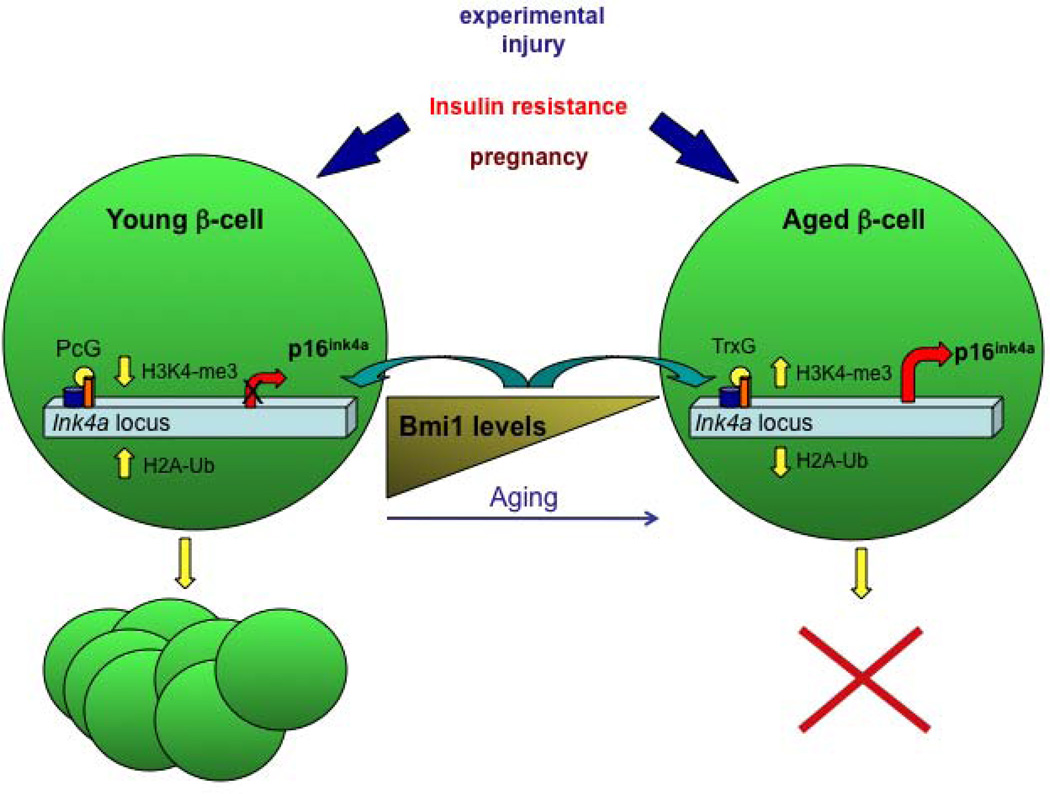
Epigenetically-based mechanisms control the regeneration capacity of β-cells: The capacity of β-cells to proliferate in response to changes in metabolic demand declines with age. In several models of beta-cell replication, such as insulin resistance, treatment with exendin-4, or following Streptozocin (STZ) treatment, only β-cells from young mice have the capacity to regenerate β-cell mass. The cell cycle inhibitor p16Ink4a, a product of the Ink/Arf locus, increases with age. Conversely, the levels of Bmi1, a polycomb-repressive complex 1 (PRC1) protein known to regulate the Ink4a locus, decline with age. In young and regenerating β-cells, increased binding of Bmi-1 and Ezh2 (a polycomb histone methyltransferase) coincides with decreased H3K4 trimethylation, increased H2A ubiquitylation and H3K27 trimethylation and repression of the Ink/Arf locus, and thus high β-cell proliferative capacity. With aging, reduced Bmi-1 binding facilitates H3K4 trimethylation by MLL1, a trithorax group (TrxG) protein and an H3K4 methyltransferase, reduced H2A ubiquitylation and increased Ink4a/Arf expression, therefore reduced β-cell replication.

References

    1. Gittes GK. Developmental biology of the pancreas: a comprehensive review. Dev Biol. 2009;326:4–35. - PubMed
    1. Pan FC, Wright C. Pancreas organogenesis: from bud to plexus to gland. Dev Dyn. 2011;240:530–565. - PubMed
    1. Bernstein BE, Mikkelsen TS, Xie X, Kamal M, Huebert DJ, Cuff J, et al. A bivalent chromatin structure marks key developmental genes in embryonic stem cells. Cell. 2006;125:315–326. - PubMed
    1. Xu CR, Cole PA, Meyers DJ, Kormish J, Dent S, Zaret KS. Chromatin "prepattern" and histone modifiers in a fate choice for liver and pancreas. Science. 2011;332:963–966. - PMC - PubMed
    1. Collombat P, Hecksher-Sorensen J, Krull J, Berger J, Riedel D, Herrera PL, et al. Embryonic endocrine pancreas and mature beta cells acquire alpha and PP cell phenotypes upon Arx misexpression. J Clin Invest. 2007;117:961–970. - PMC - PubMed

Publication types

MeSH terms

LinkOut - more resources