


doi: 10.1038/nchembio.1005.
Epub 2012 Jun 24.
Metallo-β-lactamases withstand low Zn(II) conditions by tuning metal-ligand interactions
Affiliations
- PMID: 22729148
- PMCID: PMC3470787
- DOI: 10.1038/nchembio.1005
Item in Clipboard
Metallo-β-lactamases withstand low Zn(II) conditions by tuning metal-ligand interactions
Nat Chem Biol.
2012 Aug.
Abstract
A number of multiresistant bacterial pathogens inactivate antibiotics by producing Zn(II)-dependent β-lactamases. We show that metal uptake leading to an active dinuclear enzyme in the periplasmic space of Gram-negative bacteria is ensured by a cysteine residue, an unusual metal ligand in oxidizing environments. Kinetic, structural and affinity data show that such Zn(II)-cysteine interaction is an adaptive trait that tunes the metal binding affinity, thus enabling antibiotic resistance at restrictive Zn(II) concentrations.
Figures
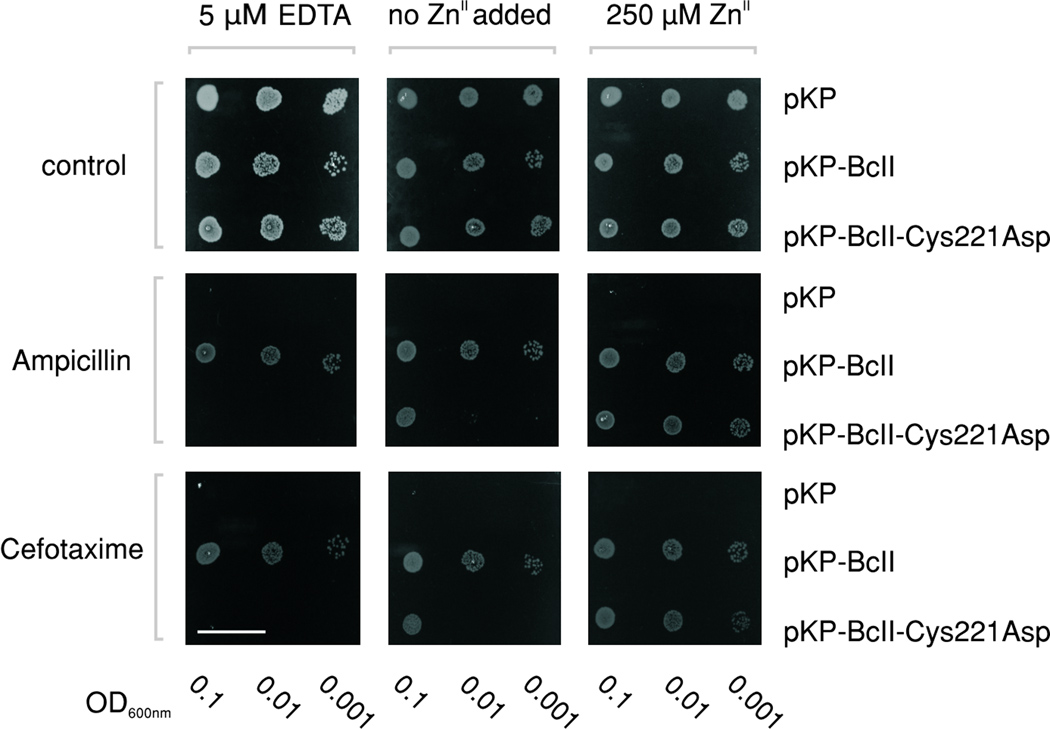
The antibiotic sensitivity of E. coli JM109 expressing BcII-Cys221Asp and BcII in the periplasmic space were measured as a function of the ZnII availability in the growth medium. Colony spots result from serial dilutions of cells transformed with the pKP vector (negative control), pKP-BcII (expressing wild-type BcII), and pKP-BcII- Cys221Asp (expressing the Cys221Asp mutant). Each strain was challenged with ampicillin (32 µg/ml) and cefotaxime (2 µg/ml), under different ZnII concentrations; namely, low ZnII (5 µM EDTA), no added ZnII, and excess ZnII (250 µM ZnSO4). These experiments were repeated three times with independent cultures for each condition tested. The length of the white scale bar corresponds to 20 mm.
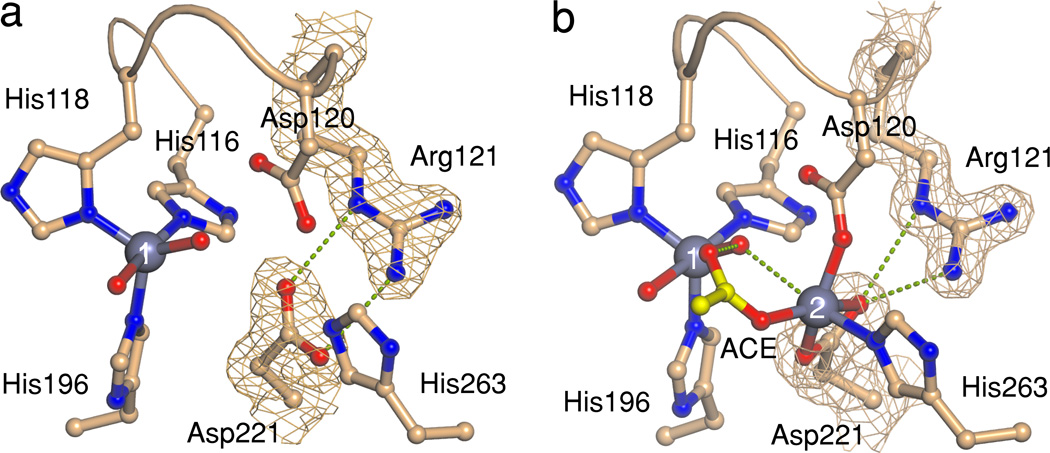
The metal-binding sites of mono-ZnII (a), and di-ZnII (b) BcII-Cys221Asp were solved at 1.71 Å and 1.58 Å resolution, respectively. Electron density maps (2FO – FC) are shown for Asp221 and Arg121 sidechains, contoured at 1.5 σ. Numbers indicate ZnII ions. Dotted lines indicate relevant electrostatic interactions. An acetate ion (ACE) was modeled bound to the di-ZnII form. Red spheres depict metal-bound water molecules.
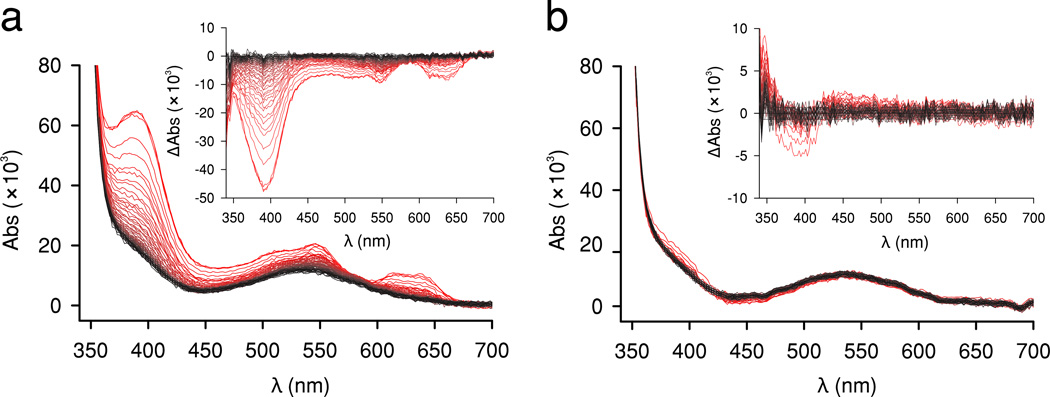
The hydrolysis of imipenem mediated by di-CoII BcII-Cys221Asp (a), and mono-CoII BcII-Cys221Asp (b) was detected via photodiode-array stopped-flow kinetic measurements. Spectra represent absorbance for a time span of 100 milliseconds (from pink to black). Insets show the same data as difference spectra (ΔA) taking the spectrum obtained after 100 milliseconds as reference. The initial spectrum in (a) exhibits an absorption band at 390 nm due to formation of a reaction intermediate, which decays in time together with ligand-field bands in the 600–650 nm region. The spectrum of the mono-CoII form (peak at 540 nm) (b) remained unchanged after 50 seconds. Reaction medium was 100 mM Hepes pH 7.5, 200 mM NaCl, at 7 °C, with 163 µM for both mono- and di-CoII species and an initial imipenem concentration of 2.5 mM.
References
-
- Crowder MW, Spencer J, Vila AJ. Metallo-beta-lactamases: Novel Weaponry for Antibiotic Resistance in Bacteria. Acc. Chem. Res. 2006;39:721–728. - PubMed
-
- Fisher JF, Meroueh SO, Mobashery S. Bacterial resistance to beta-lactam antibiotics: compelling opportunism, compelling opportunity. Chem Rev. 2005;105:395–424. - PubMed
-
- Fabiane SM, et al. Crystal structure of the zinc-dependent beta lactamase from Bacillus cereus at 1.9 A resolution: binuclear active site with features of a mononuclear enzyme. Biochemistry. 1998;37:12404–12411. - PubMed
-
- Orellano EG, Girardini JE, Cricco JA, Ceccarelli EA, Vila AJ. Spectroscopic characterization of a binuclear metal site in Bacillus cereus beta-lactamase II. Biochemistry. 1998;37:10173–10180. - PubMed
Publication types
MeSH terms
Substances
Grants and funding
LinkOut - more resources
Full Text Sources
Other Literature Sources
