


Gastric cancer treated in 2002 in Japan: 2009 annual report of the JGCA nationwide registry
- PMID: 22729699
- PMCID: PMC3549249
- DOI: 10.1007/s10120-012-0163-4
Gastric cancer treated in 2002 in Japan: 2009 annual report of the JGCA nationwide registry
Abstract
Background: The Japanese Gastric Cancer Association (JGCA) started a new nationwide gastric cancer registration in 2008.
Methods: From 208 participating hospitals, 53 items including surgical procedures, pathological diagnosis, and survival outcomes of 13,626 patients with primary gastric cancer treated in 2002 were collected retrospectively. Data were entered into the JGCA database according to the JGCA classification (13th edition) and UICC TNM classification (5th edition) using an electronic data collecting system. Finally, data of 13,002 patients who underwent laparotomy were analyzed.
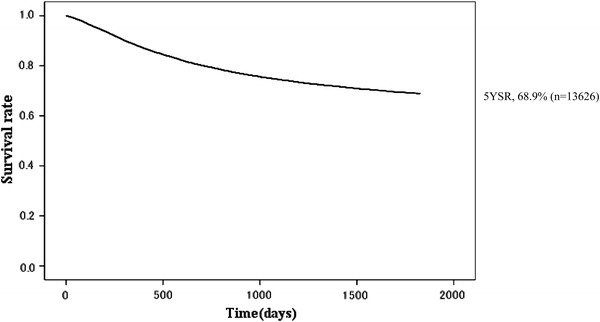
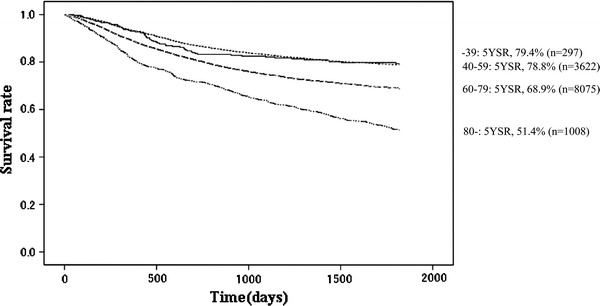
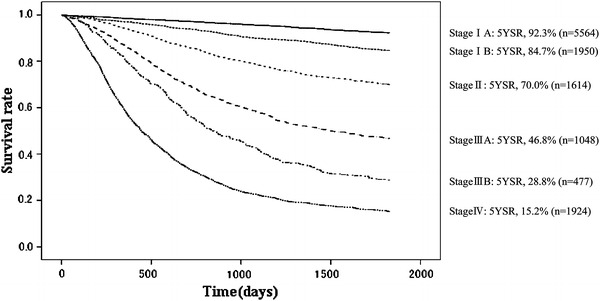
Results: The 5-year follow-up rate was 83.3 %. The direct death rate was 0.48 %. UICC 5-year survival rates (5YEARSs)/JGCA 5YEARSs were 92.2 %/92.3 % for stage IA, 85.3 %/84.7 % for stage IB, 72.1 %/70.0 % for stage II, 52.8 %/46.8 % for stage IIIA, 31.0 %/28.8 % for stage IIIB, and 14.9 %/15.3 % for stage IV, respectively. The proportion of patients more than 80 years old was 7.8 %, and their 5YEARS was 51.6 %. Postoperative outcome of the patients with primary gastric carcinoma in Japan have apparently improved in advanced cases and among the aged population when compared with the archival data. Further efforts to improve the follow-up rate are needed.
Conclusions: Postoperative outcome of the patients with primary gastric carcinoma in Japan have apparently improved in advanced cases and among the aged population when compared with the archival data. Further efforts to improve the follow-up rate are needed.
Figures










References
-
- Japanese Gastric Cancer Association . Gastric cancer treatment guidelines for doctor’s reference (in Japanese). Kanehara: Tokyo; 2001.
-
- Japanese Gastric Cancer Association. Introduction to JGCA gastric cancer treatment guidelines. www.jgca.jp/PDFfiles/E-guideline.PDF.
-
- Ferlay J, Bray F, Pisani P, Parkin DM. GLOBOCAN 2002: cancer incidence and mortality and prevalence worldwide. IARC Cancer Base No. 5, version 2.0. Lyon: IARC Press; 2004.
MeSH terms
LinkOut - more resources
Full Text Sources
Medical
