. 2012 Oct;22(10):1985-94.
doi: 10.1101/gr.138297.112. Epub 2012 Jun 25.

CRISPR targeting reveals a reservoir of common phages associated with the human gut microbiome

Affiliations

CRISPR targeting reveals a reservoir of common phages associated with the human gut microbiome

Adi Stern et al. Genome Res. 2012 Oct.

Abstract

The bacterial community in the human gut has crucial health roles both in metabolic functions and in protection against pathogens. Phages, which are known to significantly affect microbial community composition in many ecological niches, have the potential to impact the gut microbiota, yet thorough characterization of this relationship remains elusive. We have reconstructed the content of the CRISPR bacterial immune system in the human gut microbiomes of 124 European individuals and used it to identify a catalog of 991 phages targeted by CRISPR across all individuals. Our results show that 78% of these phages are shared among two or more individuals. Moreover, a significant fraction of phages found in our study are shown to exist in fecal samples previously derived from American and Japanese individuals, identifying a common reservoir of phages frequently associated with the human gut microbiome. We further inferred the bacterial hosts for more than 130 such phages, enabling a detailed analysis of phage-bacteria interactions across the 124 individuals by correlating patterns of phage abundance with bacterial abundance and resistance. A subset of phages demonstrated preferred association with host genomes as lysogenized prophages, with highly increased abundance in specific individuals. Overall, our results imply that phage-bacterial attack-resistance interactions occur within the human gut microbiome, possibly affecting microbiota composition and human health. Our finding of global sharing of gut phages is surprising in light of the extreme genetic diversity of phages found in other ecological niches.


Figures
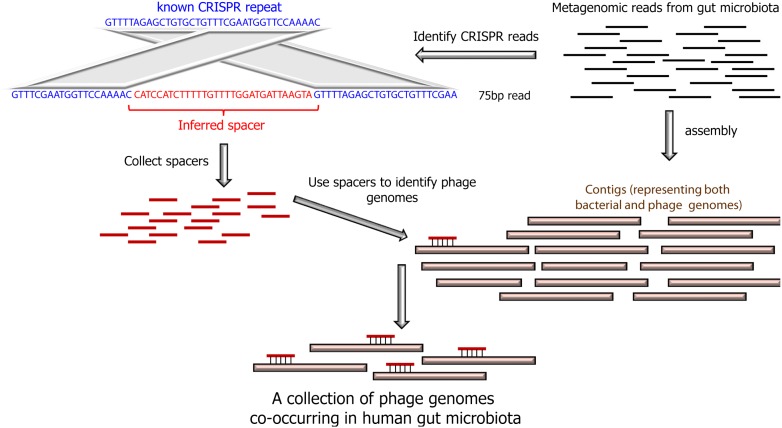
Figure 1.
Figure 1.
CRISPR spacers are used as probes to fish out phage genomes. In the MetaHIT metagenomics study (Qin et al. 2010), gut microbes were harvested from feces of 124 individuals, and DNA was sequenced to generate short reads (75 bp). These reads were then assembled into contigs, which mainly represent DNA of gut-residing bacteria, but potentially also contain DNA of phages associated with these bacteria. In the present study, CRISPR spacers were detected by searching for reads that match a known CRISPR repeat on both sides of the read. The spacers detected were then used to probe assembled contigs, and phage and mobile element contigs were identified as those showing high sequence identity with a spacer (but not with the CRISPR repeat).
Figure 2.
Figure 2.
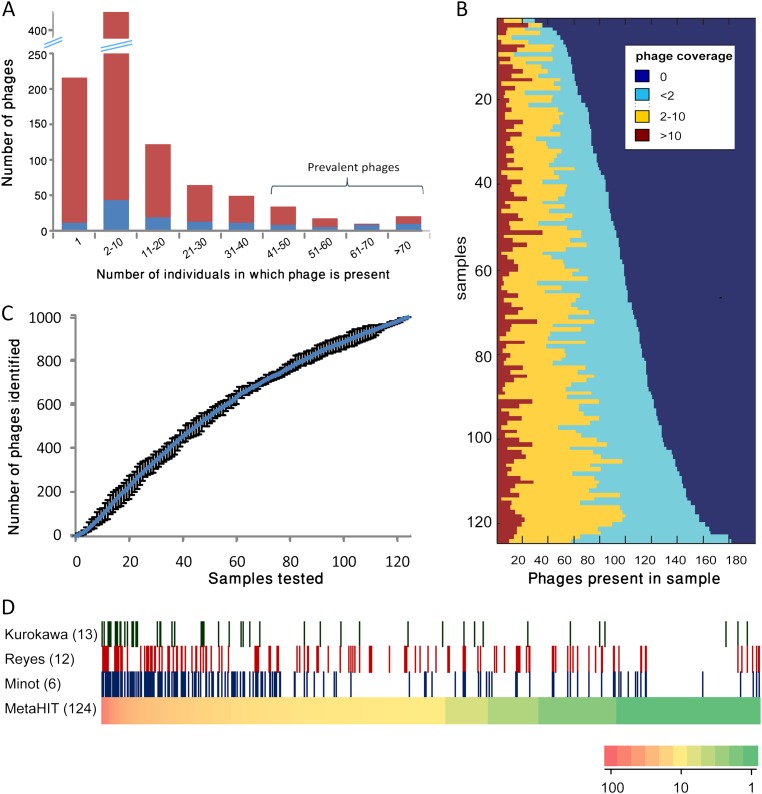
Phage distribution across individuals and populations. (A) Phage abundance profile. (X-axis) Range of the number of samples in which a phage was present; (y-axis) number of phages whose prevalence is in the range specified. A phage was deemed present if it was significantly covered by metagenomic reads in the sample (Methods). (Blue) Phages shown to integrate into bacterial genome in at least one of the 124 samples; (red) phages with no evidence for integration. (B) Virome profiles of individual samples. Phages are sorted separately in each sample (row) according to their abundance in that sample. (Brown) Highly abundant phages; (yellow) phages of intermediate abundance; (light blue) phages of low abundance. Coverage is measured in reads per kilobase per millions of reads (RPKM). (C) Discovery rate of new phages as a function of number of samples investigated. Samples were added one at a time and in each step spacers were identified. Phage contigs matching to the cumulative set of identified spacers were counted as detected. This analysis was repeated 10 times with random sample order; the charts depict the mean values obtained over the 10 iterations, and bars demarcate maximum and minimum values. (D) Evidence for presence of phages identified in this study (based on MetaHIT data) (Qin et al. 2010) in VLP data derived from American individuals (Reyes et al. 2010; Minot et al. 2011), and in gut metagenomic data derived from Japanese individuals (Kurokawa et al. 2007). (Bottom row) 991 phage contigs as bars sorted by prevalence in the MetaHIT population (heatmap). In each of the top three rows, a bar is colored if the phage is significantly covered by reads from the data set listed. The number of individuals in each data set is in parentheses.
Figure 3.
Figure 3.
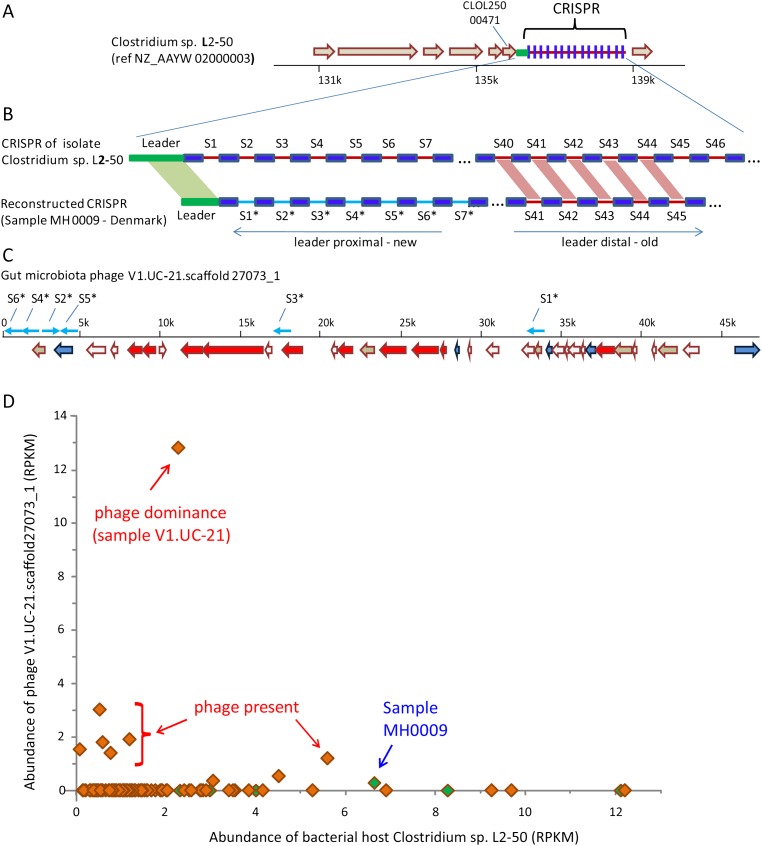
Phage/host infection and resistance interactions. (A) The CRISPR region in the isolate gut bacterium Clostridium sp. L2-50, which was sequenced as part of the Human Microbiome Project (HMP) (Turnbaugh et al. 2007). Shown is a 10-kb region from the draft assembled genome. (Block arrows) Annotated genes. (B) A CRISPR array reconstructed from metagenomic sequence reads of sample MH0009 partially matches the Clostridium sp. L2-50 array. (Dark blue boxes) CRISPR repeats; (red and cyan lines) spacers. Spacers are numbered according to their position in the array relative to the leader sequence. Spacers show identity in sequence and in order at the leader-distal region (“old” spacers), while leader-proximal spacers (newly acquired) differ between the arrays. (C) Contig V1.UC-21.scaffold27073_1 was identified as a phage in this study, because it is hit by multiple spacers. (Block arrows) Genes with colors denoting function; (red) phage-specific genes; (blue) DNA replication genes; (white) genes of unknown function; (brown) genes of other functions. (Cyan arrows) Positions where spacers from the reconstructed array in panel B show identity with the phage sequence (spacer hits not drawn to scale). All drawn spacers fully match or have one mismatch with the phage sequence. (D) Abundance of bacterial host versus phage in MetaHIT samples. X- and y-axes represent abundance of the bacterial host and phage, respectively, measured in RPKM. Each data point represents a European individual sampled as part of the MetaHIT gut microbiota project (Qin et al. 2010). Green-filled samples are those in which our analysis found a spacer that matched the phage sequence. Sample MH0009, in which the CRISPR array in panel B was reconstructed, is identified.
Figure 4.
Figure 4.
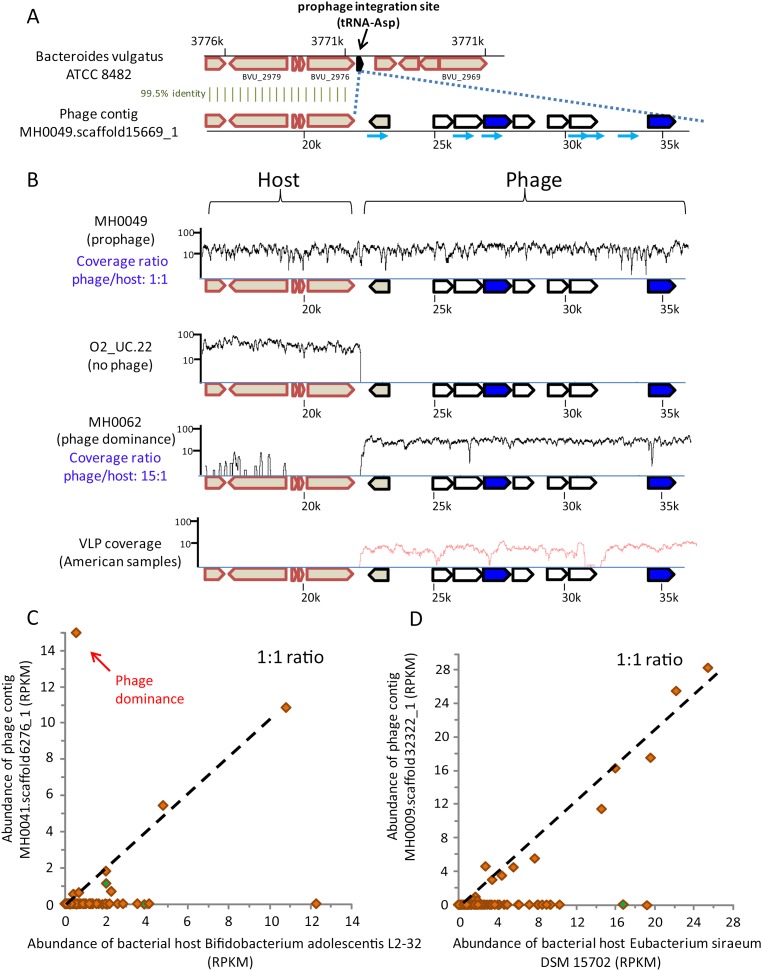
Lysogenic lifestyles of gut microbiota phages. (A) The 5′ end of phage contig MH0049.scaffold15669_1, which was assembled in sample MH0049 (Danish individual), has a 99.5% identity in the sequenced genome of Bacteroides vulgatus ATCC 8482. (Block arrows) Genes; (cyan-colored arrows) spacers matching the phage contig. (B) Coverage of phage contig MH0049.scaffold15669_1 by MetaHIT metagenomic reads from three samples. (X-axis) Position on phage contig; (y-axis) read coverage (log scale). (Red curve) Coverage of VLP reads from Reyes et al. (2010). (C,D) Abundance of phages MH0041.scaffold6276_1 and MH0009.scaffold32322_1 and their respective bacterial hosts in MetaHIT samples, indicative of lysogeny as a preferred lifestyle. The x- and y-axes represent abundance of host and phage, respectively. Each data point represents a European individual sampled as part of the MetaHIT gut microbiota project (Qin et al. 2010). Green-colored samples are the ones in which a spacer matched the phage sequence. “Phage dominance” indicates samples where the phage is suspected to have become active. The correlation coefficient of phage and host abundances for samples where both existed is 0.4 and 0.98, respectively.

References

    1. Andersson AF, Banfield JF 2008. Virus population dynamics and acquired virus resistance in natural microbial communities. Science 320: 1047–1050 - PubMed
    1. Arumugam M, Raes J, Pelletier E, Le Paslier D, Yamada T, Mende DR, Fernandes GR, Tap J, Bruls T, Batto JM, et al. 2011. Enterotypes of the human gut microbiome. Nature 473: 174–180 - PMC - PubMed
    1. Avrani S, Wurtzel O, Sharon I, Sorek R, Lindell D 2011. Genomic island variability facilitates Prochlorococcus-virus coexistence. Nature 474: 604–608 - PubMed
    1. Barrangou R, Fremaux C, Deveau H, Richards M, Boyaval P, Moineau S, Romero DA, Horvath P 2007. CRISPR provides acquired resistance against viruses in prokaryotes. Science 315: 1709–1712 - PubMed
    1. Breitbart M, Hewson I, Felts B, Mahaffy JM, Nulton J, Salamon P, Rohwer F 2003. Metagenomic analyses of an uncultured viral community from human feces. J Bacteriol 185: 6220–6223 - PMC - PubMed

Publication types

LinkOut - more resources