


doi: 10.1016/j.trsl.2012.05.005.
Epub 2012 Jun 22.
The world within: living with our microbial guests and guides
Affiliations
- PMID: 22732305
- PMCID: PMC6440546
- DOI: 10.1016/j.trsl.2012.05.005
Item in Clipboard
The world within: living with our microbial guests and guides
Transl Res.
2012 Oct.
No abstract available
Figures
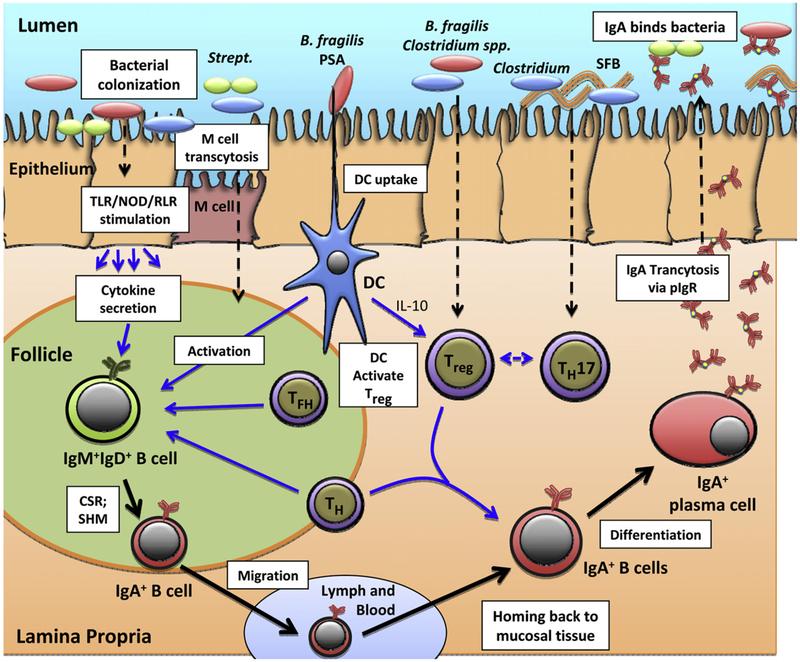
Specific colonizing bacteria elicit innate immune responses and development of T cells and IgA-producing cells in the intestine. (1) Bacteria colonize the lumen and interact with epithelial cells. Bacteria can be transported directly through the epithelium by Microfold cells. Binding and uptake of bacteria or their products by epithelial cells can activate innate receptors (toll-like receptor, NOD, retinoic acid-inducible gene-1–like receptors) and stimulate cytokine secretion from the basolateral surface. DCs extending through the epithelium can sample antigens, such as polysaccharide A of Bacteroides fragilis, and become activated. B. fragilis and Clostridium spp. can enhance differentiation of Treg and segmented filamentous bacteria in the development of T-helper 17 cells. (2) In the lymphoid follicle or germinal center, naïve IgD+IgM+B cells are activated by bacterial antigens. In association with epithelial-derived soluble factors, these cells are committed to undergo class switch recombination to IgA and somatic hypermutation under the influence of DCs, follicular helper CD4+ T cells (T follicular helper cells), and T-helper cells. These committed B cells then leave the follicle, transit through the lymph and blood, and return or “home” predominantly to the lamina propria effector sites from which they originated. With support from Treg and T-helper cells, the returning B cells in the lamina propria differentiate into IgA-producing plasma cells. (3) The polymeric IgA produced binds to polymeric IgA receptors on the basolateral surface of epithelial cells and is transported into the lumen to bind bacteria and their antigens to limit adherence to, activation of, and transport through epithelial cells. CSR, class switch recombination; DC, dendritic cell; Ig, immunoglobulin; M cell, Microfold cell; pIgR, polymeric immunoglobulin A receptor; PSA, polysaccharide A; RLR, retinoic acid-inducible gene-1–like receptor; SFB, segmented filamentous bacteria; SHM, somatic hypermutation; TFH, T follicular helper cells; TH, T-helper cells; TLR, toll-like receptor; Treg, T-regulatory cells.
References
-
- Dave M, Higgins PD, Middha S, Rioux KP. The human gut micro-biome: current knowledge, challenges and future directions. Transl Res 2012. [Epub ahead of print]. - PubMed
Publication types
MeSH terms
Substances
Grants and funding
LinkOut - more resources
Full Text Sources
