


Pulsed high intensity focused ultrasound increases penetration and therapeutic efficacy of monoclonal antibodies in murine xenograft tumors
- PMID: 22732476
- PMCID: PMC4219504
- DOI: 10.1016/j.jconrel.2012.06.025
Pulsed high intensity focused ultrasound increases penetration and therapeutic efficacy of monoclonal antibodies in murine xenograft tumors
Abstract
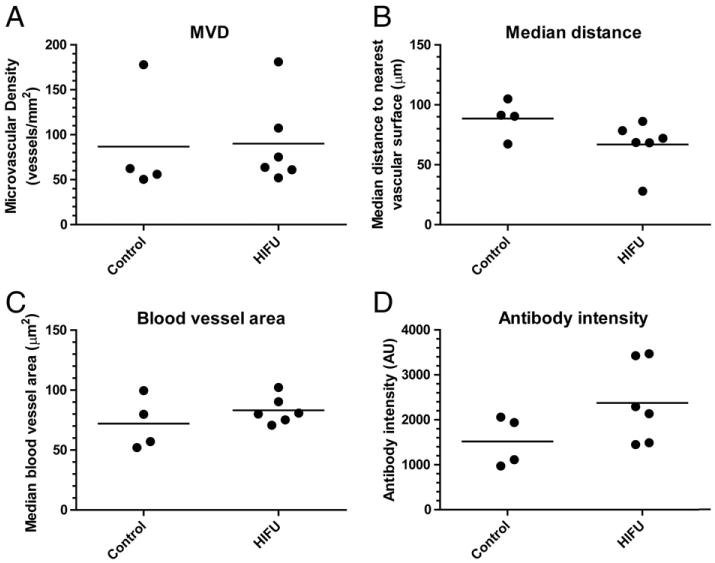
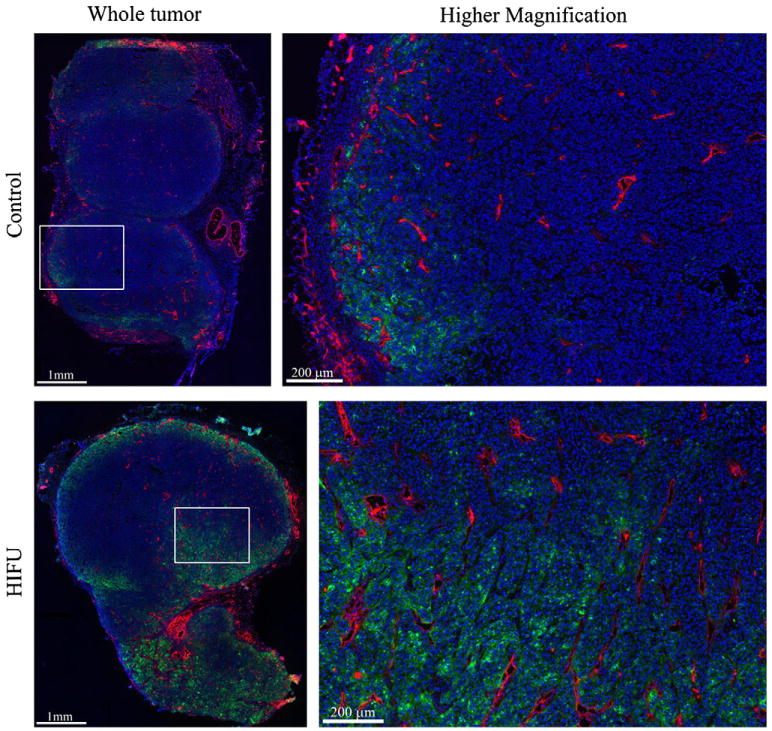
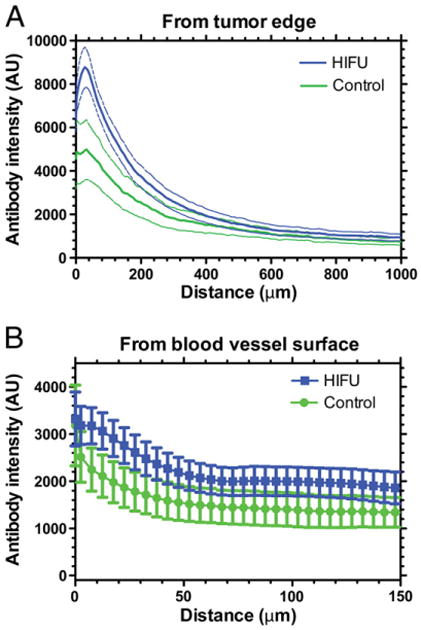
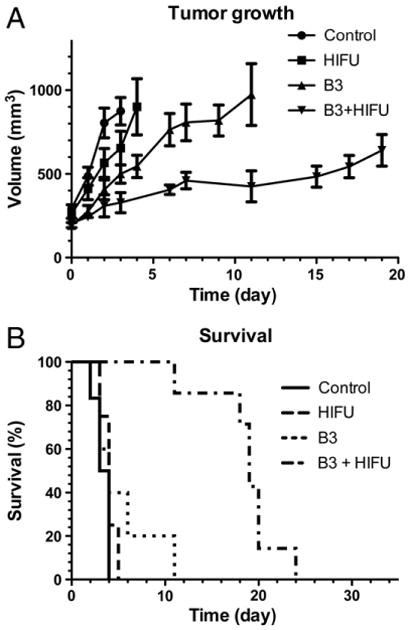
The success of radioimmunotherapy for solid tumors remains elusive due to poor biodistribution and insufficient tumor accumulation, in part, due to the unique tumor microenvironment resulting in heterogeneous tumor antibody distribution. Pulsed high intensity focused ultrasound (pulsed-HIFU) has previously been shown to increase the accumulation of (111)In labeled B3 antibody (recognizes Lewis(y) antigen). The objective of this study was to investigate the tumor penetration and therapeutic efficacy of pulsed-HIFU exposures combined with (90)Y labeled B3 mAb in an A431 solid tumor model. The ability of pulsed-HIFU (1 M Hz, spatial averaged temporal peak intensity=2685 W cm(-2); pulse repetition frequency=1 Hz; duty cycle=5%) to improve the tumor penetration and therapeutic efficacy of (90)Y labeled B3 mAb ((90)Y-B3) was evaluated in Le(y)-positive A431 tumors. Antibody penetration from the tumor surface and blood vessel surface was evaluated with fluorescently labeled B3, epi-fluorescent microscopy, and custom image analysis. Tumor size was monitored to determine treatment efficacy, indicated by survival, following various treatments with pulsed-HIFU and/or (90)Y-B3. The pulsed-HIFU exposures did not affect the vascular parameters including microvascular density, vascular size, and vascular architecture; although 1.6-fold more antibody was delivered to the solid tumors when combined with pulsed-HIFU. The distribution and penetration of the antibodies were significantly improved (p-value<0.05) when combined with pulsed-HIFU, only in the tumor periphery. Pretreatment with pulsed-HIFU significantly improved (p-value<0.05) survival over control treatments.
Published by Elsevier B.V.
Figures
References
-
- Allen TM. Ligand-targeted therapeutics in anticancer therapy. Nat Rev Cancer. 2002;2:750–763. - PubMed
-
- Koppe MJ, Postema EJ, Aarts F, Oyen WJ, Bleichrodt RP, Boerman OC. Antibody-guided radiation therapy of cancer. Cancer Metastasis Rev. 2005;24:539–567. - PubMed
-
- Yan L, Hsu K, Beckman RA. Antibody-based therapy for solid tumors. Cancer J. 2008;14:178–183. - PubMed
-
- Slamon DJ, Leyland-Jones B, Shak S, Fuchs H, Paton V, Bajamonde A, Fleming T, Eiermann W, Wolter J, Pegram M, Baselga J, Norton L. Use of chemotherapy plus a monoclonal antibody against HER2 for metastatic breast cancer that overexpresses HER2. N Engl J Med. 2001;344:783–792. - PubMed
-
- Jain M, Venkatraman G, Batra SK. Optimization of radioimmunotherapy of solid tumors: biological impediments and their modulation. Clin Cancer Res. 2007;13:1374–1382. - PubMed
Publication types
MeSH terms
Substances
Grants and funding
LinkOut - more resources
Full Text Sources
Other Literature Sources
