


Influence of race, ethnicity and socioeconomic status on kidney disease
- PMID: 22735764
- PMCID: PMC3950900
- DOI: 10.1038/nrneph.2012.117
Influence of race, ethnicity and socioeconomic status on kidney disease
Abstract
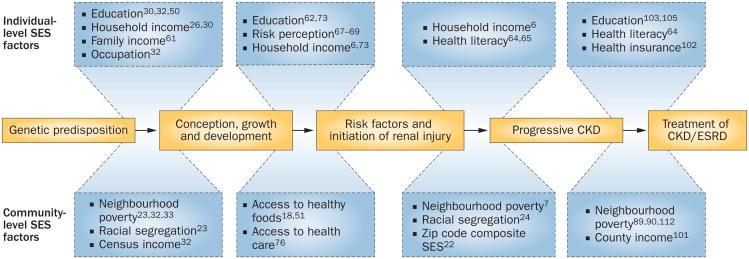
Low socioeconomic status (SES) influences disease incidence and contributes to poor health outcomes throughout an individual's life course across a wide range of populations. Low SES is associated with increased incidence of chronic kidney disease, progression to end-stage renal disease, inadequate dialysis treatment, reduced access to kidney transplantation, and poor health outcomes. Similarly, racial and ethnic disparities, which in the USA are strongly associated with lower SES, are independently associated with poor health outcomes. In this Review, we discuss individual-level and group-level SES factors, and the concomitant role of race and ethnicity that are associated with and mediate the development of chronic kidney disease, progression to end-stage renal disease and access to treatment.
Conflict of interest statement
Figures
References
-
- Grassmann A, Gioberge S, Moeller S, Brown G. ESRD patients in 2004: global overview of patient numbers, treatment modalities and associated trends. Nephrol Dial Transplant. 2005;20:2587–2593. - PubMed
-
- US Renal Data System. US Renal Data System 2010 Annual Data Report: Atlas of Chronic Kidney Disease and End-Stage Renal Disease in the United States [online] 2010 http://www.usrds.org/atlas10.aspx.
-
- Coresh J, et al. Prevalence of chronic kidney disease in the United States. JAMA. 2007;298:2038–2047. - PubMed
-
- US Department of Health and Human Services. National Healthcare Quality Report [online] 2010 http://www.ahrq.gov/qual/nhqr10/nhqr10.pdf.
Publication types
MeSH terms
Grants and funding
LinkOut - more resources
Full Text Sources
Medical
