


Incidence, treatment and survival of patients with craniopharyngioma in the surveillance, epidemiology and end results program
- PMID: 22735773
- PMCID: PMC3408265
- DOI: 10.1093/neuonc/nos142
Incidence, treatment and survival of patients with craniopharyngioma in the surveillance, epidemiology and end results program
Abstract
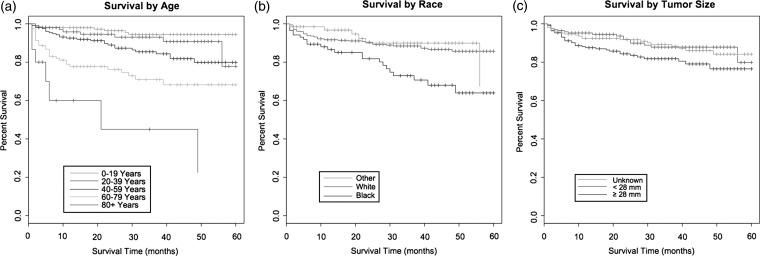
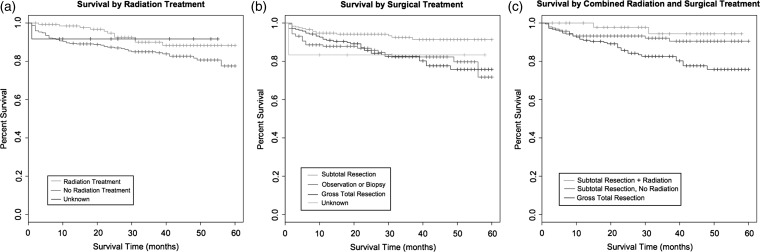
Craniopharyngioma is a rare primary central nervous system neoplasm. Our objective was to determine factors associated with incidence, treatment, and survival of craniopharyngiomas in the United States. We used the surveillance, epidemiology and end results program (SEER) database to identify patients who received a diagnosis of craniopharyngioma during 2004-2008. We analyzed clinical and demographic information, including age, race, sex, tumor histology, and treatment. Age-adjusted incidence rates and age, sex, and race-adjusted expected survival rates were calculated. We used Cox proportional hazards models to determine the association between covariates and overall survival. We identified 644 patients with a diagnosis of craniopharyngioma. Black race was associated with an age-adjusted relative risk for craniopharyngioma of 1.26 (95% confidence interval [CI], 0.98-1.59), compared with white race. One- and 3-year survival rates of 91.5% (95% CI, 88.9%-93.5%), and 86.2% (95% CI, 82.7%-89.0%) were observed for the cohort; relative survival rates were 92.1% (95% CI, 89.5%-94.0%) and 87.6% (95% CI, 84.1%-90.4%) for 1- and 3-years, respectively. In the multivariable model, factors associated with prolonged survival included younger age, smaller tumor size, subtotal resection, and radiation therapy. Black race, on the other hand, was associated with worse overall survival in the final model. We demonstrated that >85% of patients survived 3 years after diagnosis and that subtotal resection and radiation therapy were associated with prolonged survival. We also noted a higher incidence rate and worse 1- and 3-year survival rates in the black population. Future investigations should examine these racial disparities and focus on evaluating the efficacy of emerging treatment paradigms.
Figures
References
-
- Hoffman HJ. Surgical management of craniopharyngioma. Pediatr Neurosurg. 1994;21(Suppl 1):44–49. - PubMed
-
- States, C. B. T. R. O. T. U. 2011. CBTRUS Statistical Report. 2011
-
- Komotar RJ, Roguski M, Bruce JN. Surgical management of craniopharyngiomas. J Neurooncol. 2009;92:283–296. - PubMed
-
- Tuniz F, Soltys SG, Choi CY, et al. Multisession cyberknife stereotactic radiosurgery of large, benign cranial base tumors: preliminary study. Neurosurgery. 2009;65:898–907. discussion 907. - PubMed
-
- Chakrabarti I, Amar AP, Couldwell W, Weiss MH. Long-term neurological, visual, and endocrine outcomes following transnasal resection of craniopharyngioma. J Neurosurg. 2005;102:650–657. - PubMed
MeSH terms
LinkOut - more resources
Full Text Sources
Other Literature Sources
Medical
