


The risk of hepatocellular carcinoma among individuals with acquired immunodeficiency syndrome in the United States
- PMID: 22736272
- PMCID: PMC3965349
- DOI: 10.1002/cncr.27694
The risk of hepatocellular carcinoma among individuals with acquired immunodeficiency syndrome in the United States
Abstract
Background: Hepatocellular carcinoma (HCC) is a concern among individuals with human immunodeficiency virus (HIV) infection and acquired immunodeficiency syndrome (AIDS).
Methods: The authors analyzed population-based registry linkage data from the US HIV/AIDS Cancer Match Study (1980-2009) to examine the risk and trends of HCC among individuals with AIDS. Standardized incidence ratios (SIRs) were used to measure HCC risk relative to the general population, and Poisson regression was used to calculate incidence rate ratios (RR) comparing incidence among individuals with AIDS. People with AIDS were categorized according to their HIV risk group into high and low hepatitis C virus (HCV) prevalence groups based on their HIV transmission risk category.
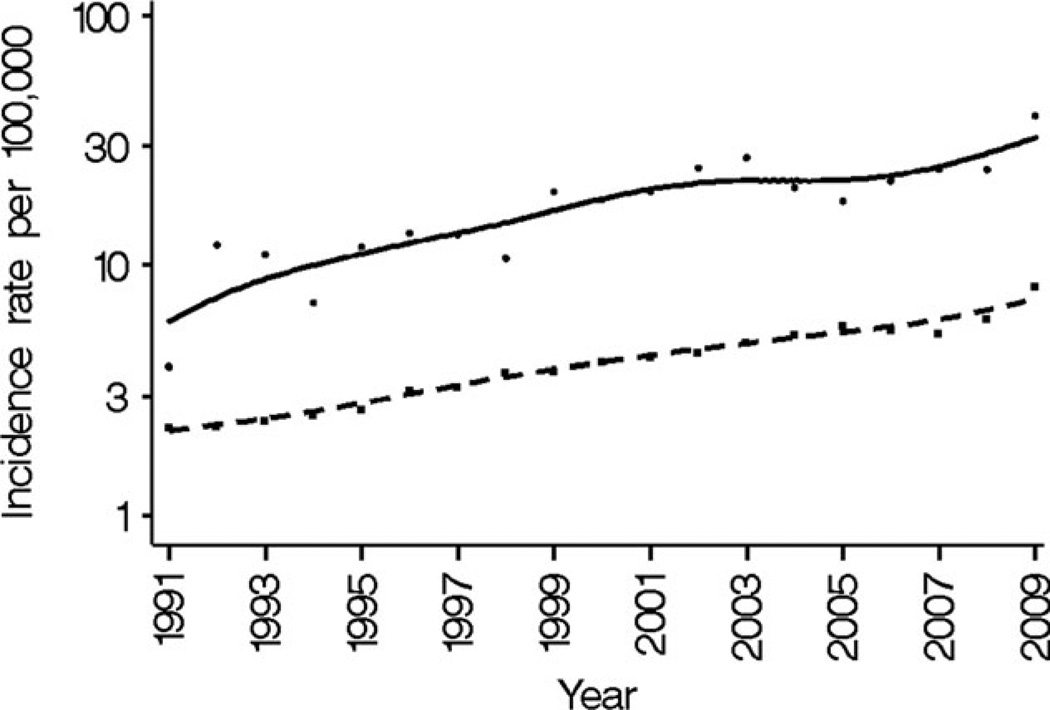
Results: Among 615,150 individuals with AIDS, HCC risk was elevated almost 4 times compared with the risk in the general population (N = 366; SIR, 3.8; 95% confidence interval, 3.5-4.3). Although HCC incidence increased steadily across calendar periods (P(trend) < .0001; adjusted for sex and age), the excess risk in individuals with AIDS compared with the general population remained somewhat constant (SIRs range, 3.5-3.9) between the monotherapy/dual therapy era (1990-1995) and the recent highly active antiretroviral therapy era (2001-2009). In a multivariate model adjusting for sex, race/ethnicity, and attained calendar period, HCC incidence increased with advancing age (P(trend) < .0001) and was associated with HIV risk groups with a known higher prevalence of HCV (adjusted RR, 2.2; 95% confidence interval, 1.8-2.8).
Conclusions: HCC incidence in individuals with AIDS has increased over time despite improved HIV treatment regimens, likely reflecting prolonged survival with chronic liver disease. The high incidence in older adults suggests that this cancer will increase in importance with aging of the HIV-infected population.
Published 2012 American Cancer Society.
Conflict of interest statement
CONFLICT OF INTEREST DISCLOSURES
The authors made no disclosures.
Figures
References
-
- Engels EA, Frisch M, Lubin JH, Gail MH, Biggar RJ, Goedert JJ. Prevalence of hepatitis C virus infection and risk for hepatocellular carcinoma and non-Hodgkin lymphoma in AIDS. J Acquir Immune Defic Syndr. 2002;31:536–541. - PubMed
-
- Puoti M, Rossotti R, Garlaschelli A, Bruno R. Hepatocellular carcinoma in HIV hepatitis C virus. Curr Opin HIV AIDS. 2011;6:534–538. - PubMed
-
- Lopez-Dieguez M, Montes ML, Pascual-Pareja JF, et al. The natural history of liver cirrhosis in HIV-hepatitis C virus-coinfected patients. AIDS. 2011;25:899–904. - PubMed
Publication types
MeSH terms
Grants and funding
LinkOut - more resources
Full Text Sources
Medical
