


Breast cancer resistance protein (ABCG2) determines distribution of genistein phase II metabolites: reevaluation of the roles of ABCG2 in the disposition of genistein
- PMID: 22736306
- PMCID: PMC3463821
- DOI: 10.1124/dmd.111.043901
Breast cancer resistance protein (ABCG2) determines distribution of genistein phase II metabolites: reevaluation of the roles of ABCG2 in the disposition of genistein
Abstract
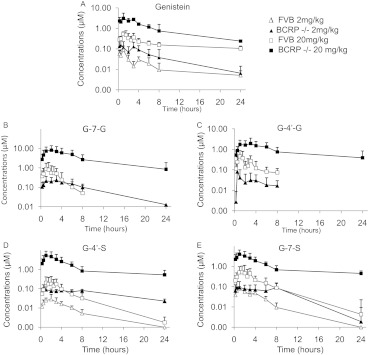
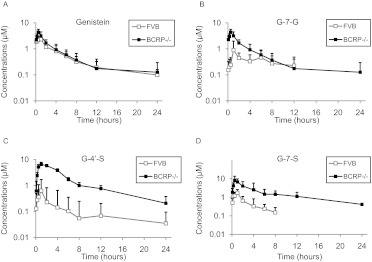
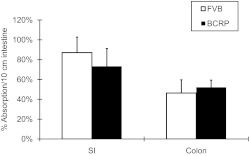
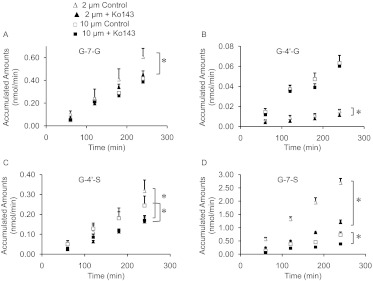
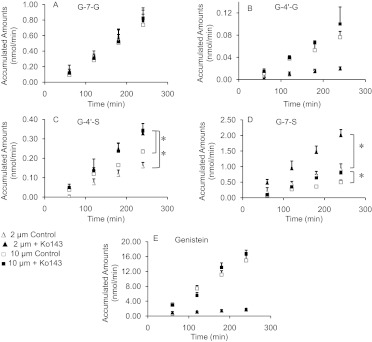
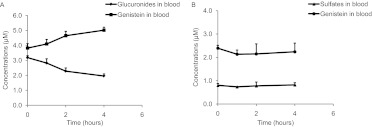
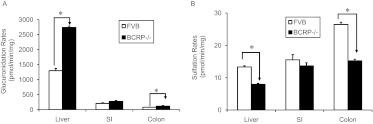
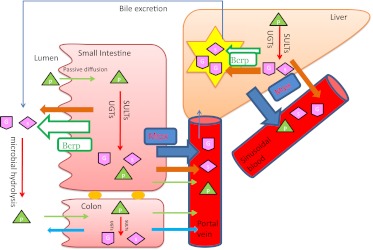
It was recently proposed that the improved oral bioavailability of genistein aglycone and conjugates in Bcrp1(-/-) mice is mainly due to increased intestinal absorption of aglycone and subsequent elevated exposure to conjugation enzymes. Here we tested this proposed mechanism and found that intestinal absorption of genistein aglycone did not increase in Bcrp1(-/-) mice compared with wild-type mice using an in situ mouse intestinal perfusion model and that inhibition of breast cancer resistance protein (BCRP) in Caco-2 cells also did not significantly increase permeability or intracellular concentration of aglycone. Separately, we showed that 5- to 10-fold increases in exposures of conjugates and somewhat lower fold increases (<2-fold) in exposures of aglycone were apparent after both oral and intraperitoneal administration in Bcrp1(-/-) mice. In contrast, the intestinal and biliary excretion of genistein conjugates significantly decreased in Bcrp1(-/-) mice without corresponding changes in aglycone excretion. Likewise, inhibition of BCRP functions in Caco-2 cells altered polarized excretion of genistein conjugates by increasing their basolateral excretion. We further found that genistein glucuronides could be hydrolyzed back to genistein, whereas sulfates were stable in blood. Because genistein glucuronidation rates were 110% (liver) and 50% (colon) higher and genistein sulfation rates were 40% (liver) and 42% (colon) lower in Bcrp1(-/-) mice, the changes in genistein exposures are not mainly due to changes in enzyme activities. In conclusion, improved bioavailability of genistein and increased plasma area under the curve of its conjugates in Bcrp1(-/-) mice is due to altered distribution of genistein conjugates to the systemic circulation.
Figures
Comment in
-
Reevaluation of the roles of ABCG2 in the disposition of genistein.Drug Metab Dispos. 2012 Nov;40(11):2219; author reply 2219-20. doi: 10.1124/dmd.112.048140. Drug Metab Dispos. 2012. PMID: 23077210 Free PMC article. No abstract available.
Similar articles
-
Bioavailability of the glucuronide and sulfate conjugates of genistein and daidzein in breast cancer resistance protein 1 knockout mice.Drug Metab Dispos. 2011 Nov;39(11):2008-12. doi: 10.1124/dmd.111.040881. Epub 2011 Aug 9. Drug Metab Dispos. 2011. PMID: 21828252
-
Breast Cancer Resistance Protein and Multidrug Resistance Protein 2 Determine the Disposition of Esculetin-7-O-Glucuronide and 4-Methylesculetin-7-O-Glucuronide.Drug Metab Dispos. 2019 Mar;47(3):203-214. doi: 10.1124/dmd.118.083493. Epub 2019 Jan 2. Drug Metab Dispos. 2019. PMID: 30602435
-
Breast cancer resistance protein (BCRP) and sulfotransferases contribute significantly to the disposition of genistein in mouse intestine.AAPS J. 2010 Dec;12(4):525-36. doi: 10.1208/s12248-010-9209-x. Epub 2010 Jun 26. AAPS J. 2010. PMID: 20582579 Free PMC article.
-
P-glycoprotein and breast cancer resistance protein affect disposition of tandutinib, a tyrosine kinase inhibitor.Drug Metab Lett. 2010 Dec;4(4):201-12. doi: 10.2174/187231210792928279. Drug Metab Lett. 2010. PMID: 20670210
-
Dietary substances and their glucuronides: structures, occurrence and biological activity.Nat Prod Rep. 2025 Jun 4. doi: 10.1039/d5np00002e. Online ahead of print. Nat Prod Rep. 2025. PMID: 40464213 Review.
Cited by
-
Glyceollin transport, metabolism, and effects on p-glycoprotein function in Caco-2 cells.J Med Food. 2014 Apr;17(4):462-71. doi: 10.1089/jmf.2013.0115. Epub 2014 Jan 29. J Med Food. 2014. PMID: 24476214 Free PMC article.
-
Revolving door action of breast cancer resistance protein (BCRP) facilitates or controls the efflux of flavone glucuronides from UGT1A9-overexpressing HeLa cells.Mol Pharm. 2013 May 6;10(5):1736-50. doi: 10.1021/mp300562q. Epub 2013 Apr 23. Mol Pharm. 2013. PMID: 23402418 Free PMC article.
-
Dietary Phytoestrogens and Their Metabolites as Epigenetic Modulators with Impact on Human Health.Antioxidants (Basel). 2021 Nov 26;10(12):1893. doi: 10.3390/antiox10121893. Antioxidants (Basel). 2021. PMID: 34942997 Free PMC article. Review.
-
Glyceollin Effects on MRP2 and BCRP in Caco-2 Cells, and Implications for Metabolic and Transport Interactions.J Pharm Sci. 2016 Feb;105(2):972-981. doi: 10.1002/jps.24605. Epub 2016 Jan 11. J Pharm Sci. 2016. PMID: 26296158 Free PMC article.
-
In utero exposure to di-(2-ethylhexyl) phthalate induces testicular effects in neonatal rats that are antagonized by genistein cotreatment.Biol Reprod. 2015 Oct;93(4):92. doi: 10.1095/biolreprod.115.129098. Epub 2015 Aug 26. Biol Reprod. 2015. PMID: 26316063 Free PMC article.
References
-
- Adachi Y, Suzuki H, Schinkel AH, Sugiyama Y. (2005) Role of breast cancer resistance protein (Bcrp1/Abcg2) in the extrusion of glucuronide and sulfate conjugates from enterocytes to intestinal lumen. Mol Pharmacol 67:923–928 - PubMed
-
- Álvarez AI, Vallejo F, Barrera B, Merino G, Prieto JG, Tomás-Barberán F, Espín JC. (2011) Bioavailability of the glucuronide and sulfate conjugates of genistein and daidzein in breast cancer resistance protein 1 knockout mice. Drug Metab Dispos 39:2008–2012 - PubMed
-
- Chen J, Lin H, Hu M. (2003) Metabolism of flavonoids via enteric recycling: role of intestinal disposition. J Pharmacol Exp Ther 304:1228–1235 - PubMed
-
- Chen J, Lin H, Hu M. (2005a) Absorption and metabolism of genistein and its five isoflavone analogs in the human intestinal Caco-2 model. Cancer Chemother Pharmacol 55:159–169 - PubMed
Publication types
MeSH terms
Substances
Grants and funding
LinkOut - more resources
Full Text Sources
