Lipid peroxidation in brain tissue following administration of low and high doses of arsenite and L-ascorbate in wistar strain rats
- PMID: 22736903
- PMCID: PMC3339245
- DOI: 10.4103/0971-6580.94516
Lipid peroxidation in brain tissue following administration of low and high doses of arsenite and L-ascorbate in wistar strain rats
Abstract
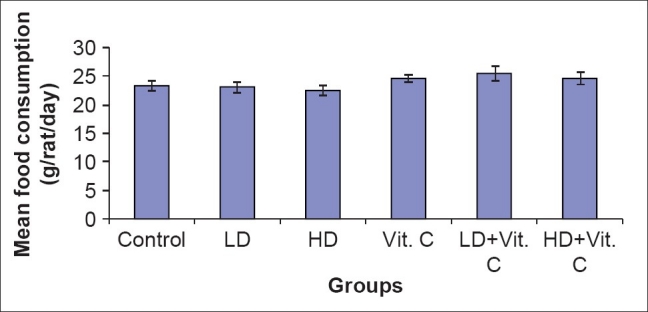
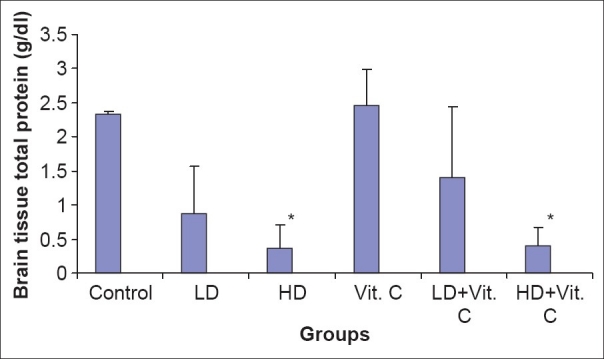
This study aimed at investigating the mechanism by which sodium arsenite induces brain injury and the role of L-ascorbate. Thirty adult (n=5) Wistar rats weighing between 140 and 160 g were used. Group 1 neither received sodium arsenite nor L-ascorbate (control), group 2 was administered low dose of arsenite only, group 3 received high dose of arsenite only, group 4 was administered L-ascorbate only, group 5 was administered low dose of arsenite and L-ascorbate, and group 6 received high dose of arsenite and L-ascorbate. M0 alon dialdehyde, MDA, levels were significantly increased in rats treated with high dose of arsenite when compared with those treated with low dose of arsenite. However, all treated groups except those treated with L-ascorbate only showed significant increase in MDA levels when compared with the control group. Rats treated with high dose of arsenite and L-ascorbate showed a significantly higher MDA level than those treated with low dose of arsenite and L-ascorbate. However, catalase activity, body weight gain, brain weight and mean food consumption were comparable across all groups. Brain tissue total protein was similar in all groups except in both groups treated with high dose of arsenite, where they were significantly reduced when compared with the control group. I0 n conclusion, sodium arsenite treatment induces brain injury via a mechanism associated with lipid peroxidation, but not catalase-dependent. However, L-ascorbate ameliorates arsenite-induced oxidative injury in the brain. L-ascorbate antioxidative potential in alleviating arsenite-induced brain injury is dependent on the concentration of arsenite.
Keywords: Arsenite; L-ascorbate; brain; lipid peroxidation; weight.
Conflict of interest statement
Figures
References
-
- Waalkes MP, Ward JM, Liu J, Diwan BA. Transplacental carcniongenility of inorganic arsenic in the drinking water: Induction of hepatic ovarian, pulmonary and adrenal tumors in mice. Toxicol Appl Pharmacol. 2003;186:7–17. - PubMed
-
- Borzsonyl A, Bereczky A, Rudnai P, Csanady M, Horvath A. Epidemiological studies on human subjects exposed to arsenic in drinking water in southern Hungary. Arch Toxicol. 1992;66:77–8. - PubMed
-
- Chatterjee A, Das D, Chatterjee D. The study of ground water contamination by arsenic in the residential area of Behala, Calcutta, due to industrial pollution. Environ Pollut. 1993;80:52–65. - PubMed
-
- Nickson R, McArthur J, Burges W, Ahmed KM, Ravenser P, Rahman M. Arsenic poisoning of Bangladesh ground water. Nature. 1998;395:338. - PubMed
LinkOut - more resources
Full Text Sources