. 2012;12(3):2742-65.
doi: 10.3390/s120302742. Epub 2012 Feb 29.

Metamaterials application in sensing

Affiliations

Metamaterials application in sensing

Tao Chen et al. Sensors (Basel). 2012.

Abstract

Metamaterials are artificial media structured on a size scale smaller than wavelength of external stimuli, and they can exhibit a strong localization and enhancement of fields, which may provide novel tools to significantly enhance the sensitivity and resolution of sensors, and open new degrees of freedom in sensing design aspect. This paper mainly presents the recent progress concerning metamaterials-based sensing, and detailedly reviews the principle, detecting process and sensitivity of three distinct types of sensors based on metamaterials, as well as their challenges and prospects. Moreover, the design guidelines for each sensor and its performance are compared and summarized.

Keywords: biosensor; metamaterial; sensing; strain sensor; thin-film sensor.


Figures
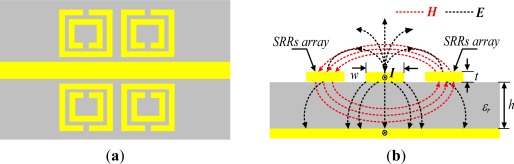
Figure 1.
Figure 1.
The structure of biosensing based on SRR array: (a) Top view of a microstrip transmission line and (b) Cross section of a microstrip transmission line with a pair SRRs and a schematic electromagnetic field distribution.
Figure 2.
Figure 2.
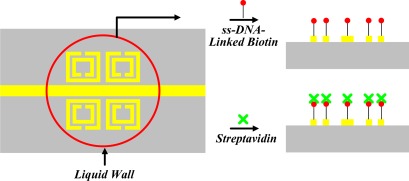
Binding bioprocess of biotin and streptavidin: the liquid wall (red circle) shows the receptacle for liquid solution confinement. The sample was immersed in biotin (red) for 12 h, rinsed, and exposed to streptavidin (green) for 6 h.
Figure 3.
Figure 3.
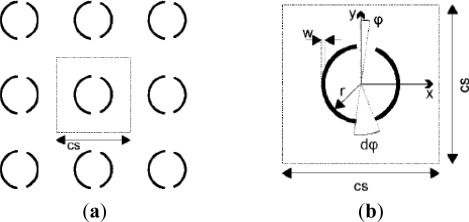
(a) Schematic section of aDSR based FSS adopting a square lattice and (b) Unit cell with radius r = 50 μm, width w = 5 μm, cell size cs = 220 μm, asymmetry angle φ = 4°, and gap angle dφ = 20° [48].
Figure 4.
Figure 4.
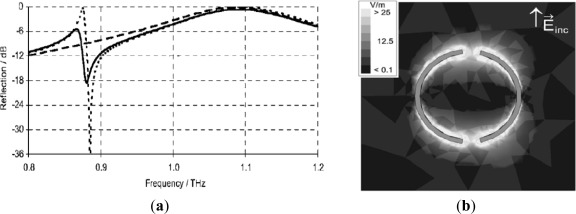
(a) Reflection of FSS of symmetric (dashed line) and asymmetric DSRs with φ = 4° for a perfect conductor (dotted line) and for gold (solid line); (b) The E-field in the resonator plane shows a strong concentration (white) at the ends of the arcs. f = 875 GHz, amplitude of excitation 1 V/m [48].
Figure 5.
Figure 5.
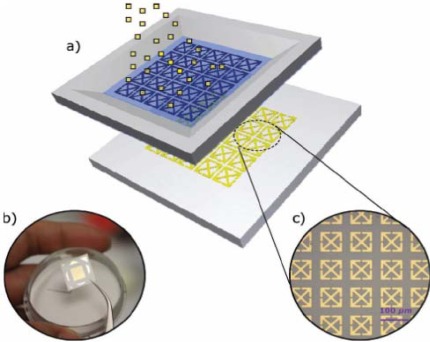
(a) Schematic of the micrometer-sized metamaterial resonators sprayed on paper substrates with a predefined microstencil; (b) Photograph of a paper-based terahertz metamaterial sample; (c) Optical microscopy image of one portion of an as-fabricated paper metamaterial sample [49].
Figure 6.
Figure 6.
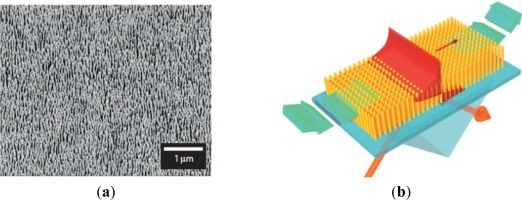
(a) Typical scanning electron micrograph of plasmonic nanorod metamaterial and (b) Schematic of the attenuated total internal reflection (ATR) measurements and flow cell [55].
Figure 7.
Figure 7.
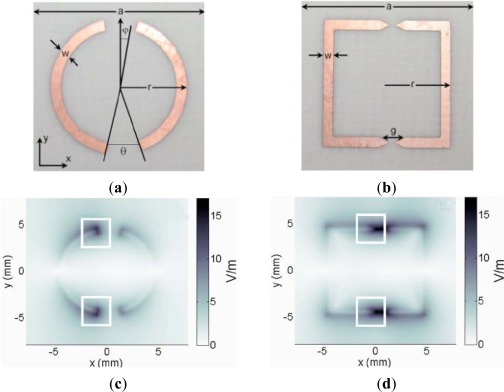
Layout of (a) the circular aDSR and (b) the rectangular aDSR with field confining tips, spatial field distribution in case of an excited field strength of 1 V/m for (c) the circular aDSR and (d) the rectangular aDSR with field confining tips [64].
Figure 8.
Figure 8.
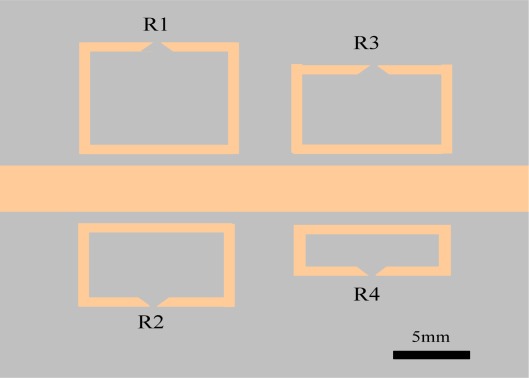
Diagram of four-channel sensor containing four SRR’s structure.
Figure 9.
Figure 9.
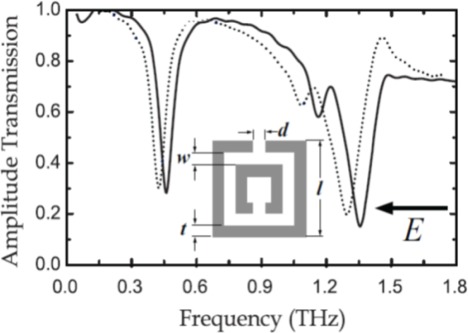
Frequency-dependent amplitude transmission of a double SRR metamaterial without (solid curves) and with (dotted curves) photoresist overlayers of 16 μm thickness [81].
Figure 10.
Figure 10.
(a) The designed SRR unit cell; (b) SEM images of fabricated planar SRRs; (c) Schematic reflectance measurement upon the SRR-based plasmonic sensor. Here no optical coupler is required to excite plasmonic resonance. The details of the measured geometric parameters of five samples can be found in supporting information [83].
Figure 11.
Figure 11.
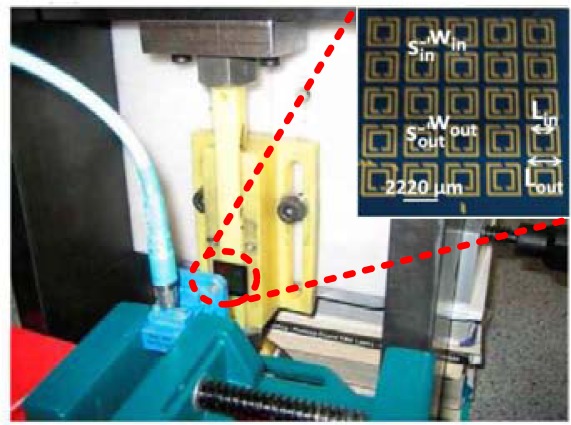
Fabricated 5 × 5 SRR array-based strain sensor under test in the compression apparatus [92].
Figure 12.
Figure 12.
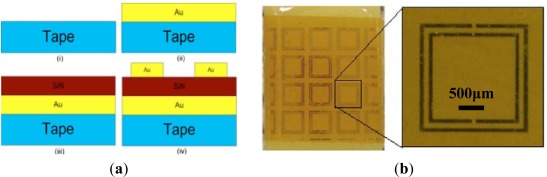
(a) Fabrication procedure of the tape-based flexible sensor and (b) The final fabricated structure of the tape-based flexible sensor [94].

References

    1. Veselago V.G. The electrodynamics of substance with simultaneously negative values of ε and μ. Sov. Phys. Usp. 1968;10:509–514.
    1. Pendry J.B., Holden A.J., Robbins D.J., Stewart W.J. Magnetism from conductors and enhanced nonlinear phenomena. IEEE Trans. Microw. Theory Tech. 1999;47:2075–2084.
    1. Shelby R.A., Smith D.R., Schultz S. Experimental verification of a negative index of refraction. Science. 2001;292:77–79. - PubMed
    1. Pendry J.B. Negative refraction makes a perfect lens. Phys. Rev. Lett. 2000;85:3966–3969. - PubMed
    1. Jacob Z., Alekseyev L.V., Narimanov E. Optical hyperlens: Far-field imaging beyond the diffraction limit. Opt. Express. 2006;14:8247–8256. - PubMed

Publication types