


Illuminating the dark matter of social neuroscience: Considering the problem of social interaction from philosophical, psychological, and neuroscientific perspectives
- PMID: 22737120
- PMCID: PMC3380416
- DOI: 10.3389/fnhum.2012.00190
Illuminating the dark matter of social neuroscience: Considering the problem of social interaction from philosophical, psychological, and neuroscientific perspectives
Abstract
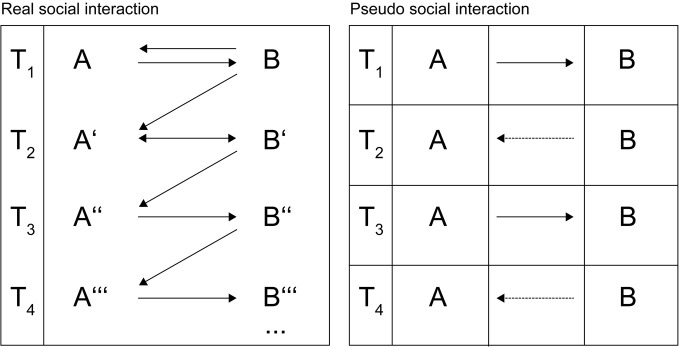
Successful human social interaction depends on our capacity to understand other people's mental states and to anticipate how they will react to our actions. Despite its importance to the human condition, the exact mechanisms underlying our ability to understand another's actions, feelings, and thoughts are still a matter of conjecture. Here, we consider this problem from philosophical, psychological, and neuroscientific perspectives. In a critical review, we demonstrate that attempts to draw parallels across these complementary disciplines is premature: The second-person perspective does not map directly to Interaction or Simulation theories, online social cognition, or shared neural network accounts underlying action observation or empathy. Nor does the third-person perspective map onto Theory-Theory (TT), offline social cognition, or the neural networks that support Theory of Mind (ToM). Moreover, we argue that important qualities of social interaction emerge through the reciprocal interplay of two independent agents whose unpredictable behavior requires that models of their partner's internal state be continually updated. This analysis draws attention to the need for paradigms in social neuroscience that allow two individuals to interact in a spontaneous and natural manner and to adapt their behavior and cognitions in a response contingent fashion due to the inherent unpredictability in another person's behavior. Even if such paradigms were implemented, it is possible that the specific neural correlates supporting such reciprocal interaction would not reflect computation unique to social interaction but rather the use of basic cognitive and emotional processes combined in a unique manner. Finally, we argue that given the crucial role of social interaction in human evolution, ontogeny, and every-day social life, a more theoretically and methodologically nuanced approach to the study of real social interaction will nevertheless help the field of social cognition to evolve.
Keywords: mentalizing; online/offline social cognition; second-person perspective; simulation; social interaction; social neuroscience; stimulus independent thoughts; theory-theory.
References
-
- Asch S. E. (1951). “Effects of group pressure upon the modification and distortion of judgements,” in Groups, Leadership, and Men, ed Guetzkow H. (Pittsburgh, PA: Carnegie Press; ), 177–190
LinkOut - more resources
Full Text Sources
Other Literature Sources
