


Indications for corneal transplantation at a tertiary referral center in tehran
- PMID: 22737335
- PMCID: PMC3380679
Indications for corneal transplantation at a tertiary referral center in tehran
Abstract
Purpose: To report the indications and techniques of corneal transplantation at a tertiary referral center in Tehran over a 3-year period.
Methods: Records of patients who had undergone any kind of corneal transplantation at Labbafinejad Medical Center, Tehran, Iran from March 2004 to March 2007 were reviewed to determine the indications and types of corneal transplantation.
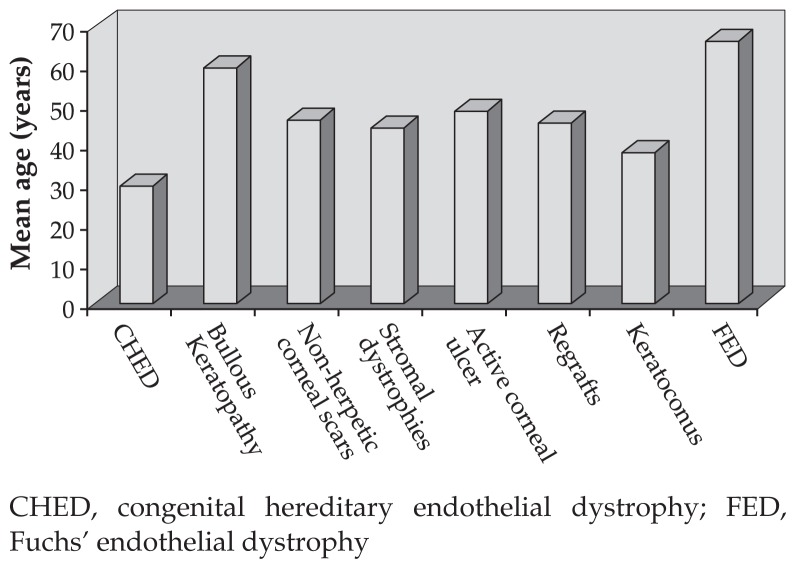
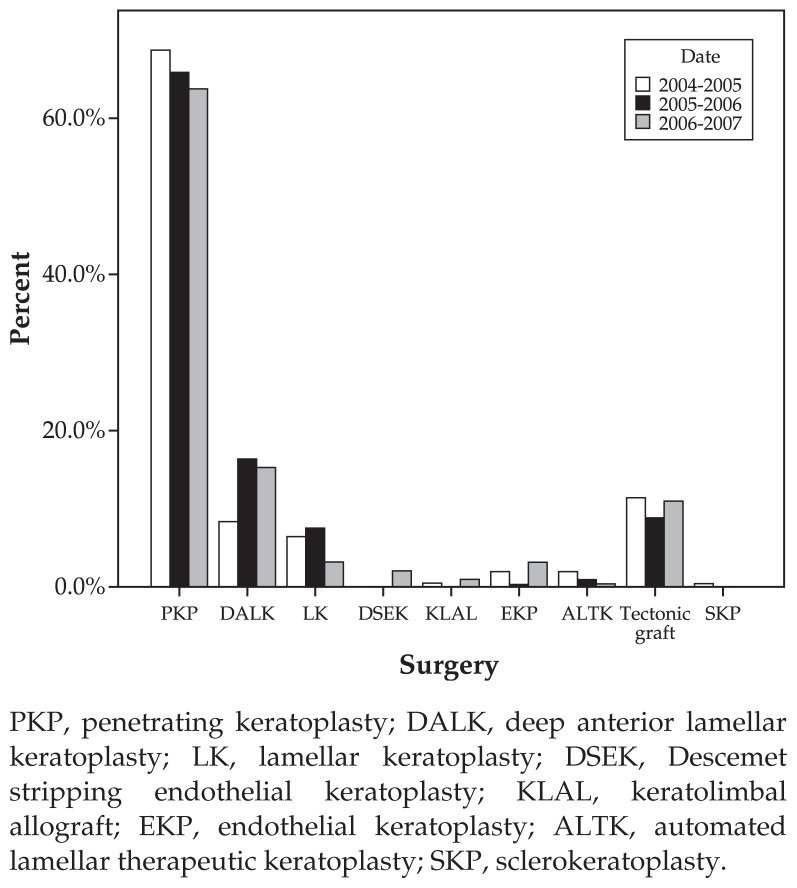
Results: During this period, 776 eyes of 756 patients (including 504 male subjects) with mean age of 41.3±21.3 years underwent corneal transplantation. The most common indication was keratoconus (n=317, 40.8%) followed by bullous keratopathy (n=90, 11.6%), non-herpetic corneal scars (n=62, 8.0%), infectious corneal ulcers (n=61, 7.9%), previously failed grafts (n=61, 7.9%), endothelial and stromal corneal dystrophies (n=28, 3.6%), and trachoma keratopathy (n=26, 3.3%). Other indications including Terrien's marginal degeneration, post-LASIK keratectasia, trauma, chemical burns, and peripheral ulcerative keratitis constituted the rest of cases. Techniques of corneal transplantation included penetrating keratoplasty (n=607, 78.2%), deep anterior lamellar keratoplasty (n=108, 13.9%), conventional lamellar keratoplasty (n=44, 5.7%), automated lamellar therapeutic keratoplasty (n=8, 1.0%), and Descemet stripping endothelial keratoplasty (n=6, 0.8%) in descending order. The remaining cases were endothelial keratoplasty and sclerokeratoplasty.
Conclusion: In this study, keratoconus was the most common indication for penetrating keratoplasty which was the most prevalent technique of corneal transplantation. However, deep anterior lamellar keratoplasty is emerging as a growing alternative for corneal pathologies not involving the endothelium.
Keywords: Corneal Transplantation; Lamellar Keratoplasty; Penetrating Keratoplasty.
Figures
References
-
- Maurin JF, Cornand G. Corneal blindness in tropical environment. Rev Int Trach Pathol Ocul Trop Subtrop Sante Publique. 1990;67:23–138. - PubMed
-
- Kanavi MR, Javadi MA, Sanagoo M. Indications for penetrating keratoplasty in Iran. Cornea. 2007;26:561–563. - PubMed
-
- Flowers CW, Chanq KY, McLeod SD, Irvine JA, McDonnell PJ, Rao N, et al. Changing indications for penetrating keratoplasty, 1989–1993. Cornea. 1995;14:583–588. - PubMed
-
- Sony P, Sharma N, Sen S, Vajpayee RB. Indications of penetrating keratoplasty in Northern India. Cornea. 2005;24:989–991. - PubMed
-
- Cosar CB, Sridhar MS, Cohen EJ, Held EL, Alvim Pde T, Rapuano CJ, et al. Indications for penetrating keratoplasty and associated procedures, 1996–2000. Cornea. 2002;21:148–151. - PubMed
LinkOut - more resources
Full Text Sources