


Prediction of Self-Management Behavior among Iranian Women with Type 2 Diabetes: Application of the Theory of Reasoned Action along with Self-Efficacy (ETRA)
- PMID: 22737561
- PMCID: PMC3372043
Prediction of Self-Management Behavior among Iranian Women with Type 2 Diabetes: Application of the Theory of Reasoned Action along with Self-Efficacy (ETRA)
Abstract
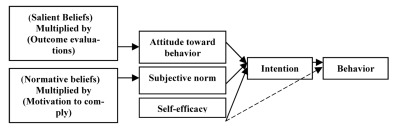
Background: Continuous performing of diabetes self-care behaviors was shown to be an effective strategy to control diabetes and to prevent or reduce its- related complications. This study aimed to investigate predictors of self-care behavior based on the extended theory of reasoned action by self efficacy (ETRA) among women with type 2 diabetes in Iran.
Methods: A sample of 352 women with type 2 diabetes, referring to a Diabetes Clinic in Khoy, Iran using the nonprobability sampling was enrolled. Appropriate instruments were designed to measure the variables of interest (diabetes knowledge, personal beliefs, subjective norm, self-efficacy and behavioral intention along with self- care behaviors). Reliability and validity of the instruments using Cronbach's alpha coefficients (the values of them were more than 0.70) and a panel of experts were tested.
Results: A statistical significant correlation existed between independent constructs of proposed model and modelrelated dependent constructs, as ETRA model along with its related external factors explained 41.5% of variance of intentions and 25.3% of variance of actual behavior. Among constructs of model, self-efficacy was the strongest predictor of intentions among women with type 2 diabetes, as it lonely explained 31.3% of variance of intentions and 11.4% of variance of self-care behavior.
Conclusion: The high ability of the extended theory of reasoned action with self-efficacy in forecasting and explaining diabetes mellitus self management can be a base for educational intervention. So to improve diabetes self management behavior and to control the disease, use of educational interventions based on proposed model is suggested.
Keywords: Behavior; Diabetes; Reasoned action; Self-efficacy; Self-management.
Conflict of interest statement
Figures
References
-
- Aghamolaei T, Eftkhar H, Mohammad K, Nakhjavani M, Shojaeizadeh D, Ghofranipour F, Safa O. Effects of health education program on behavior, HbA1c and health-related quality of life in diabetic patients. Acta Medica Iranica J. 2004;43:89–94.
-
- Centers for Disease Control and Prevention. National diabetes fact sheet, United States. 2003 Available at: [www.cdc.gov/diabetes/ pubs/pdf/ndfs_2003.pdf]. Accessed June 1, 2006.
-
- Lim S, Kim DJ, Jeong IK, Son HS, Chung CH, Koh G, Lee DH, Won KC, Park JH, Park TS, Ahn J, Kim J, Park KG, KO SH, Ahn YB, Lee I. A nationwide survey about the current status of glycemic control and complications in diabetic patients in 2006. The Committee of the Korean Diabetes Association on the Epidemiology of Diabetes Mellitus. Korean Diabetes J. 2009;33:48–57. doi: 10.4093/kdj.2009.33.1.48. - DOI
LinkOut - more resources
Full Text Sources
Medical