. 2012 Sep 1;72(17):4472-82.
doi: 10.1158/0008-5472.CAN-12-0057. Epub 2012 Jun 27.

Targeting eNOS in pancreatic cancer

Affiliations

Targeting eNOS in pancreatic cancer

Benjamin L Lampson et al. Cancer Res. .

Abstract

Mortality from pancreatic ductal adenocarcinoma cancer (PDAC) is among the highest of any cancer and frontline therapy has changed little in years. Activation of endothelial nitric oxide synthase (eNOS, NOS3, or NOS III) has been implicated recently in the pathogenesis of PDACs. In this study, we used genetically engineered mouse and human xenograft models to evaluate the consequences of targeting eNOS in PDACs. Genetic deficiency in eNOS limited the development of preinvasive pancreatic lesions and trended toward an extended lifespan in mice with advanced pancreatic cancer. These effects were also observed upon oral administration of the clinically evaluated NOS small molecule inhibitor N(G)-nitro-L-arginine methyl ester (l-NAME). Similarly, other transgenic models of oncogenic KRas-driven tumors responded to l-NAME treatment. Finally, these results were recapitulated in xenograft models of human pancreatic cancer, in which l-NAME was found to broadly inhibit tumorigenic growth. Taken together, our findings offer preclinical proof-of-principle to repurpose l-NAME for clinical investigations in treatment of PDACs and possibly other KRas-driven human cancers.


Conflict of interest statement

Disclosure of Portential Conflicts of Interest: CMC, BBA and DFK submitted a patent application to inhibit eNOS for the treatment of Ras mutation-positive cancers. CMC and KSB had a collaboration with GlaxoSmithKline to develop eNOS-specific inhibitors.

Figures

Figure 1
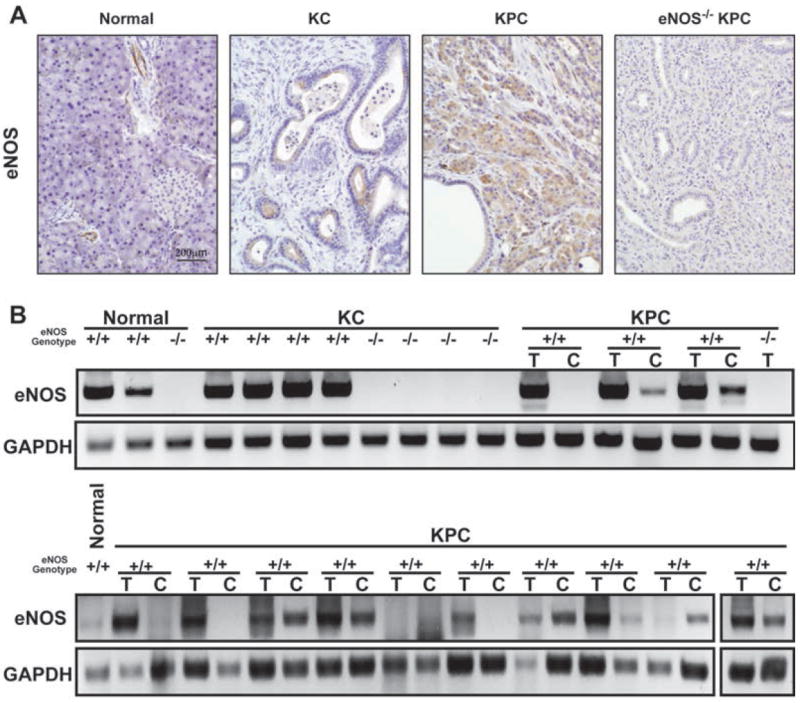
Figure 1. eNOS levels during murine pancreatic tumorigenesis
(A) eNOS protein and (B) mRNA, as detected by immunohistochemical staining and semi-quantitative RT-PCR, in the pancreata of normal (e.g. LSL-KrasG12D/+ mice that lack Pdx-Cre), KC (330 days of age), KPC, or eNOS-/- KPC mouse (at the mortality endpoint). T, pancreatic tumor tissue. C, cancer cell line derived from the matched tumor.
Figure 2
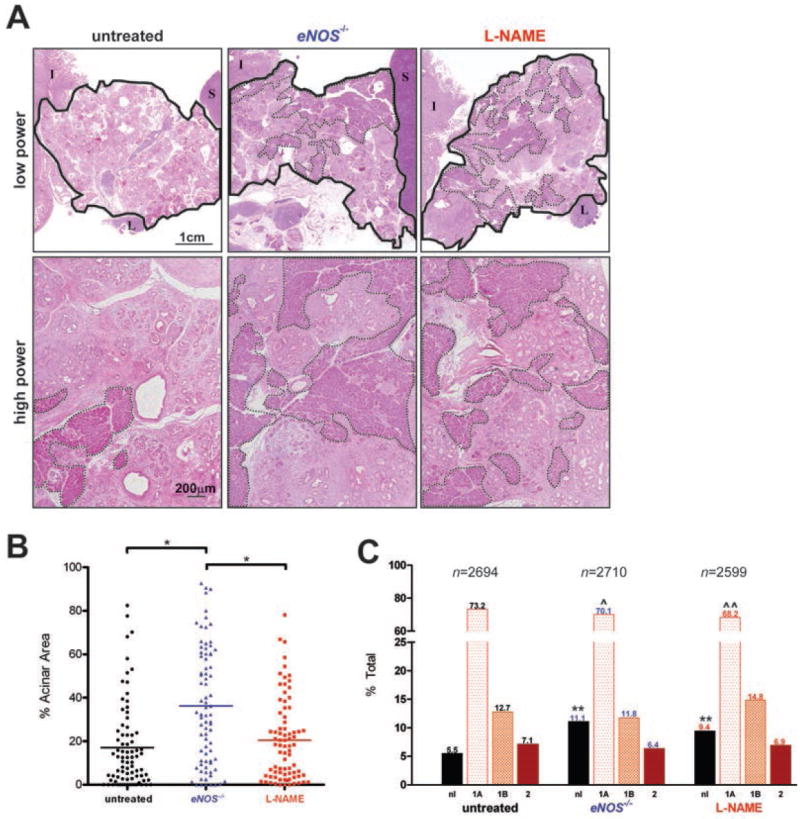
Figure 2. Analysis of pancreatic lesions in eNOS-/- and L-NAME-treated KC mice
(A) Whole mount (low-power) and magnified (high-power) H&E stained pancreata (solid line: outline of pancreas, dashed line: normal acinar tissue, I: intestine, L: lymph node, S: spleen). (B) Average area of normal acini from typically five random high-power fields per mouse (Bar, mean % normal acini. *P<0.001) and (C) % of lobules with the highest grade lesion being normal duct (nl), PanIN-1A (1A), PanIN-1B (1B), or PanIN-2 (2). n, graded lobules. **P<0.0001, normal versus abnormal ducts compared to untreated, and ˆP<0.05 or ˆˆP<0.0001, PanIN-1A versus all other ducts compared to untreated, in the indicated cohorts of 12 to 16 KC mice untreated, L-NAME-treated or eNOS-/-.
Figure 3
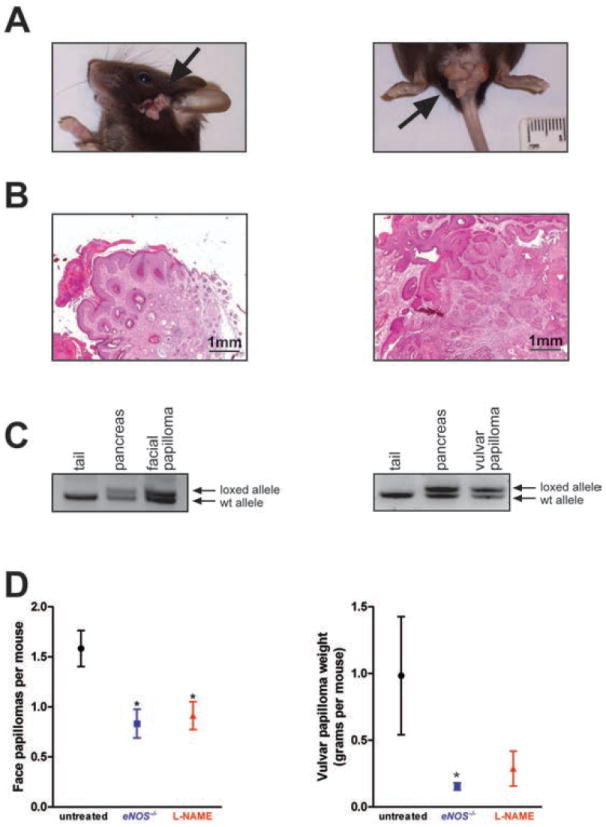
Figure 3. Analysis of facial and vulvar tumors in eNOS-/- and L-NAME-treated KC mice
(A) Gross photograph and (B) H&E stained section of a representative facial squamous papilloma (left) and a vulvar papilloma (right) from KC mice. (C) PCR analysis with primers specific for either the wild type Kras allele (wt allele) or the LSL-KrasG12D allele after Cre excision (loxed allele). Samples include DNA isolated from the tail (negative control sample, no Cre excision), pancreas (positive control sample, Cre excision) and a facial (left) and a vulvar (right) tumor. (D) Mean ± SEM of the total number of new facial tumors (left) developing over the course of 330 days in cohorts (n=24) of KC mice either untreated or treated with L-NAME, or eNOS-/- KC mice. Mean weight ± SEM of vulvar tumors (right) arising at 330 days of age in females in cohorts of KC mice either untreated (n=9) or treated with L-NAME (n=7) and in a cohort of eNOS-/- KC mice (n=11). *P<0.05 compared to untreated.
Figure 4
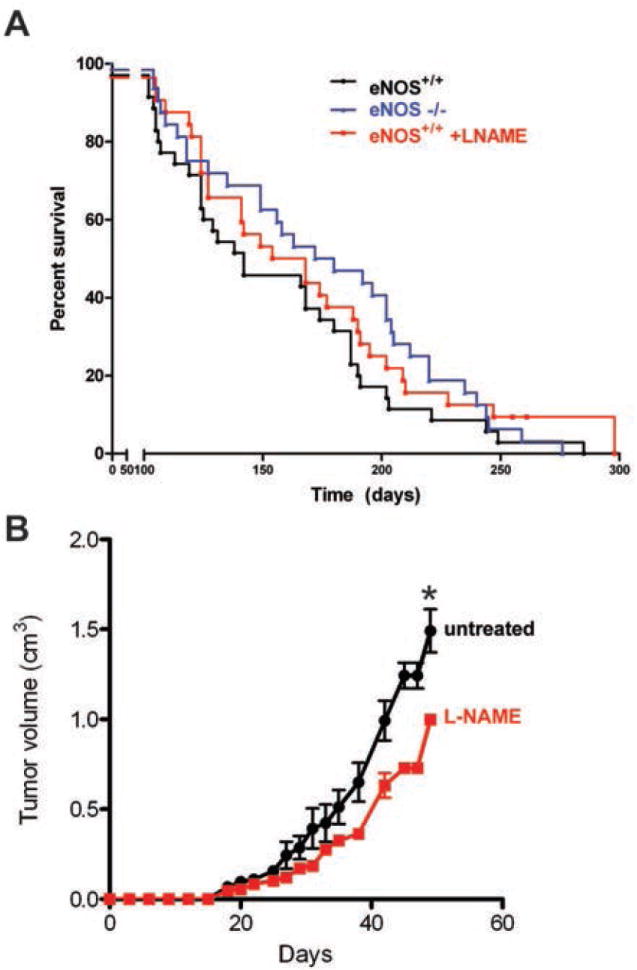
Figure 4. Lifespan of eNOS-/- and L-NAME-treated KPC mice
(A) Kaplan-Meier survival curve of cohorts of KPC mice untreated (n=35) or treated with L-NAME (n=32) and eNOS-/- KPC mice (n=32). (B) mean size ± SEM of subcutaneous xenograft tumors generated by a cell line derived from a KPC adenocarcinoma injected in isogenic immunocompetent cohorts of mice randomly assigned to either be untreated (n=4) or treated with L-NAME (n=4). *P<0.05. One L-NAME treated mouse was euthanized at day 29 for reasons unrelated to tumor size.
Figure 5
Figure 5. Tumorigenic growth of human pancreatic cancer cells treated with L-NAME
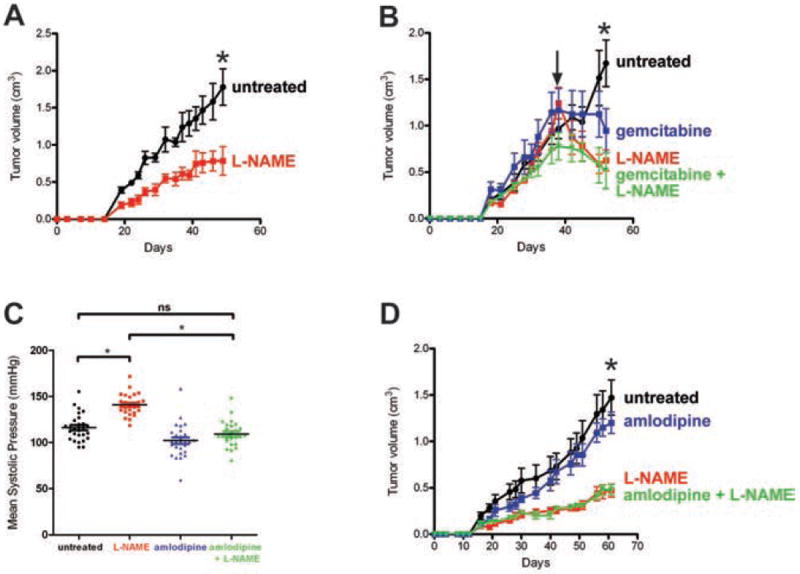
(A) Mean size ± SEM of subcutaneous tumors derived from CFPac-1 cells in cohorts (n=5) of mice untreated or L-NAME-treated. *P<0.05. (B) Mean size ± SEM of subcutaneous CFPac-1 tumors in cohorts of mice (n=4 to 5) that, upon reaching an established size of 0.75cm3 (arrow), were untreated or treated with L-NAME, gemcitabine, or L-NAME + gemcitabine. P<0.05, *each treatment compared to untreated. (C) The daily mean systolic pressure taken on 26 days over 8 weeks for the cohorts of mice (n=4 to 5) with subcutaneous CFPac-1 tumors that were either untreated or treated with L-NAME, amlodipine, or L-NAME + amlodipine. *P<0.05. ns, non-significant. (D) Mean size ± SEM of CFPac-1 xenografts in animals corresponding to treatment groups described in (C). *P<0.05, L-NAME ± amlodipine compared to untreated.
Figure 6
Figure 6. Analysis of phosphorylated eNOS, HRas-GTP, CD31 and Ki67 immunoreactivity in tumorigenic cells upon pharmacologic inhibition or loss of eNOS
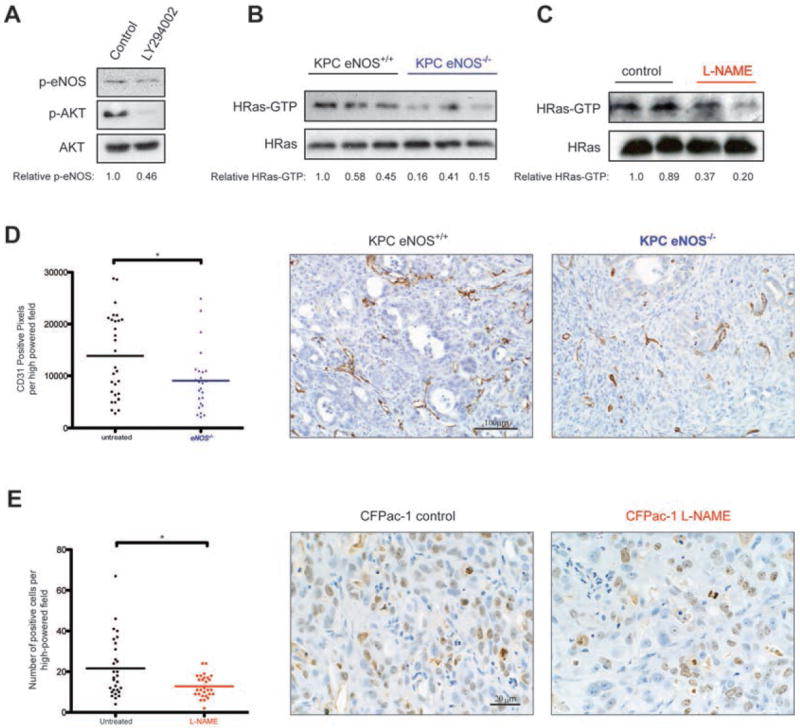
(A) Phospho-eNOS (normalized quantitation shown beneath), phospho-AKT, and AKT levels in CFPac-1 cells treated without (control) and with PI3K inhibitor LY294002. (B,C) HRas-GTP, as assessed by capture with GST-tagged RBD followed by immunoblot with an αHRas antibody, and total HRas levels (normalized quantitation shown beneath) in (B) cell lines established from eNOS+/+ and eNOS-/- KPC tumors and (C) tumors derived from CFPac-1 cells injected into mice treated or untreated with L-NAME for 7 weeks. (D) Representative example and CD31 immunoreactivity per field from typically five random high-power fields from pancreata of eNOS+/+ (n=6) and eNOS-/- (n=5) KPC mice. Bar, mean pixels per high-power field. *P<0.05. (E) Representative example and number of Ki67-positive cells per field from four to five random high-power fields from untreated control (n=7) and L-NAME-treated (n=7) CFPac-1 xenografts. Bar, mean number of cells per high-power field. *P<0.05

References

    1. Jemal A, Siegel R, Ward E, Hao Y, Xu J, Thun MJ. Cancer statistics, 2009. CA Cancer J Clin. 2009;59:225–49. - PubMed
    1. Conroy T, Desseigne F, Ychou M, Bouche O, Guimbaud R, Becouarn Y, et al. FOLFIRINOX versus gemcitabine for metastatic pancreatic cancer. N Engl J Med. 364:1817–25. - PubMed
    1. Ko AH, Tempero MA. Treatment of metastatic pancreatic cancer. J Natl Compr Canc Netw. 2005;3:627–36. - PubMed
    1. Downward J. Targeting RAS signalling pathways in cancer therapy. Nat Rev Cancer. 2003;3:11–22. - PubMed
    1. Qian J, Niu J, Li M, Chiao PJ, Tsao MS. In vitro modeling of human pancreatic duct epithelial cell transformation defines gene expression changes induced by K-ras oncogenic activation in pancreatic carcinogenesis. Cancer Res. 2005;65:5045–53. - PubMed

Publication types

MeSH terms