. 2012 Sep;86(18):9708-20.
doi: 10.1128/JVI.01019-12. Epub 2012 Jun 27.

Construction and manipulation of a new Kaposi's sarcoma-associated herpesvirus bacterial artificial chromosome clone

Affiliations

Construction and manipulation of a new Kaposi's sarcoma-associated herpesvirus bacterial artificial chromosome clone

Kevin F Brulois et al. J Virol. 2012 Sep.

Abstract

Efficient genetic modification of herpesviruses such as Kaposi's sarcoma-associated herpesvirus (KSHV) has come to rely on bacterial artificial chromosome (BAC) technology. In order to facilitate this approach, we generated a new KSHV BAC clone, called BAC16, derived from the rKSHV.219 virus, which stems from KSHV and Epstein-Barr virus-coinfected JSC1 primary effusion lymphoma (PEL) cells. Restriction enzyme and complete sequencing data demonstrate that the KSHV of JSC1 PEL cells showed a minimal level of sequence variation across the entire viral genome compared to the complete genomic sequence of other KSHV strains. BAC16 not only stably propagated in both Escherichia coli and mammalian cells without apparent genetic rearrangements, but also was capable of robustly producing infectious virions (∼5 × 10(7)/ml). We also demonstrated the utility of BAC16 by generating deletion mutants of either the K3 or K5 genes, whose products are E3 ligases of the membrane-associated RING-CH (MARCH) family. While previous studies have shown that individual expression of either K3 or K5 results in efficient downregulation of the surface expression of major histocompatibility complex class I (MHC-I) molecules, we found that K5, but not K3, was the primary factor critical for the downregulation of MHC-I surface expression during KSHV lytic reactivation or following de novo infection. The data presented here demonstrate the utility of BAC16 for the generation and characterization of KSHV knockout and mutant recombinants and further emphasize the importance of functional analysis of viral genes in the context of the KSHV genome besides the study of individual gene expression.


Figures
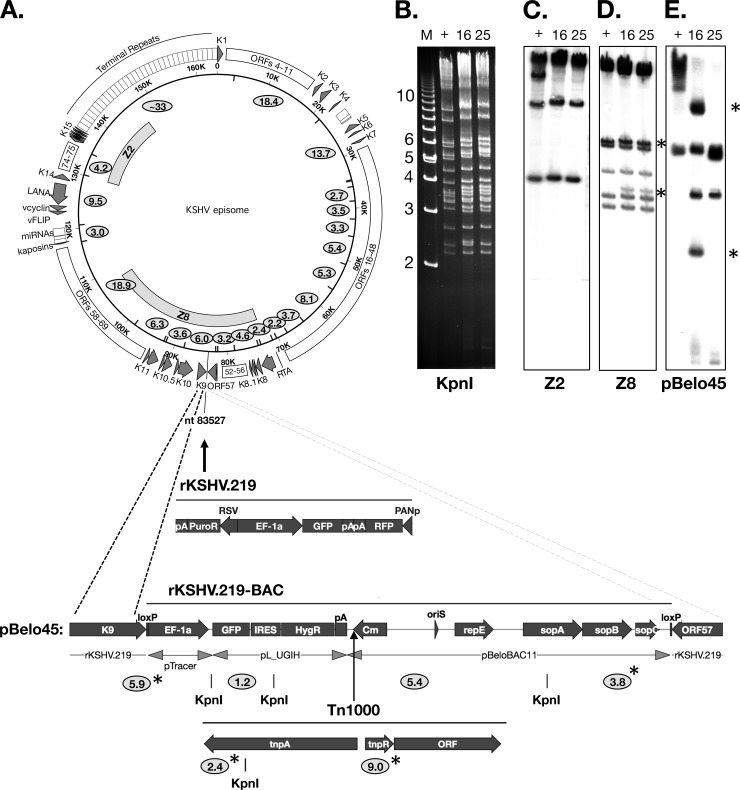
Fig 1
Fig 1
Construction and analysis of rKSHV.219-derived BAC clones. (A) Schematic diagram of the KSHV genome, the rKSHV.219 and 219-BAC insertion site (GQ994935), the RFP-GFP-Puror cassette, and the pBelo45 targeting construct containing the BAC vector, GFP-Hygror cassette, flanking loxP sites, and flanking sequences for homologous recombination (dashed lines). A majority of 219BAC clones also contain a Tn1000 insertion immediately following the TAA codon of the cam gene, as depicted. KpnI recognition sites are indicated by inward tick marks or below the diagrammed sequence features. KpnI fragment sizes (in kilobase pairs) are indicated as ovals and are based on the GK18 sequence (NC_009333) and the pBelo45 sequence. Fragment sizes marked with an asterisk result from the depicted integration events. (B) Gel electrophoresis of KpnI-digested BAC DNA. Two different clones of 219BAC, BAC16, and BAC25, were analyzed. BAC36 DNA was used as a positive control (+) (75). M, 1-kb marker. (C to E) Southern blot hybridization using a 32P-labeled probe from Z2 (C), Z8 (D), and pBelo45 (E) to detect KSHV and 219BAC-specific sequences. The 2.4- and 9.0-kb fragments in panel E are the result of a Tn1000 insertion.
Fig 2
Fig 2
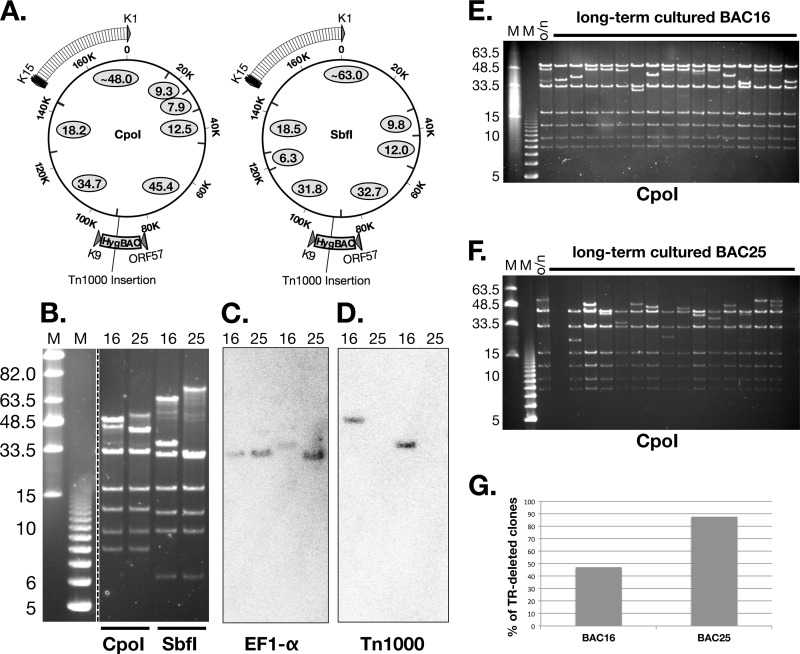
Stability of BAC16 and BAC25. (A) Schematic of CpoI and SbfI recognition sites (inward tick marks). Predicted fragment sizes (in kb) are depicted as ovals for 219BAC lacking Tn1000. As the Tn1000 sequence does not contain any CpoI or SbfI sites, the 6.0-kb Tn1000 insertion within BAC16, the 45.4-kb (CpoI) and 31.8-kb (SbfI) fragment sizes are predicted to be 51.4 kb and 37.8 kb, respectively. (B) Gel electrophoresis of CpoI- or SbfI-digested BAC16 or BAC25 DNA. M, midrange PFGE or 1-kb size marker. (C and D) Southern blot hybridization with an EF1-α-specific probe (C) or a Tn1000-specific probe (D). (E and F) E. coli DH10B harboring BAC16 (E) or BAC25 (F) was passaged daily in liquid culture for a total of 5 days. DNAs isolated from single colonies derived from this long-term culture were analyzed by CpoI digestion and gel electrophoresis. BAC16 and BAC25 DNAs from overnight (o/n) cultures were analyzed in parallel. Panel G shows the percentage of TR-fragment-deleted clones (among a total of 32 clones) analyzed from each long-term culture.
Fig 3
Fig 3
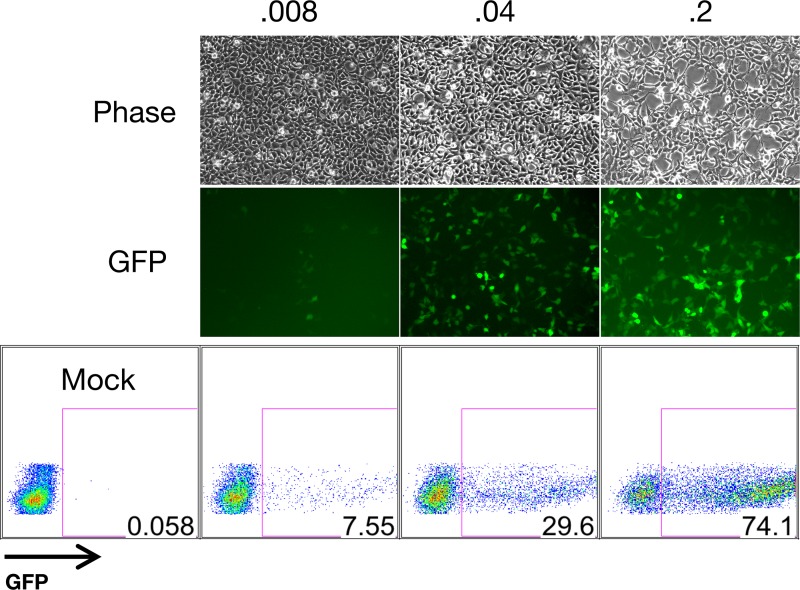
Infectious BAC16 virus production. A BAC16 virus stock was generated as described in Materials and Methods. Four 15-cm plates containing iSLK cells harboring BAC16 were seeded at ∼70% confluence and treated with 1 μg/ml of doxycycline and 1 mM sodium butyrate for 96 h. Approximately 40 ml of virus-containing supernatants were concentrated via centrifugation using a SW32 rotor. Virus pellets were then resuspended in the residual medium (∼300 μl). Then 293A cells were infected with 0.008, 0.04, or 0.2 μl of this BAC16 virus stock and analyzed by fluorescence microscopy and flow cytometry at 24 h postinfection.
Fig 4
Fig 4
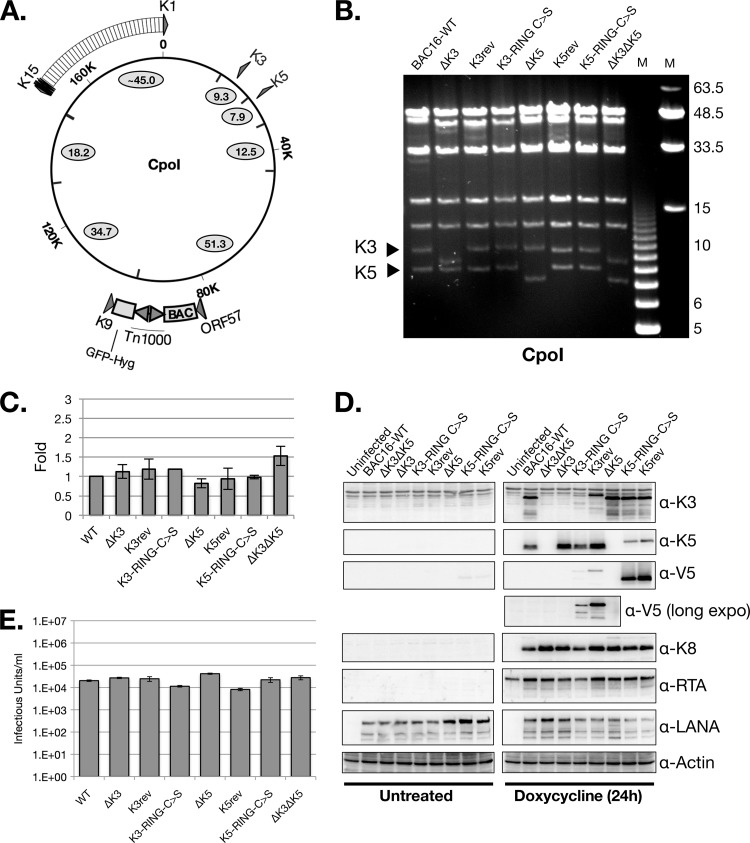
Characterization of WT and mutant BAC16 virus. (A) Schematic diagram of CpoI digestion of BAC16 (including Tn1000 sequence) (B) Pulsed-field gel analysis of CpoI-digested WT and mutant BAC16 DNAs. Triangles denote the 9.3-kb and 7.9-kb fragments predicted to harbor the K3 and K5 coding sequences, respectively. (C) iSLK cells stably transfected with WT or mutant BAC16 were analyzed by qPCR to determine relative DNA copy number. (D) The same set of cells was analyzed by Western blot analysis using the indicated antibodies (α-K3, α-K5, etc). long expo, long exposure. (E) Infectious units were quantified from viral supernatants harvested from the indicated iSLK-BAC16 cell lines following 4 days of treatment with both doxycycline and sodium butyrate (see Materials and Methods). Note, the viral supernatants from this experiment were not concentrated by centrifugation and thus had a lower titer than those in Fig. 3.
Fig 5
Fig 5
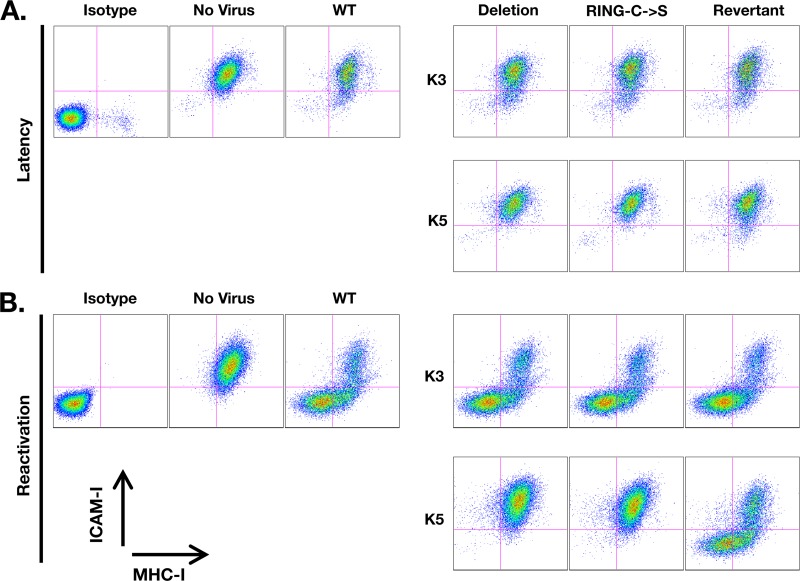
Flow cytometry analysis of ICAM-I and MHC-I surface expression of iSLK-BAC16 cell lines during latency (A) or reactivation after 24 h of doxycycline treatment (B). Each iSLK-BAC16 stable cell line sample was stained with both MHC-I (W6/32) and ICAM-I antibodies. iSLK cells lacking KSHV were also stained with the indicated antibodies or with isotype control antibodies (see Materials and Methods). Live cells were gated via forward scatter (FSC) and side scatter (SSC) profiling and analyzed for GFP, APC (ICAM-I), and APC-Cy7 (MHC-I) fluorescence. All BAC16 cell lines were ∼100% GFP positive (data not shown).
Fig 6
Fig 6
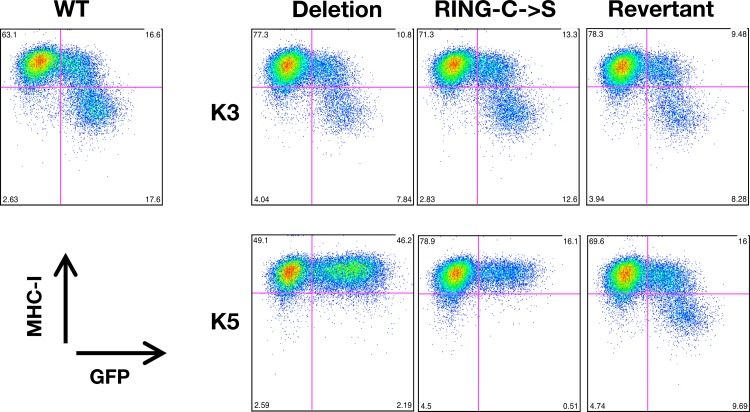
MHC-I surface expressions of 293A cells upon infection with WT or mutant BAC16 virus. At 36 h postinfection with WT or mutant BAC16 virus (multiplicity of infection [MOI] of 0.5), GFP-positive 293A cells were gated and examined for MHC-I surface expression.

References

    1. Adang LA, Tomescu C, Law WK, Kedes DH. 2007. Intracellular Kaposi's sarcoma-associated herpesvirus load determines early loss of immune synapse components. J. Virol. 81:5079–5090 - PMC - PubMed
    1. Barozzi P, et al. 2008. Changes in the immune responses against human herpesvirus-8 in the disease course of posttransplant Kaposi sarcoma. Transplantation 86:738–744 - PubMed
    1. Bartee E, Mansouri M, Hovey Nerenberg BT, Gouveia K, Fruh K. 2004. Downregulation of major histocompatibility complex class I by human ubiquitin ligases related to viral immune evasion proteins. J. Virol. 78:1109–1120 - PMC - PubMed
    1. Bartee E, McCormack A, Fruh K. 2006. Quantitative membrane proteomics reveals new cellular targets of viral immune modulators. PLoS Pathog. 2:e107 doi:10.1371/journal.ppat.0020107 - DOI - PMC - PubMed
    1. Bechtel J, Grundhoff A, Ganem D. 2005. RNAs in the virion of Kaposi's sarcoma-associated herpesvirus. J. Virol. 79:10138–10146 - PMC - PubMed

Publication types

MeSH terms

Substances