


The role of human papillomavirus type 16 E6/E7 oncoproteins in cervical epithelial-mesenchymal transition and carcinogenesis
- PMID: 22740973
- PMCID: PMC3362408
- DOI: 10.3892/ol.2011.512
The role of human papillomavirus type 16 E6/E7 oncoproteins in cervical epithelial-mesenchymal transition and carcinogenesis
Abstract
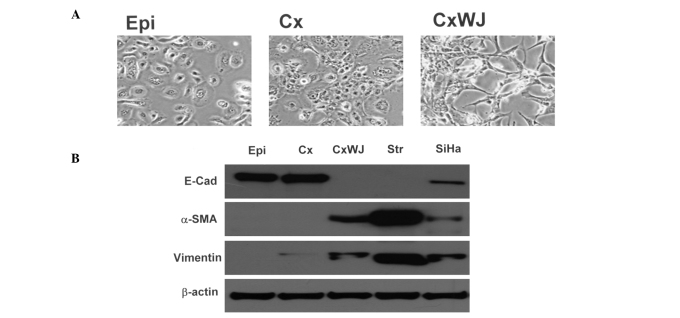
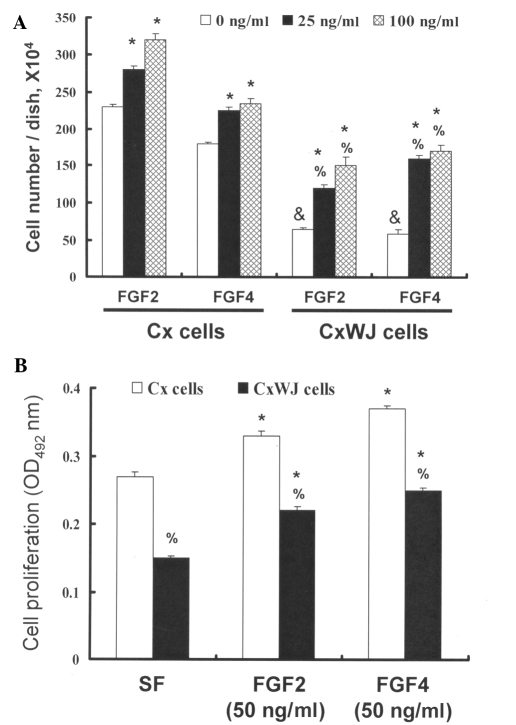
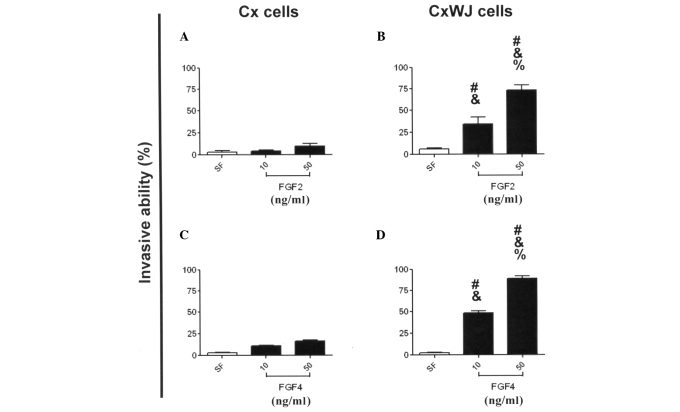
Cervical cancer is the most common malignancy in females worldwide. This study investigated the prevalence of the E6/E7 oncoproteins of human papillomavirus (HPV) type 16, which are important in fibroblast growth factor (FGF) 2- and 4-induced epithelial-mesenchymal transition (EMT) and cervical tumorigenesis. We investigated the functional interaction between HPV16 E6/E7-transfected Cx cells (CxWJ cells) and treatment with FGF2 and 4, according to the expression of α-smooth muscle actin (α-SMA), vimentin and E-cadherin protein as well as cell growth and invasive ability. The results showed the upregulation of α-SMA and vimentin and the downregulation of E-cadherin protein expression in CxWJ cells. HPV16 E6/E7 infection partially repressed proliferation, but not the invasive ability of FGF2 or FGF4 stimulation in cervical cancer cells (CxWJ cells). These data provide evidence of a functional interaction between HPV16 E6/E7 and FGFs 2 and 4, suggesting that cooperative stimulation of HPV E6/E7 and FGFs activated in human cervical cancer cells is required to completely overcome the oncogenic function associated with the development of cervical epithelial-mesenchymal transition and tumorigenesis.
Figures
References
-
- Hsu KF, Wu CL, Huang SC, et al. Conditionally replicating E1B-deleted adenovirus driven by the squamous cell carcinoma antigen 2 promoter for uterine cervical cancer therapy. Cancer Gene Ther. 2008;15:526–534. - PubMed
-
- Lang HC, Wu SL. Lifetime costs of the top five cancers in Taiwan. Eur J Health Econ. 2011 Mar 27; (Epub ahead of print) - PubMed
-
- Chen CC, Lin JC, Jan JS, Ho SC, Wang L. Definitive intensity-modulated radiation therapy with concurrent chemotherapy for patients with locally advanced cervical cancer. Gynecol Oncol. 2011 Apr 22; (Epub ahead of print) - PubMed
-
- Mühlen S, Behren A, Iftner T, Simon C. Influence of HPV16 E2 and its localisation on the expression of matrix metalloproteinase-9. Int J Oncol. 2010;37:337–345. - PubMed
LinkOut - more resources
Full Text Sources