


A novel linkage map of sugarcane with evidence for clustering of retrotransposon-based markers
- PMID: 22742069
- PMCID: PMC3443450
- DOI: 10.1186/1471-2156-13-51
A novel linkage map of sugarcane with evidence for clustering of retrotransposon-based markers
Abstract
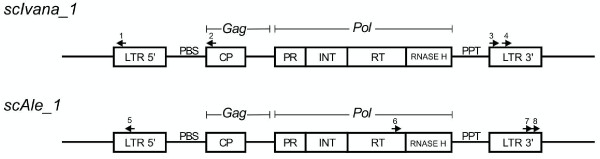
Background: The development of sugarcane as a sustainable crop has unlimited applications. The crop is one of the most economically viable for renewable energy production, and CO2 balance. Linkage maps are valuable tools for understanding genetic and genomic organization, particularly in sugarcane due to its complex polyploid genome of multispecific origins. The overall objective of our study was to construct a novel sugarcane linkage map, compiling AFLP and EST-SSR markers, and to generate data on the distribution of markers anchored to sequences of scIvana_1, a complete sugarcane transposable element, and member of the Copia superfamily.
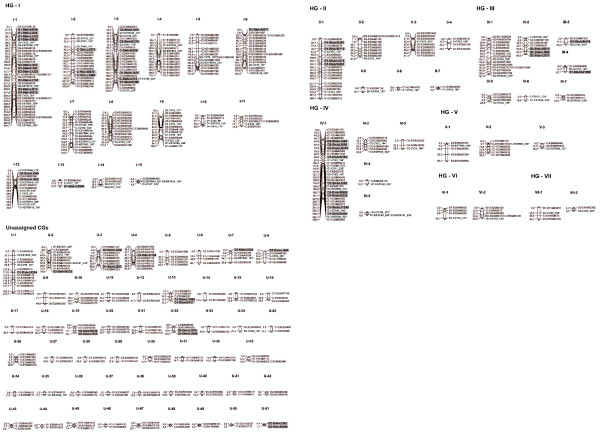
Results: The mapping population parents ('IAC66-6' and 'TUC71-7') contributed equally to polymorphisms, independent of marker type, and generated markers that were distributed into nearly the same number of co-segregation groups (or CGs). Bi-parentally inherited alleles provided the integration of 19 CGs. The marker number per CG ranged from two to 39. The total map length was 4,843.19 cM, with a marker density of 8.87 cM. Markers were assembled into 92 CGs that ranged in length from 1.14 to 404.72 cM, with an estimated average length of 52.64 cM. The greatest distance between two adjacent markers was 48.25 cM. The scIvana_1-based markers (56) were positioned on 21 CGs, but were not regularly distributed. Interestingly, the distance between adjacent scIvana_1-based markers was less than 5 cM, and was observed on five CGs, suggesting a clustered organization.
Conclusions: Results indicated the use of a NBS-profiling technique was efficient to develop retrotransposon-based markers in sugarcane. The simultaneous maximum-likelihood estimates of linkage and linkage phase based strategies confirmed the suitability of its approach to estimate linkage, and construct the linkage map. Interestingly, using our genetic data it was possible to calculate the number of retrotransposon scIvana_1 (~60) copies in the sugarcane genome, confirming previously reported molecular results. In addition, this research possibly will have indirect implications in crop economics e.g., productivity enhancement via QTL studies, as the mapping population parents differ in response to an important fungal disease.
Figures
References
-
- Food and Agriculture Organization of the United Nations. , ; [ http://faostat.fao.org]
-
- Companhia Nacional de Abastecimento. , ; [ http://www.conab.gov.br/OlalaCMS/uploads/arquivos/11_08_30_13_41_19_bole...]
-
- Bremer G. Problems in breeding and cytology of sugar cane. I - A short history of sugar cane breeding; the original forms of Saccharum. Euphytica. 1961;10:59–78. doi: 10.1007/BF00037206. - DOI
-
- Mukherjee SK. Origin and distribution of Saccharum. Bot Gaz. 1957;119:55–61. doi: 10.1086/335962. - DOI
-
- Roach BT. Nobilisation of sugarcane. Proc Int Soc Sugar Cane Technol. 1972;14:206–216.
Publication types
MeSH terms
Substances
LinkOut - more resources
Full Text Sources
Research Materials
Miscellaneous
