. 2012 Aug;53(8):1310-25.
doi: 10.2967/jnumed.111.100123. Epub 2012 Jun 28.

MIRD pamphlet No. 23: quantitative SPECT for patient-specific 3-dimensional dosimetry in internal radionuclide therapy

Affiliations

MIRD pamphlet No. 23: quantitative SPECT for patient-specific 3-dimensional dosimetry in internal radionuclide therapy

Yuni K Dewaraja et al. J Nucl Med. 2012 Aug.

Abstract

In internal radionuclide therapy, a growing interest in voxel-level estimates of tissue-absorbed dose has been driven by the desire to report radiobiologic quantities that account for the biologic consequences of both spatial and temporal nonuniformities in these dose estimates. This report presents an overview of 3-dimensional SPECT methods and requirements for internal dosimetry at both regional and voxel levels. Combined SPECT/CT image-based methods are emphasized, because the CT-derived anatomic information allows one to address multiple technical factors that affect SPECT quantification while facilitating the patient-specific voxel-level dosimetry calculation itself. SPECT imaging and reconstruction techniques for quantification in radionuclide therapy are not necessarily the same as those designed to optimize diagnostic imaging quality. The current overview is intended as an introduction to an upcoming series of MIRD pamphlets with detailed radionuclide-specific recommendations intended to provide best-practice SPECT quantification-based guidance for radionuclide dosimetry.


Conflict of interest statement

No other potential conflict of interest relevant to this article was reported.

Figures

FIGURE 1
FIGURE 1
(A) Representation of reference man anatomic model (96) used for conventional dose calculations and coronal (B) and transverse (C) views of patient’s registered and fused SPECT/CT images (in hot-iron and gray-scale display tables, respectively) that can be used for patient-specific 3D dosimetry. Patient images show uptake in normal organs and axillary tumors (indicated by arrow) after 131I-labeled tositumomab treatment for non-Hodgkin’s lymphoma.
FIGURE 2
FIGURE 2
SPECT energy spectra of 4 radionuclides relevant to internal therapy generated using the SIMIND (97) Monte Carlo code. A 99mTc energy spectrum is also shown for comparison. In each graph, the black curve corresponds to total events and red corresponds to undesired events that have undergone Compton scatter or collimator septal penetration. Typical settings for photopeak acquisition window and adjacent scatter windows are indicated, respectively, by solid and dashed vertical lines. The simulated geometry was a point source at a distance of 13 cm from the collimator centered in an 11-cm-radius water-filled phantom. Low-energy collimation was modeled for 99mTc, medium-energy collimation for 177Lu and 111In, and high-energy collimation for 131I and 90Y.
FIGURE 3
FIGURE 3
Rows show transverse-section SPECT images of, from top to bottom, 131I-labeled tositumomab, 90Y-labeled ibritumomab tiuxetan, 177Lu-labeled DOTATATE, and 111In-labeled ibritumomab tiuxetan patient studies. Columns show, from left to right, images reconstructed by OS-EM reconstruction without any corrections or filtering, OS-EM with only attenuation compensation (a), OS-EM with attenuation and scatter compensation (a,s), and OS-EM with attenuation, scatter, and CDR compensation (a,s,c).
FIGURE 4
FIGURE 4
131I activity recovery as function of OS-EM iteration (with 6 subsets) for different sphere volumes. Phantom measurements were performed on SPECT/CT system with high-energy collimation. Reconstruction included compensation for attenuation, scatter, and CDR.
FIGURE 5
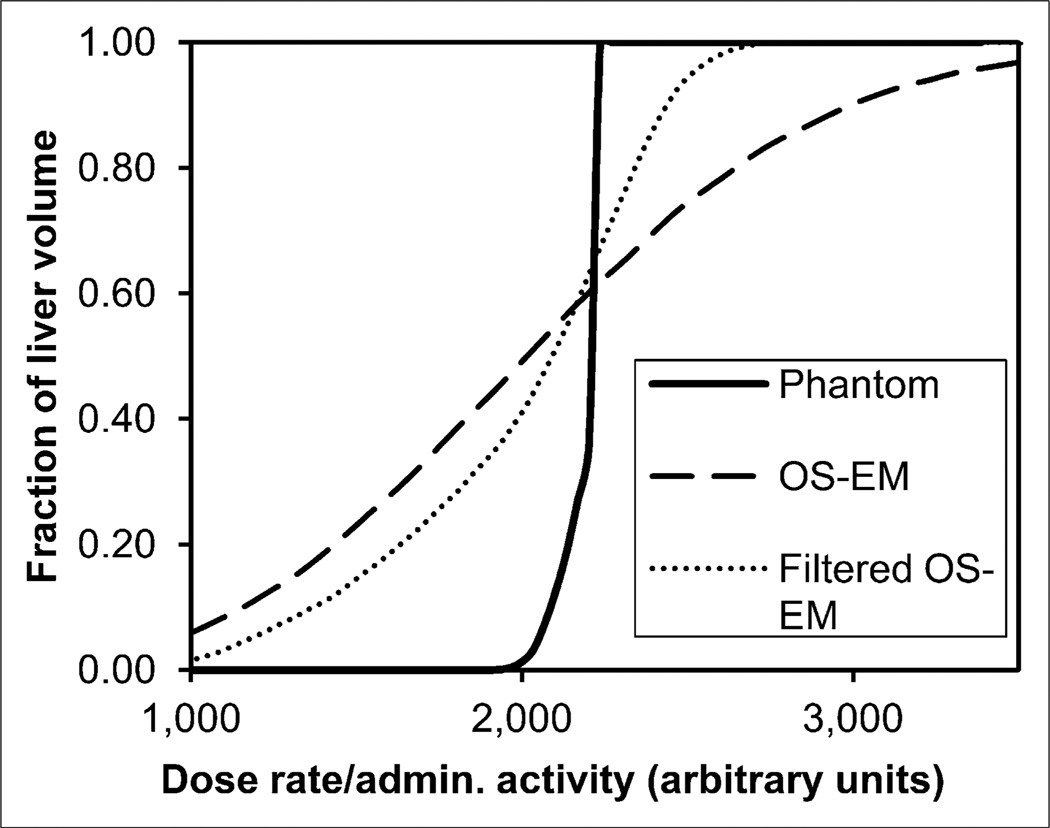
FIGURE 5
Cumulative dose–volume histogram for liver computed for true activity distribution (phantom) and for activity distributions reconstructed from simulated projections using OS-EM with and without postreconstruction Butterworth filtering (order, 8; cutoff, 0.12 pixel−1). In both cases, reconstructions used 25 iterations (32 subsets) and included model-based scatter, attenuation, and full CDR compensation.
FIGURE 6
FIGURE 6
Linear attenuation coefficient (at 99mTc and 131I photon energies) as a function of CT number for different materials in a calibration phantom (Gammex 467 Tissue Characterization Phantom [Gammex, Inc.] shown in inset) imaged on SPECT/CT system. Measured data were fit by least-squares method to bilinear function.
FIGURE 7
FIGURE 7
Various components of the collimator response for 131I, 90Y, 177Lu, and 111In obtained by Monte Carlo simulation (legend of Fig. 2 has details of simulation and energy window settings). Images are displayed on a logarithmic gray scale, and each image is normalized to its own maximum. The geometric, collimator scatter, and septal penetration fractions of the total counts corresponding to these images are, respectively, 52.6%, 20.6%, and 26.8% for 131I; 74.8%, 9.4%, and 15.9% for 90Y; 92.1%, 5.1%, and 2.8% for 177Lu; and 88.6%, 7.7%, and 3.7% for 111In.

References

    1. International Commission on Radiation Units and Measurements (ICRU) Absorbed-Dose Specification in Nuclear Medicine. Bethesda, MD: ICRU; 2002. Report 67.
    1. O’Donoghue JA. Implications of nonuniform tumor doses for radioimmunotherapy. J Nucl Med. 1999;40:1337–1341. - PubMed
    1. Dale RG. The application of the linear-quadratic dose-effect equation to fractionated and protracted radiotherapy. Br J Radiol. 1985;58:515–528. - PubMed
    1. Flux G, Bardiès M, Monsieurs M, Savolainen S, Strand SE, Lassmann M. The impact of PET and SPECT on dosimetry for targeted radionuclide therapy. Z Med Phys. 2006;16:47–59. - PubMed
    1. Siegel JA, Thomas SR, Stubbs JB, et al. MIRD pamphlet no. 16: techniques for quantitative radiopharmaceutical biodistribution data acquisition and analysis for use in human radiation dose estimates. J Nucl Med. 1999;40(suppl):37S–61S. - PubMed

Publication types

MeSH terms

LinkOut - more resources