


Heritability of the spatial distribution and peak density of macular pigment: a classical twin study
- PMID: 22744384
- PMCID: PMC3443843
- DOI: 10.1038/eye.2012.98
Heritability of the spatial distribution and peak density of macular pigment: a classical twin study
Abstract
Purpose: To elucidate the heritability of peak density and spatial width of macular pigment (MP) using a Classical Twin Study.
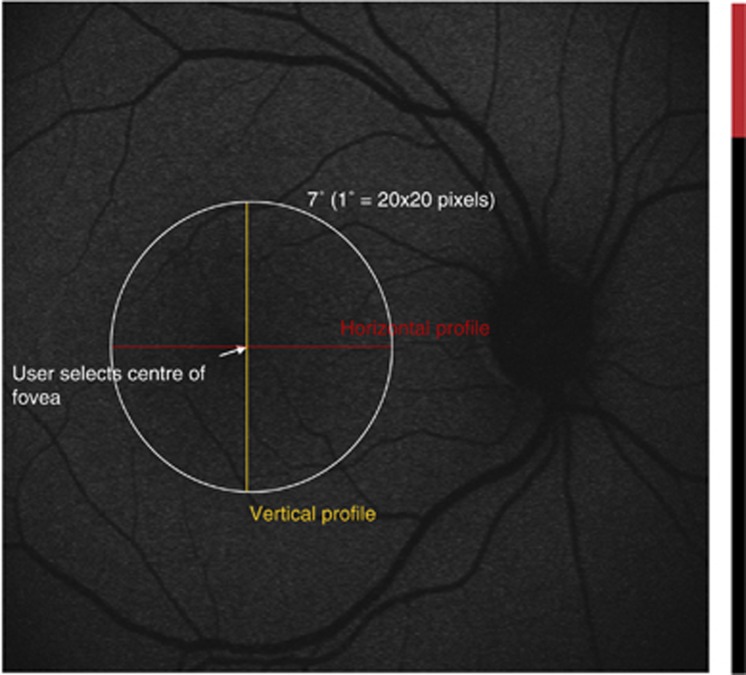
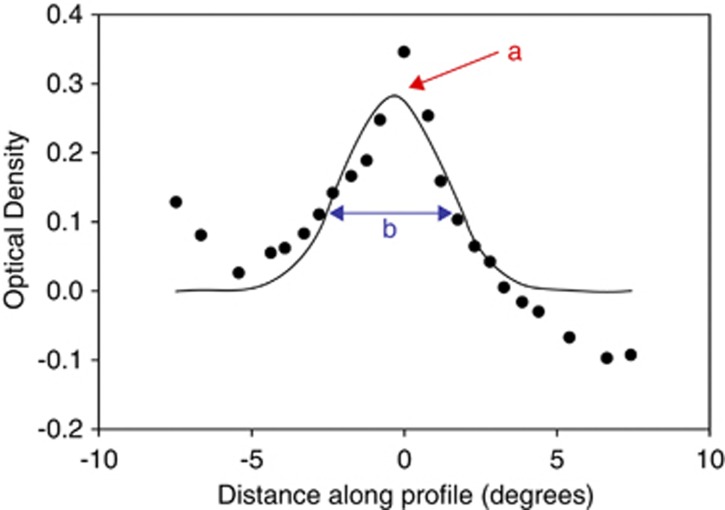
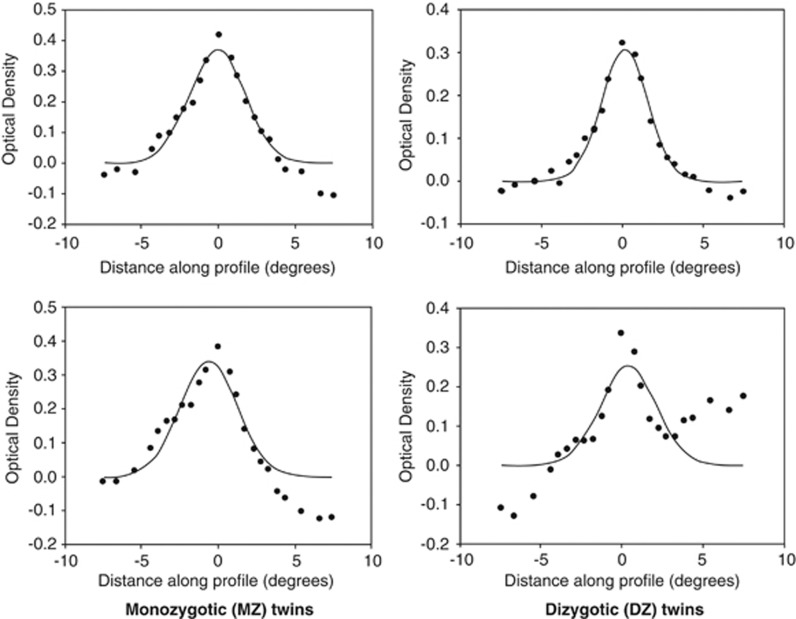
Methods: Fundus autofluorescence images were obtained at 488 nm from 86 subjects or 43 twin pairs (21 monozygotic (MZ) and 22 dizygotic (DZ)) (27 male, 59 female) aged from 55 to 76 years (mean 62.2 ± 5.3 years). The relative topographic distribution of MP was measured using a grey scale of intensity (0-255 units) in a 7° eccentricity around the fovea. Relative peak MP density (rPMPD) and relative spatial distribution of MP (rSDMP) were used as the main outcome measure in the statistical analysis.
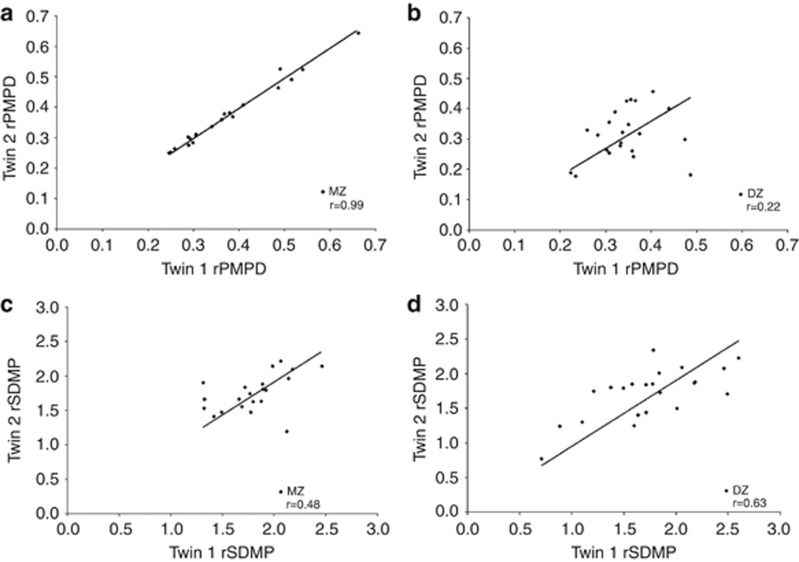
Results: A significantly higher correlation was found within MZ pairs as compared with that within DZ pairs for rPMPD, (r=0.99, 95% confidence interval (95% CI) 0.93 to 1.00) and 0.22, 95% CI -0.34 to 0.71), respectively, suggesting strong heritability of this trait. When rSDMP was compared, there was no significant difference between the correlations within MZ pairs (r=0.48, 95% CI -0.02 to 0.83) and DZ pairs (r=0.63, 95% CI 0.32 to 0.83), thus rSDMP is unlikely to have a considerable heritable component. In addition, there was no difference between any MP parameter when normal maculae were compared with early age-related macular degeneration (AMD) (rPMPD 0.36 vs 0.34, t=1.18 P=0.243, rSDMP 1.75 vs 1.75, t=0.028 P=0.977).
Conclusions: rPMPD is a strongly heritable trait whereas rSDMP has minimal genetic influence and a greater influence by environmental factors. The presence of macular changes associated with early AMD did not appear to influence any of these pigment parameters.
Figures
References
-
- Khachik F, Englert G, Daitch CE, Beecher GR, Tonucci LH, Lusby WR. Isolation and structural elucidation of the geometrical isomers of lutein and zeaxanthin in extracts from human plasma. J Chromatogr. 1992;582 (1–2:153–166. - PubMed
-
- Landrum JT, Bone RA. Lutein, zeaxanthin, and the macular pigment. Arch Biochem Biophys. 2001;385 (1:28–40. - PubMed
-
- Junghans A, Sies H, Stahl W. Macular pigments lutein and zeaxanthin as blue light filters studied in liposomes. Arch Biochem Biophy. 2001;391:160–164. - PubMed
-
- Algvere PV, Marshall J, Seregard S. Age-related maculopathy and the impact of blue light hazard. Acta Ophthalmologica Scandinavica. 2006;84 (1:4–15. - PubMed
-
- Krinsky NI, Landrum JT, Bone RA. Biologic mechanisms of the protective role of lutein and zeaxanthin in the eye. Annu Rev Nutr. 2003;23:171–201. - PubMed
Publication types
MeSH terms
Substances
LinkOut - more resources
Full Text Sources
