. 2012 Sep 1;186(5):412-9.
doi: 10.1164/rccm.201111-2023OC. Epub 2012 Jun 28.

Retinoic acid-related orphan receptor-α is induced in the setting of DNA damage and promotes pulmonary emphysema

Affiliations

Retinoic acid-related orphan receptor-α is induced in the setting of DNA damage and promotes pulmonary emphysema

Ying Shi et al. Am J Respir Crit Care Med. .

Abstract

Rationale: The discovery that retinoic acid-related orphan receptor (Rora)-α is highly expressed in lungs of patients with COPD led us to hypothesize that Rora may contribute to the pathogenesis of emphysema.

Objectives: To determine the role of Rora in smoke-induced emphysema.

Methods: Cigarette smoke extract in vitro and elastase or cigarette smoke exposure in vivo were used to model smoke-related cell stress and airspace enlargement. Lung tissue from patients undergoing lung transplantation was examined for markers of DNA damage and Rora expression.

Measurements and main results: Rora expression was induced by cigarette smoke in mice and in cell culture. Gene expression profiling of Rora-null mice exposed to cigarette smoke demonstrated enrichment for genes involved in DNA repair. Rora expression increased and Rora translocated to the nucleus after DNA damage. Inhibition of ataxia telangiectasia mutated decreased the induction of Rora. Gene silencing of Rora attenuated apoptotic cell death in response to cigarette smoke extract, whereas overexpression of Rora enhanced apoptosis. Rora-deficient mice were protected from elastase and cigarette smoke induced airspace enlargement. Finally, lungs of patients with COPD showed evidence of increased DNA damage even in the absence of active smoking.

Conclusions: Taken together, these findings suggest that DNA damage may contribute to the pathogenesis of emphysema, and that Rora has a previously unrecognized role in cellular responses to genotoxicity. These findings provide a potential link between emphysema and features of premature ageing, including enhanced susceptibility to lung cancer.


Figures
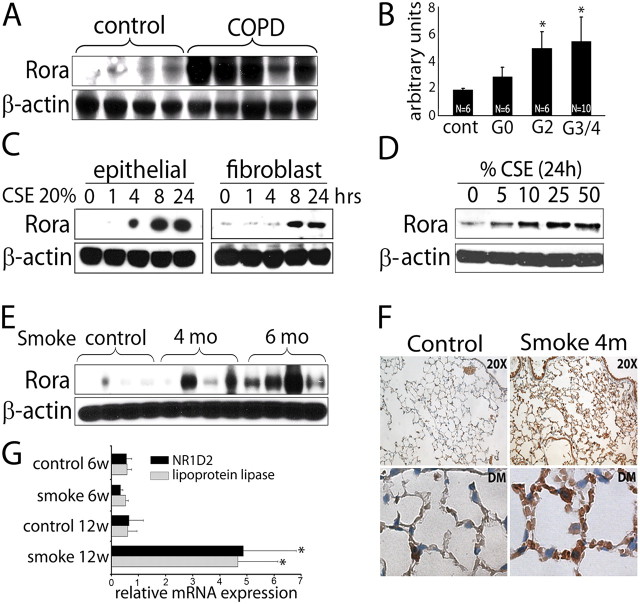
Figure 1.
Figure 1.
(A) Western blot demonstrating increased expression of retinoic acid–related orphan receptor-α(Rora) in whole-lung homogenate of patients with severe chronic obstructive pulmonary disease (COPD) (former smokers) compared with rejected transplant donor lungs. (B) Densitometry of Western blots (normalized to β-actin) showing expression of Rora by Global Initiative for Chronic Obstructive Lung Disease classification; one-way analysis of variance P < 0.001; *P < 0.05 for individual t tests relative to nonsmoking control subjects and to G0. A total of six control lungs and 22 COPD lungs were analyzed. (C) Immunoblots demonstrating increased expression of Rora in response to cigarette smoke extract (CSE) in epithelial and fibroblast cell lines over time and (D) in epithelial cell line with increasing CSE dose. (E) Increased Rora protein expression in whole mouse (C57Bl/6) lung homogenate after smoke exposure for 4 and 6 months. Three replicates of cell culture experiments and two replicates of the in vivo experiment were performed. (F) Rora immunostaining of mouse lung exposed to smoke 4 months versus control; DM = digital magnification of 40× immunohistochemistry stain; six lungs in each group were examined. (G) Expression of known Rora target genes is increased in whole mouse lung after 12 weeks smoke exposure assessed by quantitative (real time) reverse transcriptase polymerase chain reaction, *P < 0.05 for individual t tests relative to sham smoked control subjects; seven to eight mice were examined in each group (in duplicate).
Figure 2.
Figure 2.
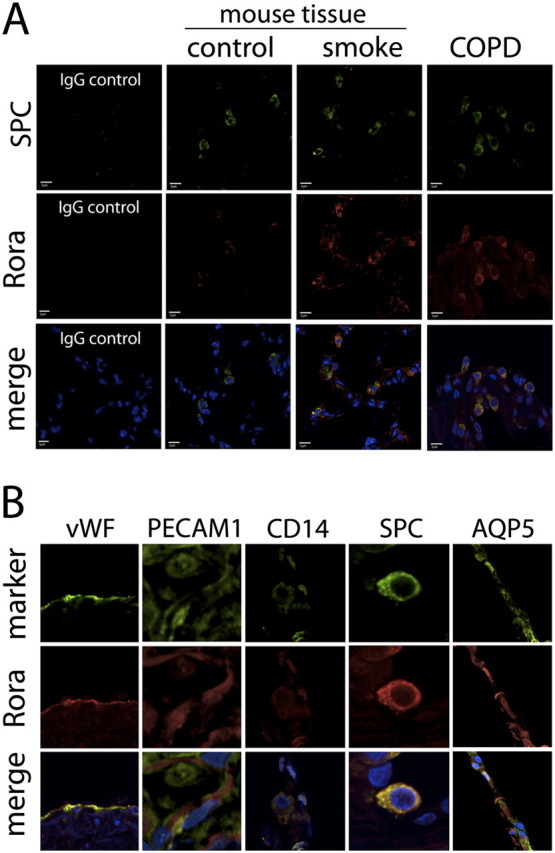
Immunofluorescent staining of mouse tissue exposed to cigarette smoke for 4 months and human chronic obstructive pulmonary disease (COPD) Global Initiative for Chronic Obstructive Lung Disease stage 4. (A) The most intense staining for retinoic acid–related orphan receptor-α(Rora) is in type 2 pneumocytes expressing surfactant protein C (SPC), although other cell types show increased Rora expression. (B) Costaining with cell markers for endothelial cells (von Willebrand factor [vWF] and PECAM-1), macrophages (CD14), type II pneumocytes (SPC), and type I pneumocytes (AQP5). Some intranuclear staining for Rora can be appreciated in types I and II pneumocytes in COPD lung, but expression is primarily cytoplasmic.
Figure 3.
Figure 3.
(A and B) Mitomycin C causes DNA damage as shown by phosphorylation of H2AX, seen as green fluorescent puncti (A) and by Western blot (B). The increase in γ-H2AX is associated with increasing intracellular levels of retinoic acid–related orphan receptor-α (Rora) and movement into the nucleus. (C) Inhibition of ataxia telangectasia mutated activity using the chemical inhibitor KU-55933 (10 μM) results in lower levels of γ-H2AX and Rora in response to treatment with cigarette smoke extract (CSE). (D) Overexpression of Rora in Beas-2B cells leads to increased p53 expression and increased phosphorylation of H2AX. (E) DNA lesions per 10 kb genomic DNA isolated from whole-lung homogenate of wild-type (WT) and Rorasg/sg mice. Results were replicated twice.
Figure 4.
Figure 4.
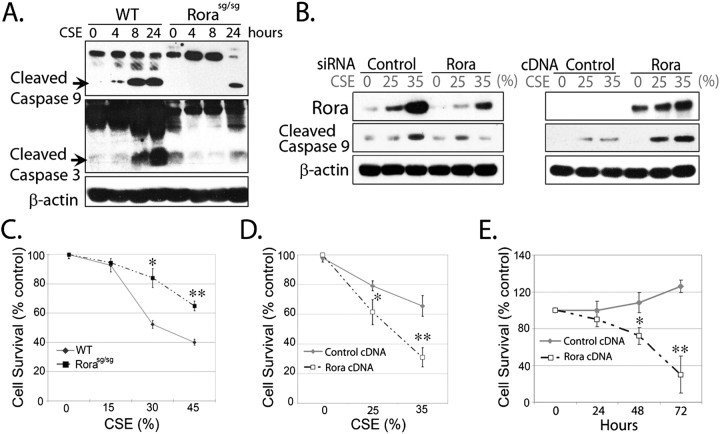
(A) Immunoblots demonstrating decreased caspase 3 and caspase 9 cleavage in retinoic acid–related orphan receptor-α(Rora)sg/sg fibroblasts compared with wild-type (WT) control fibroblasts in response to cigarette smoke extract (CSE) treatment. (B) Inhibition of Rora expression in the Beas-2B epithelial cell line using siRNA leads to decreased caspase 9 cleavage in response to CSE, whereas overexpression of RORA by cDNA transfection enhances caspase 9 cleavage in response to CSE. (C) Cell viability is higher in Rorasg/sg than control cells 24 hour after treatment with CSE (0–45%). (D) Transiently transfected Beas-2B cells overexpressing Rora and treated with CSE have lower survival relative to control transfected cells treated with CSE. (E) Rora overexpression alone decreases cell viability at late time-points (2 and 3 d) compared with control transfected cells. *P < 0.05 relative to control, **P < 0.005 relative to control. At least three independent experiments were conducted for each condition.
Figure 5.
Figure 5.
(A and B) mRNA and protein levels of two p53 target genes, Bax and Dram, are significantly lower in retinoic acid–related orphan receptor-α(Rora)sg/sg cells than in wild-type (WT) cells. (C) Rora overexpression in p53−/− fibroblasts led to increased γ-H2AX and p- ataxia telangectasia mutated (ATM) expression as in WT fibroblasts. (D) Overexpression of Rora led to the same extent of cell death in p53−/− fibroblasts as WT fibroblasts. *P < 0.05 relative to WT control; **P < 0.005 relative to WT. At least three independent experiments were conducted for each condition. CSE = cigarette smoke extract.
Figure 6.
Figure 6.
(A) Change in cytokine levels in whole-lung homogenate of smoke-exposed mice. Rora = retinoic acid–related orphan receptor-α; TNF = tumor necrosis factor; WT = wild-type. (B) Representative images of lungs from Rorasg/sg and WT smoke-exposed mice. (C) Quantitation of airspace enlargement (mean linear intercept) of smoke-exposed mice; *P < 0.05 relative to untreated, **P < 0.05 relative to WT treated. (D) Western blot showing increased γ-H2AX expression in whole mouse lung homogenate in Rorasg/sg control subjects and in response to cigarette smoke. (E) Densitometry of the blot shown in D; *P < 0.05 relative to WT control.
Figure 7.
Figure 7.
(A) DNA lesions per 10 kb genomic DNA isolated from whole-lung homogenate of nonsmokers, current smokers without airway obstruction (G0), mild-to-moderate airway obstruction (G2), and severe airway obstruction (G4). One-way analysis of variance, P < 0.0001; *P < 0.05 compared with nonsmoking control subjects; **P < 0.05 compared with nonsmoking control subjects and G0. The assay was replicated three times using the same samples. (B) Western blot showing increased γ-H2AX in whole-lung homogenate of patients with mild-to-moderate (G2) and severe (G4) chronic obstructive pulmonary disease. (C) Western blot showing increased p53 in whole-lung homogenate of patients with mild-to-moderate (G2) and severe (G4) chronic obstructive pulmonary disease.

References

    1. Stapleton CM, Jaradat M, Dixon D, Kang HS, Kim SC, Liao G, Carey MA, Cristiano J, Moorman MP, Jetten AM. Enhanced susceptibility of staggerer (roralphasg/sg) mice to lipopolysaccharide-induced lung inflammation. Am J Physiol Lung Cell Mol Physiol 2005;289:L144–L152. - PubMed
    1. Jaradat M, Stapleton C, Tilley SL, Dixon D, Erikson CJ, McCaskill JG, Kang HS, Angers M, Liao G, Collins J, et al. Modulatory role for retinoid-related orphan receptor alpha in allergen-induced lung inflammation. Am J Respir Crit Care Med 2006;174:1299–1309. - PMC - PubMed
    1. Meyer T, Kneissel M, Mariani J, Fournier B. In vitro and in vivo evidence for orphan nuclear receptor roralpha function in bone metabolism. Proc Natl Acad Sci U S A 2000;97:9197–9202. - PMC - PubMed
    1. Ueda HR, Chen W, Adachi A, Wakamatsu H, Hayashi S, Takasugi T, Nagano M, Nakahama K, Suzuki Y, Sugano S, et al. A transcription factor response element for gene expression during circadian night. Nature 2002;418:534–539. - PubMed
    1. Coste H, Rodriguez JC. Orphan nuclear hormone receptor rev-erbalpha regulates the human apolipoprotein CIII promoter. J Biol Chem 2002;277:27120–27129. - PubMed

MeSH terms