


Evaluation of the effectiveness of neuromuscular training to reduce anterior cruciate ligament injury in female athletes: a critical review of relative risk reduction and numbers-needed-to-treat analyses
- PMID: 22745221
- PMCID: PMC4164156
- DOI: 10.1136/bjsports-2011-090895
Evaluation of the effectiveness of neuromuscular training to reduce anterior cruciate ligament injury in female athletes: a critical review of relative risk reduction and numbers-needed-to-treat analyses
Abstract
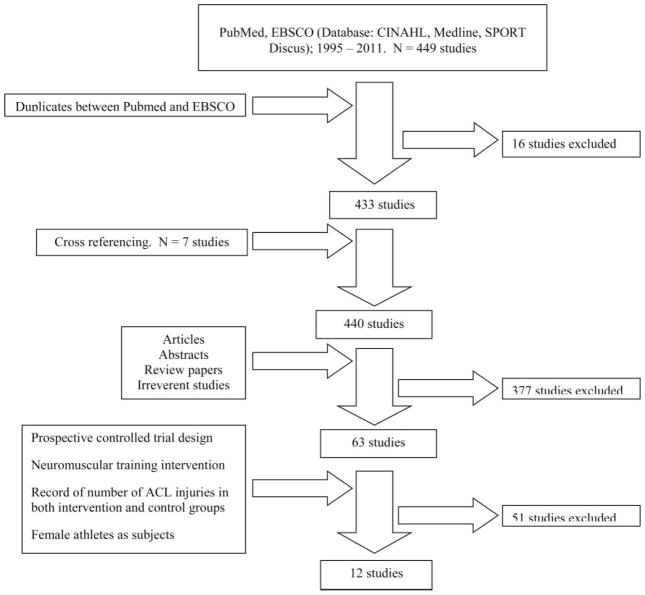
Since previous numbers-needed-to-treat (NNT) and relative risk reduction (RRR) report, a few studies were published to evaluate prophylactic effectiveness of neuromuscular training for anterior cruciate ligament (ACL) injury in female athletes. The purpose of the current analyses was to determine the effectiveness of neuromuscular training interventions in reducing both non-contact and overall ACL injury risk in female athletes through RRR and NNT. The keywords 'knee', 'anterior cruciate ligament', 'ACL', 'prospective', 'neuromuscular', 'training', 'female' and 'prevention' were searched to find studies published from 1995 to 2011 in PubMed and EBSCO (CINAHL, Health source, MEDLINE and SPORT Discus). Inclusion criteria required that relevant studies: recruited physically active young girls as subjects, documented the number of ACL injuries, employed a neuromuscular training intervention, and used a prospective controlled study design. The numbers of non-contact and overall ACL injuries, subjects and observation time period were used to calculate RRR and NNT for each study. A total of 12 studies met the inclusion criteria. There was a 73.4% (95% CI 62.5% to 81.1%) and 43.8% (95% CI 28.9% to 55.5%) of RRR for non-contact and overall ACL injuries. From the NNT analysis, it was determined that, respectively, 108 (95% CI 86 to 150) and 120 (95% CI 74 to 316) individuals would need to be trained to prevent one non-contact or one overall ACL injury over the course of one competitive season. Although the RRR analysis indicated prophylactic benefits of neuromuscular training, the relatively large NNT indicated that many athletes are needed to prevent one ACL injury. A future direction to reduce NNT and improve the efficiency of ACL injury-prevention strategies is to develop a screening system for identifying at-risk athletes.
References
-
- Gottlob CA, Baker CL, Jr, Pellissier JM, et al. Cost effectiveness of anterior cruciate ligament reconstruction in young adults. Clin Orthop Relat Res. 1999:272–82. - PubMed
-
- Cimino F, Volk BS, Setter D. Anterior cruciate ligament injury: diagnosis, management, and prevention. Am Fam Physician. 2010;82:917–22. - PubMed
-
- Dugan SA. Sports-related knee injuries in female athletes: what gives? Am J Phys Med Rehabil. 2005;84:122–30. - PubMed
-
- Morrey MA, Stuart MJ, Smith AM, et al. A longitudinal examination of athletes’ emotional and cognitive responses to anterior cruciate ligament injury. Clin J Sport Med. 1999;9:63–9. - PubMed
Publication types
MeSH terms
Grants and funding
LinkOut - more resources
Full Text Sources
Other Literature Sources
Medical
Miscellaneous
