. 2012:2:471.
doi: 10.1038/srep00471. Epub 2012 Jun 28.

Understanding the nature of "superhard graphite"

Affiliations

Understanding the nature of "superhard graphite"

Salah Eddine Boulfelfel et al. Sci Rep. 2012.

Abstract

Numerous experiments showed that on cold compression graphite transforms into a new superhard and transparent allotrope. Several structures with different topologies have been proposed for this phase. While experimental data are compatible with most of these models, the only way to solve this puzzle is to find which structure is kinetically easiest to form. Using state-of-the-art molecular-dynamics transition path sampling simulations, we investigate kinetic pathways of the pressure-induced transformation of graphite to various superhard candidate structures. Unlike hitherto applied methods for elucidating nature of superhard graphite, transition path sampling realistically models nucleation events necessary for physically meaningful transformation kinetics. We demonstrate that nucleation mechanism and kinetics lead to M-carbon as the final product. W-carbon, initially competitor to M-carbon, is ruled out by phase growth. Bct-C₄ structure is not expected to be produced by cold compression due to less probable nucleation and higher barrier of formation.


Figures
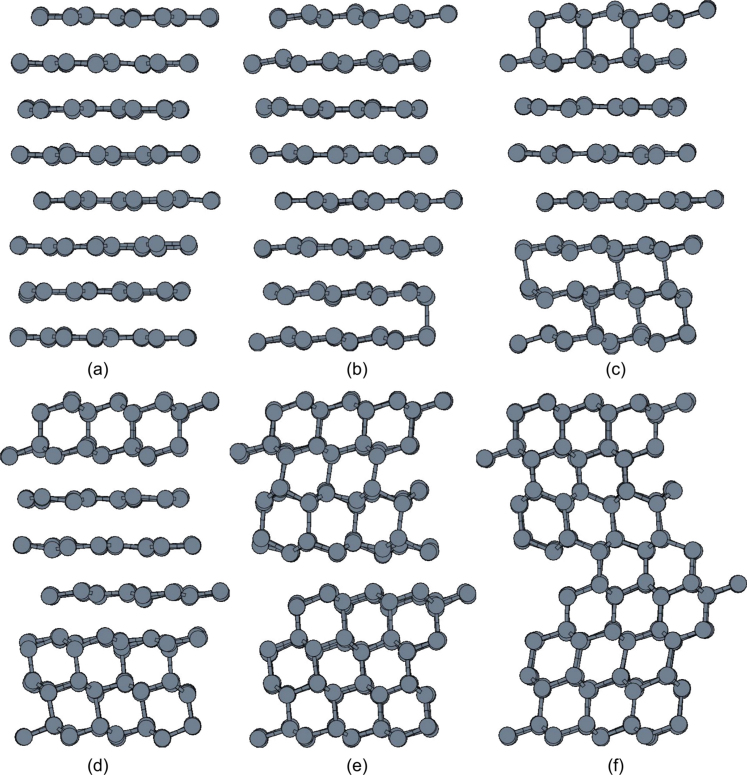
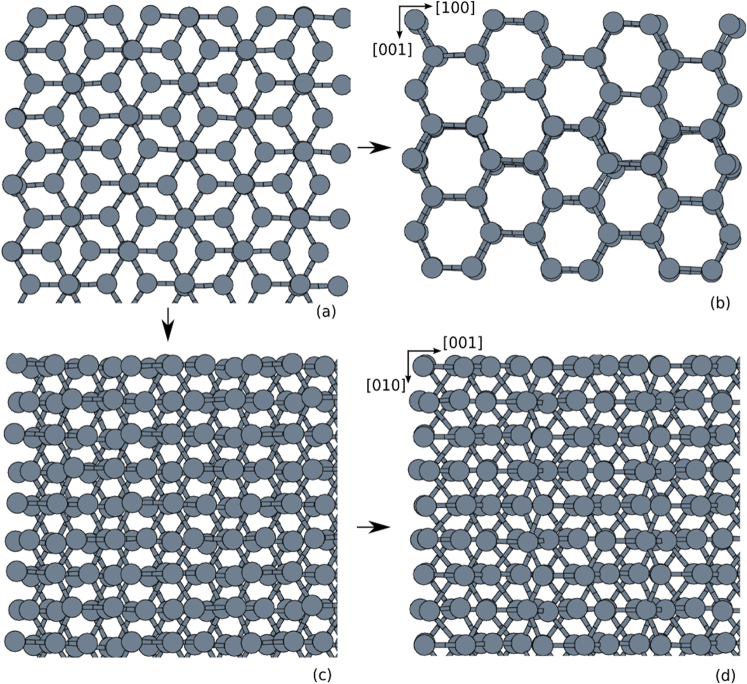
Figure 1
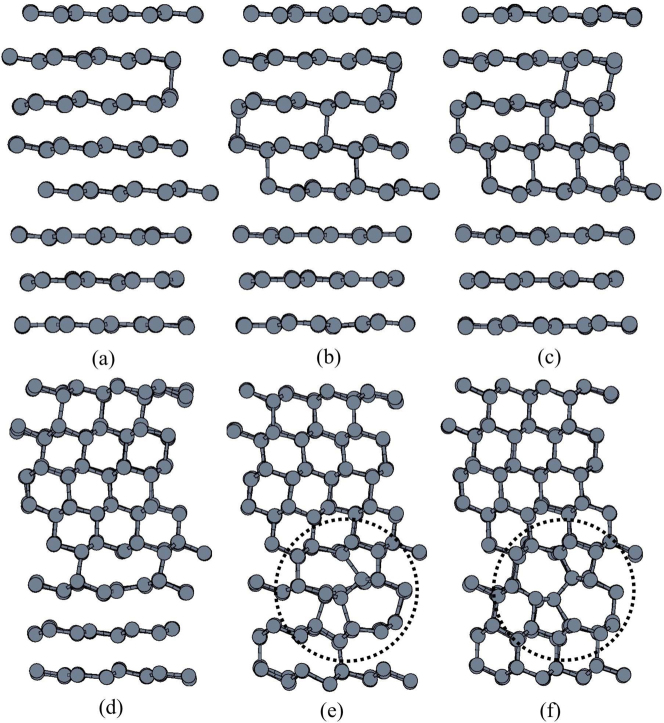
Figure 1. Snapshots from a dynamical trajectory collected from transition path sampling connecting (a) graphite to (f) a polytype intermediate between cubic and hexagonal diamond.
The buckling of graphene layers in initiated by the formation of C–C bonds along [001]graphite (b)–(c). Domains of cubic diamond are formed with different orientation (d)–(e). The interface between the latter domains defines a region of hexagonal diamond (e)–(f).
Figure 2
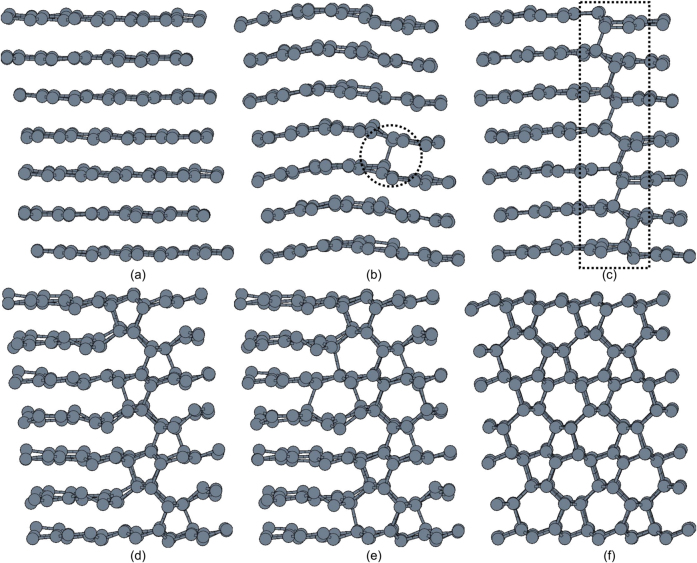
Figure 2. Snapshots from a representative trajectory illustrating the evolution of the graphite to cubic diamond transition regime.
The mobility of graphene layers during the reconstruction creates (d)–(f) an inset of 5- and 7-membered rings (dotted circle) within a 6-membered rings network. This inset interfaces well with cubic diamond and represents the seed of the metastable phase resulting from the cold compression of graphite.
Figure 3
Figure 3. Snapshots of a representative trajectory of the stable regime corresponding to the cold compression of graphite.
A single event of (a) bond formation (dotted circle) between graphene layers triggers (b) a series of bond formation along [001]graphite in a zigzag fashion (dotted rectangle). The latter contacts facilitate the formation of (c)–(d) 5-membered rings causing the corrugation of graphene layers and inducing the formation of (d)–(e) 7-membered rings.
Figure 4
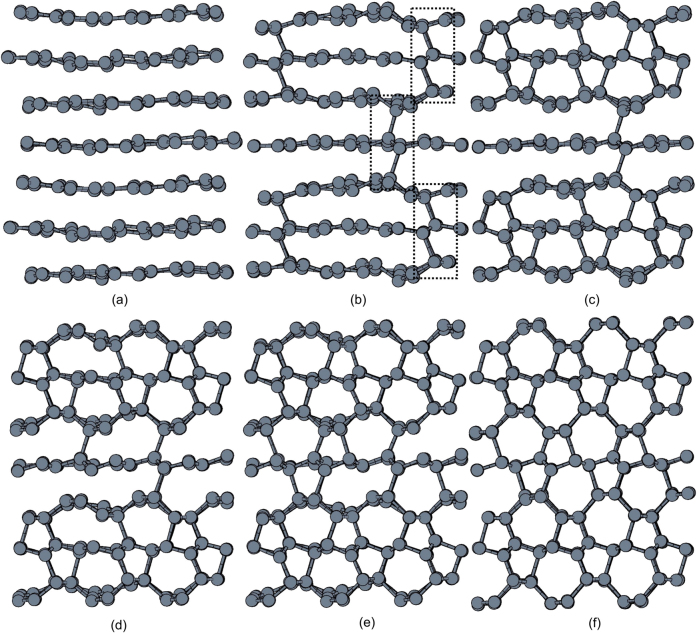
Figure 4. Snapshots taken from a representative graphite to W-carbon transformation pathway.
The buckling of graphene layers is initiated by (a)–(b) formation C–C contacts along [001]graphite in the form of finite size zigzag chains. Each zigzag chain facilitates the corrugation of graphene layers inducing the formation of (c)–(e) 5- and 7-membered rings transforming graphite into (f) W-carbon.
Figure 5
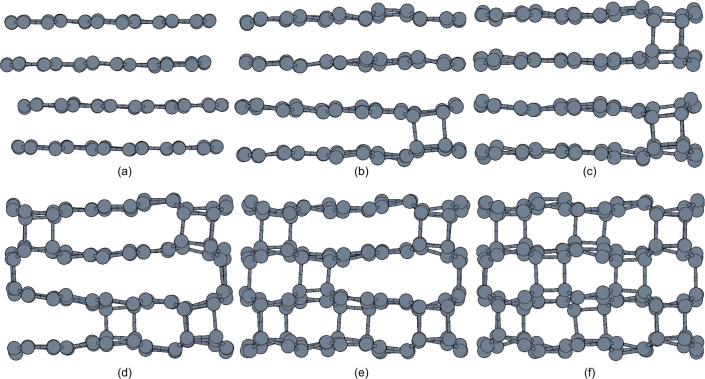
Figure 5. Snapshots taken from a representative graphite to bct-C4 transformation pathway.
The transition proceeds via nucleation of C4 square units. Further growth is achieved by corrugation of graphene layers to form more C4 units and reconstruct the graphite into bct-C4.
Figure 6
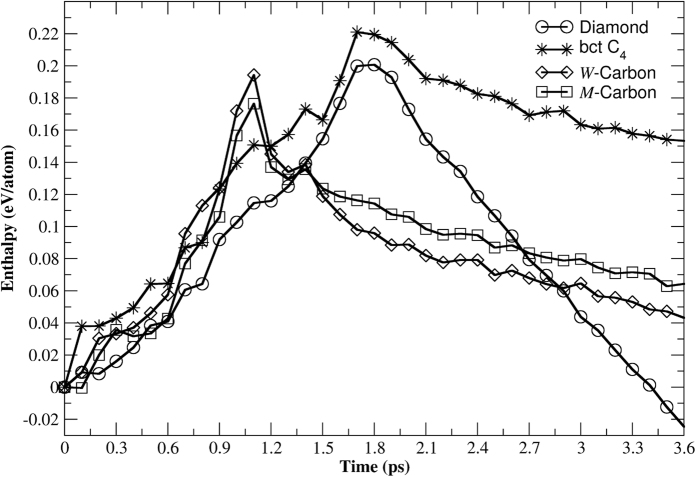
Figure 6. Enthalpy variation of different simulated transformations of graphite under pressure (15 GPa) and ambient temperature.
The graphite to M-carbon transformation route (square line) indicates a lower energy barrier than the transition to W-carbon (diamond line). The possibility of graphite transformation into bct-C4 structure (star line) on cold compression is ruled out because of higher barrier than the graphite to cubic diamond transition (circle line).
Figure 7
Figure 7. Top view of graphene layers sliding fashions parallel to (001) plane.
The (a) graphite to (b) bct-C4 transition requires an eclipsed arrangement of next-neighboring layer along [001] and changes the layers stacking sequence from …AB… into …AA… in order to trigger layers buckling (only 3 graphitic layers are shown for better clarity). The (a) graphite to (d) M-carbon transformation implies small atomic displacements to induce (c) the onset of graphitic layers buckling.

References

    1. Oganov A. R. (ed.) Modern Methods of Crystal Structure Prediction (WILEY-VCH, Weinheim, 2010).
    1. Oganov A. R. et al. Ionic high-pressure form of elemental boron. Nature 457, 863–867 (2009). - PubMed
    1. Ma Y. et al. Transparent dense sodium. Nature 458, 182–185 (2009). - PubMed
    1. Li Q. et al. Superhard Monoclinic Polymorph of Carbon. Phys. Rev. Lett. 102, 175506–175509 (2009). - PubMed
    1. Umemoto K., Wentzcovitch R. M., Saito S. & Miyake T. Body-Centered Tetragonal C4: A Viable sp3 Carbon Allotrope. Phys. Rev. Lett. 104, 125504–125507 (2010). - PubMed

Publication types