. 2012 Aug 3;11(8):4308-14.
doi: 10.1021/pr3004216. Epub 2012 Jul 13.

Evaluation of the compact high-field orbitrap for top-down proteomics of human cells

Affiliations

Evaluation of the compact high-field orbitrap for top-down proteomics of human cells

Dorothy R Ahlf et al. J Proteome Res. .

Abstract

Mass spectrometry based proteomics generally seeks to identify and fully characterize protein species with high accuracy and throughput. Recent improvements in protein separation have greatly expanded the capacity of top-down proteomics (TDP) to identify a large number of intact proteins. To date, TDP has been most tightly associated with Fourier transform ion cyclotron resonance (FT-ICR) mass spectrometry. Here, we couple the improved separations to a Fourier-transform instrument based not on ICR but using the Orbitrap Elite mass analyzer. Application of this platform to H1299 human lung cancer cells resulted in the unambiguous identification of 690 unique proteins and over 2000 proteoforms identified from proteins with intact masses<50 kDa. This is an early demonstration of high throughput TDP (>500 identifications) in an Orbitrap mass spectrometer and exemplifies an accessible platform for whole protein mass spectrometry.


Figures
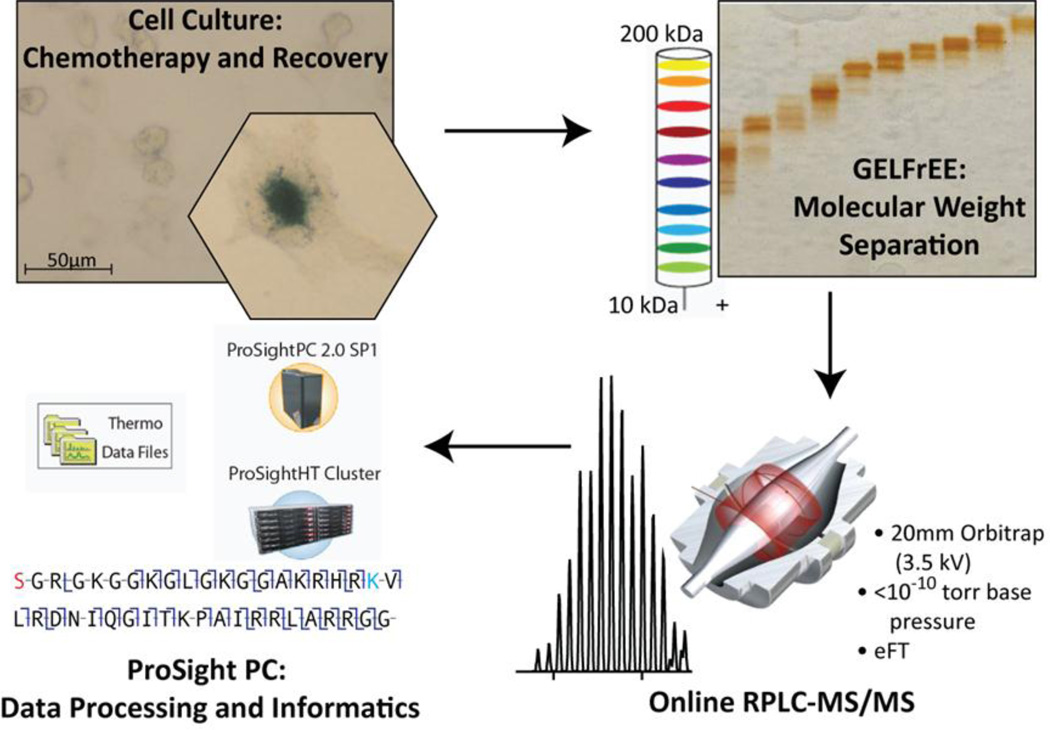
Figure 1
Figure 1
The overall platform used in this study of proteins from H1299 cells. Cell cultures treated and untreated were harvested in pellets from ~107 cells, and lysed. Protein aliquots of 200–400 µg were separated by GELFREE and SDS was removed. Analysis by nano-capillary RPLC-MS/MS with CID, ETD, HCD, or SID fragmentation followed. Data analysis and informatics was performed using ProSight running on a cluster or single PC with data processing routines detailed in the main text.
Figure 2
Figure 2
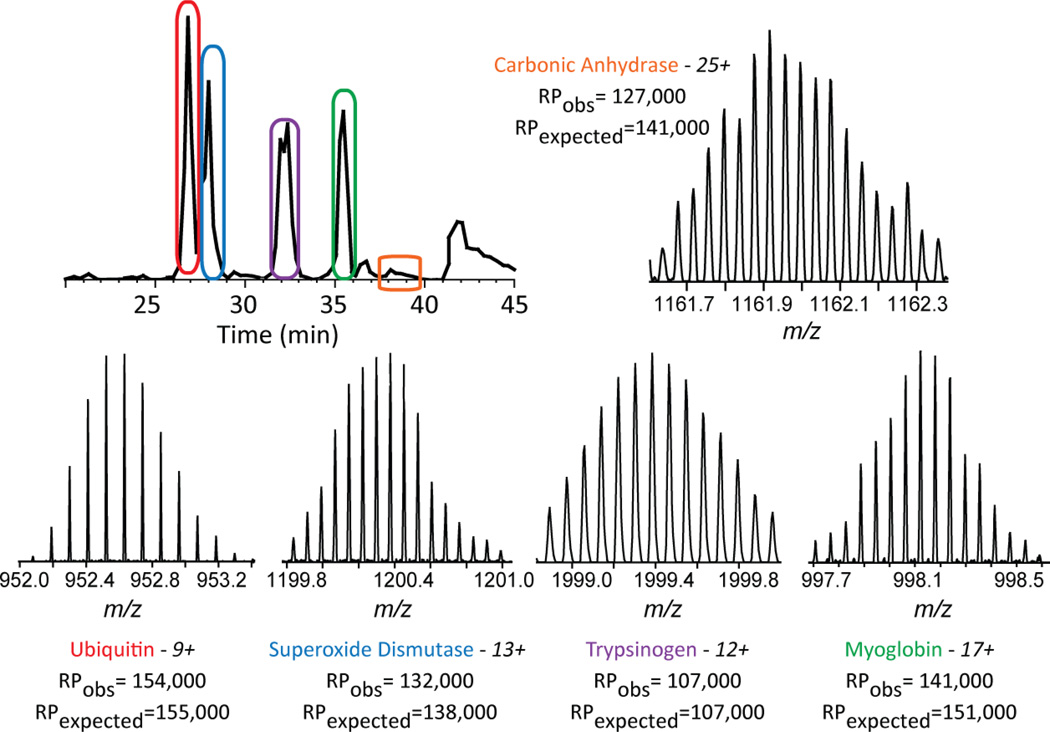
Intact protein standards. Five protein standards were separated in a linear gradient. All proteins were isotopically resolved, and with the exception of trypsinogen, were completely characterized by MS/MS; RP= resolving power.
Figure 3
Figure 3
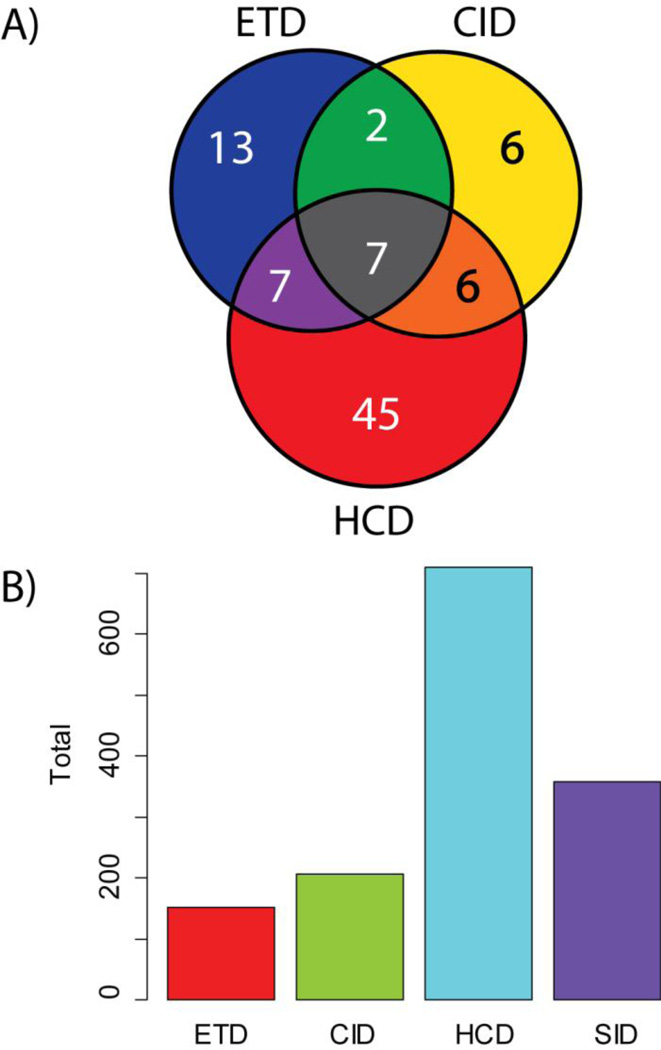
A) Comparison of identifications across the three main fragmentation methods used in this study. For 6 LC-MS/MS runs encompassing the mass range of 5–20 kDa, a top 2 experiment, rotating between the three main fragmentation methods, produced a total of 96 identifications of unique Swiss-Prot accession numbers, separated as shown. ETD, HCD, and CID fragmented each target for a total of 6 fragmentation scans in a top 2 data-dependent experiment. B) Histogram of unique identifications separated by method of fragmentation. 45% of LC-MS/MS runs were fragmented using HCD, partially explaining the observed bias. Many proteins were also identified using multiple fragmentation methods.
Figure 4
Figure 4
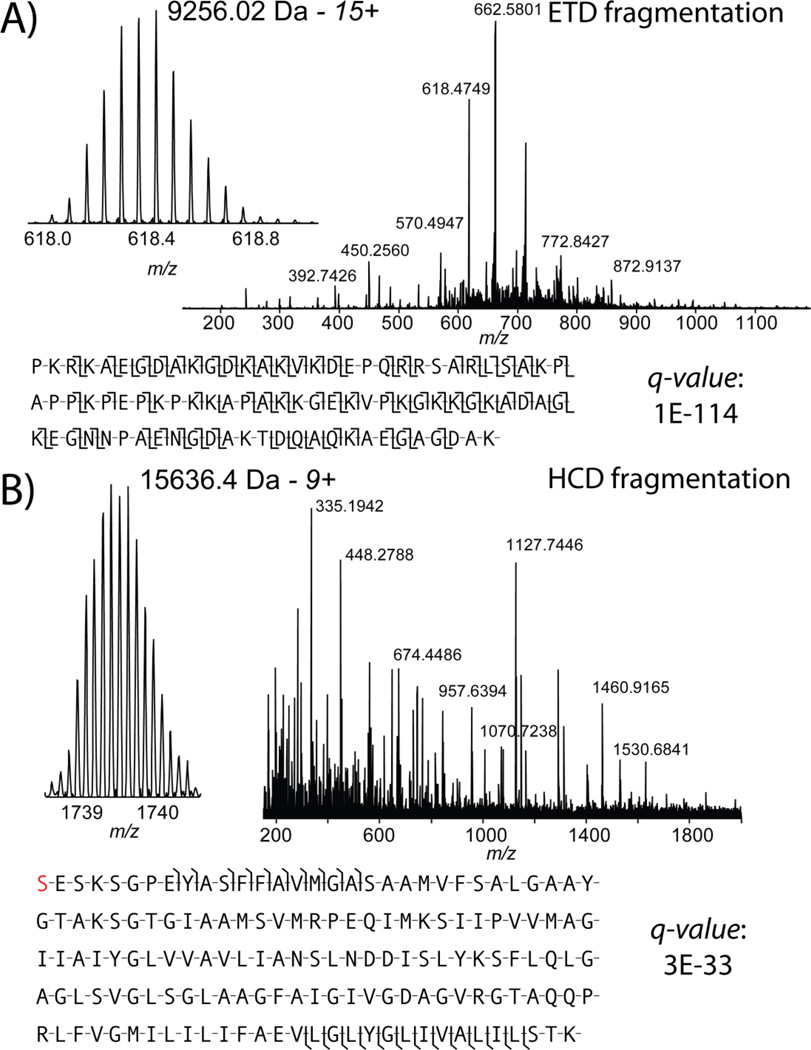
Two example identifications obtained in discovery mode. A) Online electron transfer dissociation provided complete characterization of HMG-17 with a q-value of 1 × 10−114. B) Online HCD also provided a confident identification of the 15.6 kDa proteolipid subunit from the V-type ATPase with a q-value of 3 × 10⁻³³.
Figure 4
Figure 4
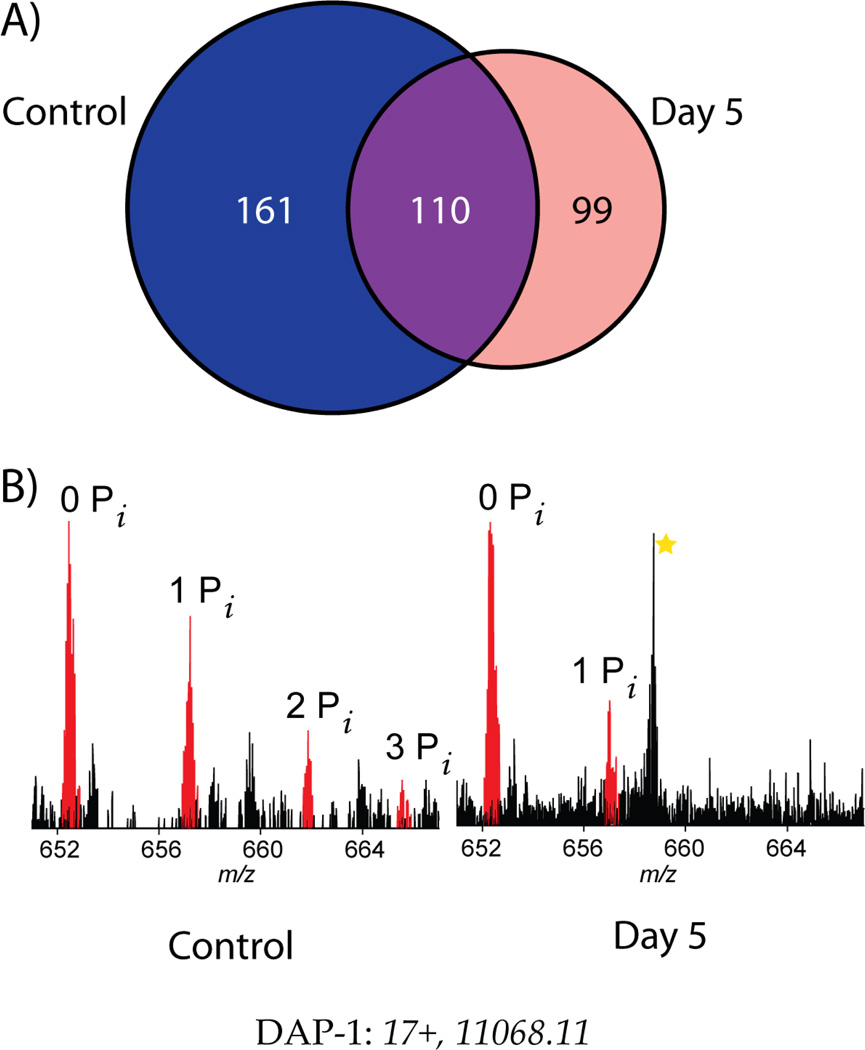
Initial scan for proteins dynamic with the onset of cellular senescence 5 days after treatment with a DNA-damaging agent. A) A Venn diagram detailing identifications from two biological replicate injections of whole cell lysate separated on a 12% GELFREE cartridge (masses up to 35 kDa). B) An example of PTM changes across senescence with Death Associated Protein-1 (DAP-1). Prior to the onset of senescence, two phosphorylations are clearly visible with a third possible. After the onset of senescence, only one phosphorylation is observed, and at a lower stoichiometry than originally observed. The absolute signal intensities are comparable, strongly supporting the assertion that a hypophosphorylated state is adopted on DAP-1 during senescence.

References

    1. Wisniewski JR, Zougman A, Nagaraj N, Mann M. Universal sample preparation method for proteome analysis. Nature Methods. 2009;6:359–362. - PubMed
    1. Tran JC, Zamdborg L, Ahlf DR, Lee JE, Catherman AD, Durbin KR, Tipton JD, Vellaichamy A, Kellie JF, Li M, Wu C, Sweet SMM, Early BP, Siuti N, LeDuc RD, Compton PD, Thomas PM, Kelleher NL. Mapping intact protein isoforms in discovery mode using top-down proteomics. Nature. 2011;480:254–258. - PMC - PubMed
    1. Service RF. Proteomics ponders prime time. Science. 2008;321:1758–1761. - PubMed
    1. Nesvizhskii A, Aebersold R. Interpretation of shotgun proteomic data: the protein inference problem. Molecular & Cellular Proteomics. 2005;4:1419–1440. - PubMed
    1. Compton PD, Zamdborg L, Thomas PM, Kelleher NL. On the scalability and requirements of whole protein mass spectrometry. Analytical Chemistry. 2011;83:6868–6874. - PMC - PubMed

Publication types