Review
doi: 10.1146/annurev-micro-092611-150138.
Epub 2012 Jun 28.
RNA interference pathways in fungi: mechanisms and functions
Affiliations
- PMID: 22746336
- PMCID: PMC4617789
- DOI: 10.1146/annurev-micro-092611-150138
Item in Clipboard
Review
RNA interference pathways in fungi: mechanisms and functions
Annu Rev Microbiol.
2012.
Abstract
RNA interference (RNAi) is a conserved eukaryotic gene regulatory mechanism that uses small noncoding RNAs to mediate posttranscriptional/transcriptional gene silencing. The fission yeast Schizosaccharomyces pombe and the filamentous fungus Neurospora crassa have served as important model systems for RNAi research. Studies on these two organisms and other fungi have contributed significantly to our understanding of the mechanisms and functions of RNAi in eukaryotes. In addition, surprisingly diverse RNAi-mediated processes and small RNA biogenesis pathways have been discovered in fungi. In this review, we give an overview of different fungal RNAi pathways with a focus on their mechanisms and functions.
Figures
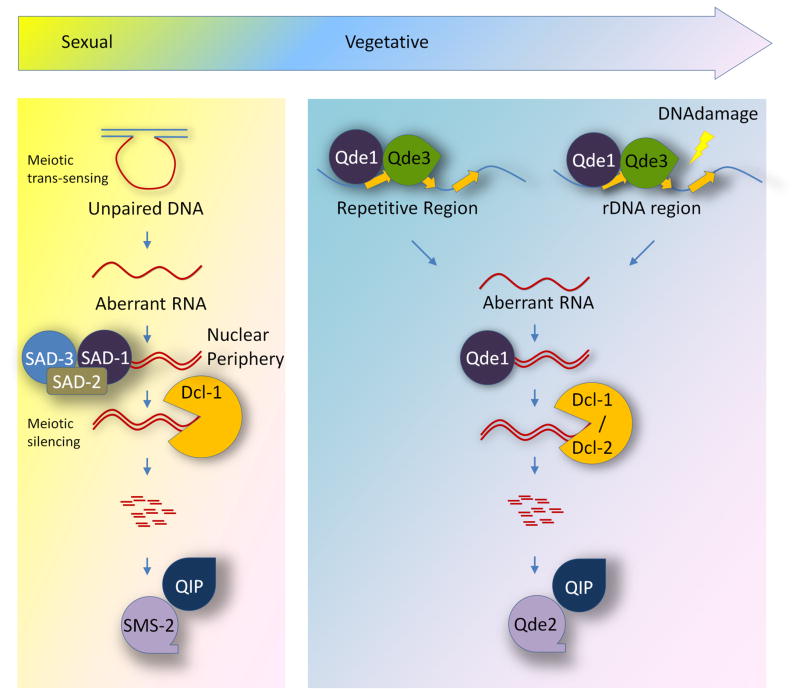
Models for RNAi-related pathways in Neurospora. During vegetative stage (right), both repetitive transgene (quelling) and ribosomal DNA loci (qiRNA) lead to the production of aRNAs by QDE-1 and QDE-3. Single-stranded aRNAs are then converted to dsRNA precursors by QDE-1. dsRNA are processed by DCLs into sRNAs, which are then loaded onto QDE-2/QIP-based RISC to execute gene silencing. During meiosis (left), unpaired DNA can be sensed and results in the production of aRNAs. aRNAs are converted to dsRNA by SAD1, SAD2, and SAD3 in the nuclear periphery. dsRNA are processed by DCL-1 into sRNAs, which are then loaded onto an SMS-2/QIP-based RISC to execute gene silencing.
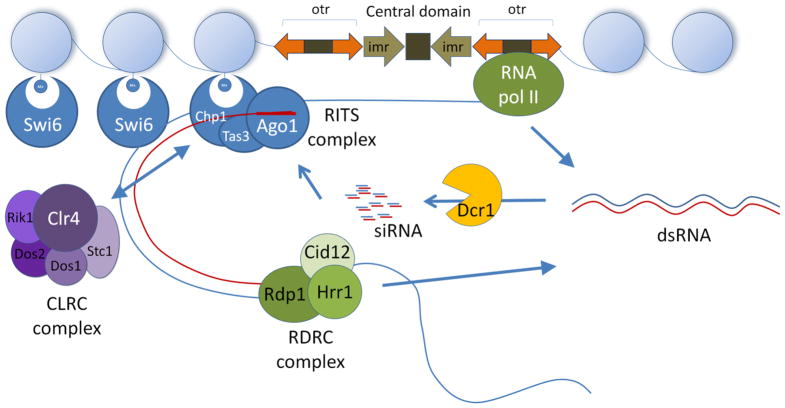
Model for RNAi-mediated heterochromatin formation in S. pombe. siRNA guided RITS complex targets the centromeric nascent transcript synthesized by RNA polymerase II during the S phase of the cell cycle. RITS associates with RDRC complex, where the RdRP activity of the RDRC complex generates more dsRNA. Dcr1 processes the dsRNA into siRNA, feeding into the loop. CLRC complex associates with the RITS complex, which comes into close proximity with the chromatin. Clr4 methylates H3K9 and allows Swi6 (HP1 homolog) to dock at the modified chromatin, thereby forming heterochromatin.
References
-
- Alexander WG, Raju NB, Xiao H, Hammond TM, Perdue TD, et al. DCL-1 colocalizes with other components of the MSUD machinery and is required for silencing. Fungal Genet Biol. 2008;45:719–27. - PubMed
-
- Aramayo R, Metzenberg RL. Meiotic transvection in fungi. Cell. 1996;86:103–13. - PubMed
-
- Bühler M, Verdel A, Moazed D. Tethering RITS to a Nascent Transcript Initiates RNAi- and Heterochromatin-Dependent Gene Silencing. Cell. 2006;125:873–86. This study demonstrate that the targeting of RITS complex via RNA to a chromosomal locus is sufficient to induce transcriptional gene silencing. - PubMed
Publication types
MeSH terms
Substances
Grants and funding
LinkOut - more resources
Full Text Sources