


Molecular epidemiology of extended-spectrum β-lactamase-producing Escherichia coli in the community and hospital in Korea: emergence of ST131 producing CTX-M-15
- PMID: 22747570
- PMCID: PMC3458991
- DOI: 10.1186/1471-2334-12-149
Molecular epidemiology of extended-spectrum β-lactamase-producing Escherichia coli in the community and hospital in Korea: emergence of ST131 producing CTX-M-15
Abstract
Background: The prevalence of extended-spectrum β-lactamase (ESBL)-producing Escherichia coli has been increased not only in the hospital but also in the community worldwide. This study was aimed to characterize ESBL- producing E. coli isolates and to investigate the molecular epidemiology of community isolates in comparison with hospital isolates at a single center in Korea.
Methods: A total of 142 ESBL-producing E. coli isolates were collected at Daejeon St Mary's Hospital in Korea from January 2008 to September 2009. The ESBLs were characterized by PCR sequencing using specific primers. The genetic relatedness was determined by pulsed field gel electrophoresis (PFGE) and multilocus sequence typing (MLST).
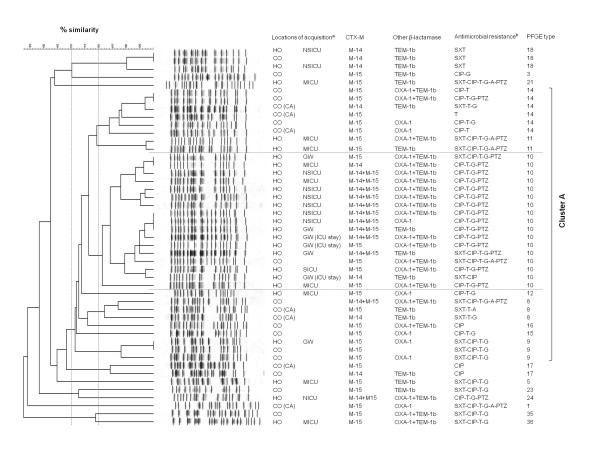
Results: Of 142 isolates, 139 were positive for CTX-M type ESBLs; CTX-M-14 (n = 69, 49.6 %), CTX-M-15 (n = 53, 38.1 %) and both CTX-M-14 and -15 (n = 17, 12.2 %). CTX-M-14 and CTX-M-15 were detected in both community and hospital isolates whereas isolates producing both CTX-M14 and-15 were mainly identified in the hospital. CTX-M producing E. coli isolates were genetically heterogeneous, revealing 75 distinct PFGE types. By MLST, 21 distinctive STs including 5 major STs (ST131, ST405, ST38, ST10, and ST648) were identified. Major STs were distributed in both community and hospital isolates, and ST131 was the predominant clone regardless of the locations of acquisition. No specific major STs were confined to a single type of ESBLs. However, ST131 clones were significantly associated with CTX-M-15 and the majority of them were multidrug-resistant. Distinctively, we identified a hospital epidemic caused by the dissemination of an epidemic strain, ST131-PFGE type 10, characterized by multidrug resistance and co-producing both CTX-Ms with OXA-1 or TEM-1b.
Conclusions: The epidemiology of ESBL-producing E. coli is a complex and evolving phenomenon attributed to the horizontal transfer of genetic elements and clonal spread of major clones, predominantly ST131. The multidrug resistant ST131 clone producing CTX-M-15 has emerged as a major clone in both the community and hospital, suggesting the widespread of this epidemic clone in Korea.
Figures
References
-
- Woodford N, Ward ME, Kaufmann ME, Turton J, Fagan EJ, James D, Johnson AP, Pike R, Warner M, Cheasty T. et al. Community and hospital spread of Escherichia coli producing CTX-M extended-spectrum β-lactamases in the UK. J Antimicrob Chemother. 2004;54(4):735–743. doi: 10.1093/jac/dkh424. - DOI - PubMed
-
- Peirano G, Costello M, Pitout JD. Molecular epidemiology over an 11-year period (2000 to 2010) of extended-spectrum β-lactamase-P\producing Escherichia coli causing bacteremia in a centralized Canadian region. Int J Antimicrob Agents. 2010;36(1):19–23. doi: 10.1016/j.ijantimicag.2010.02.016. - DOI - PubMed
Publication types
MeSH terms
Substances
LinkOut - more resources
Full Text Sources
Medical
