


The response of face-selective cortex with single face parts and part combinations
- PMID: 22750118
- PMCID: PMC3423083
- DOI: 10.1016/j.neuropsychologia.2012.06.016
The response of face-selective cortex with single face parts and part combinations
Abstract
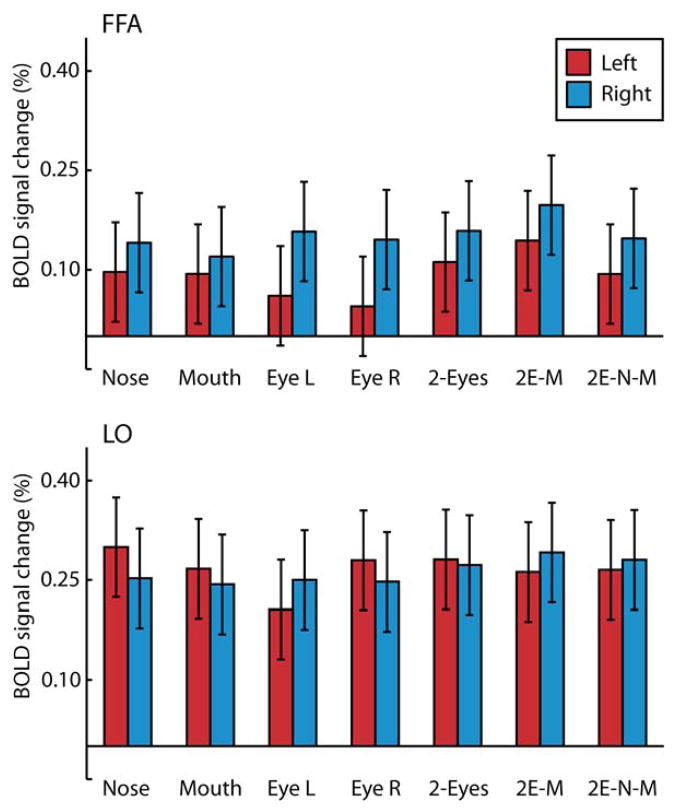
A critical issue in object recognition research is how the parts of an object are analyzed by the visual system and combined into a perceptual whole. However, most of the previous research has examined how changes to object parts influence recognition of the whole, rather than recognition of the parts themselves. This is particularly true of the research on face recognition, and especially with questions related to the neural substrates. Here, we investigated patterns of BOLD fMRI brain activation with internal face parts (features) presented singly and in different combinations. A preference for single features over combinations was found in the occipital face area (OFA) as well as a preference for the two-eyes combination stimulus over other combination stimulus types. The fusiform face area (FFA) and lateral occipital cortex (LO) showed no preferences among the single feature and combination stimulus types. The results are consistent with a growing view that the OFA represents processes involved in early, feature-based analysis.
Copyright © 2012 Elsevier Ltd. All rights reserved.
Figures


References
-
- Avidan G, Harel M, Hendler T, Ben-Bashat D, Zohary E, Malach R. Contrast sensitivity in human visual areas and its relationship to object recognition. Journal of Neurophysiology. 2002;87(6):3102–3116. - PubMed
-
- Betts LR, Wilson HR. Heterogeneous structure in face-selective human occipito-temporal cortex. Journal of Cognitive Neuroscience. 2010;22(10):2276–2288. - PubMed
-
- Brainard DH. The Psychophysics Toolbox. Spat Vis. 1997;10(4):433–436. - PubMed
Publication types
MeSH terms
Grants and funding
LinkOut - more resources
Full Text Sources
Medical
