. 2012 Jul 1;26(13):1427-32.
doi: 10.1101/gad.192872.112.

Conserved microRNA miR-8 controls body size in response to steroid signaling in Drosophila

Affiliations

Conserved microRNA miR-8 controls body size in response to steroid signaling in Drosophila

Hua Jin et al. Genes Dev. .

Abstract

Body size determination is a process that is tightly linked with developmental maturation. Ecdysone, an insect maturation hormone, contributes to this process by antagonizing insulin signaling and thereby suppressing juvenile growth. Here, we report that the microRNA miR-8 and its target, u-shaped (USH), a conserved microRNA/target axis that regulates insulin signaling, are critical for ecdysone-induced body size determination in Drosophila. We found that the miR-8 level is reduced in response to ecdysone, while the USH level is up-regulated reciprocally, and that miR-8 is transcriptionally repressed by ecdysone's early response genes. Furthermore, modulating the miR-8 level correlatively changes the fly body size; either overexpression or deletion of miR-8 abrogates ecdysone-induced growth control. Consistently, perturbation of USH impedes ecdysone's effect on body growth. Thus, miR-8 acts as a molecular rheostat that tunes organismal growth in response to a developmental maturation signal.


Figures
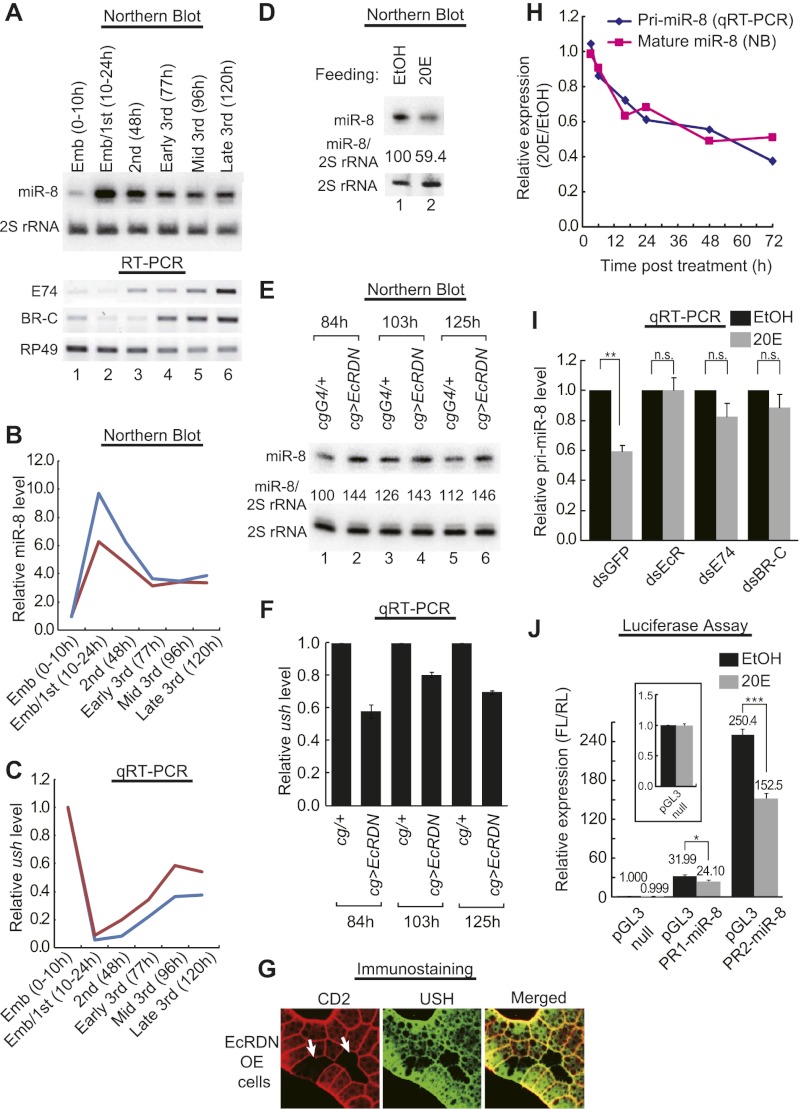
Figure 1.
Figure 1.
Regulation of miR-8 and USH by ecdysone signaling in vivo and in vitro. (A, top) Temporal expression pattern of miR-8 during larval development. (Bottom) Temporal expression patterns of E74 and BR-C during larval development. Harvesting times (AEL) are denoted above the blot. (B) Temporal expressions of miR-8 from two independent experiments are individually plotted as blue and red lines. (C) Temporal expression of ush transcripts from two independent experiments are individually plotted as blue and red lines. (D) Feeding with 20-hydroxyecdysone (20E) decreases the level of miR-8 in the whole larvae. Newly hatched larvae were fed 20E-containing (0.25 mg/mL) glucose–yeast paste until 3 d AEL, after which RNA was prepared. (E) Inhibition of EcR activity by expressing EcRDN in larval fat bodies increases miR-8 levels sustainably during the third instar larval period. (F) EcRDN expression in larval fat bodies sustainably decreases USH transcripts during the third instar larval period. Two biological replicates (six to nine animals from each genotype per replicate) were measured. (G) Fat cell clones overexpressing EcRDN by FLP-out GAL4 (marked by the absence of CD2; white arrows) show decreased levels of USH, as analyzed by immunostaining with USH antibody. (H) Treatment with 10 μM 20E in S2 cells progressively decreases both mature and pri-miR-8 levels in a similar pattern. pri-miR-8 levels were normalized against mitochondrial large ribosomal RNA1 (mtl rRNA1). This experiment was repeated with similar results. (I) Knockdown of EcR, E74, or BR-C impedes the repressive effect of 20E on pri-miR-8 expression in S2 cells (n = 3). (J) Promoter activity of pri-miR-8 is significantly down-regulated by 20E treatment. The inset shows a magnified graph of the pGL3-null reporter. Fivefold more pGL3-null plasmids were transfected than the other reporter plasmids (n = 3). (***) P < 0.001; (**) P < 0.02; (*) P < 0.05 compared with respective controls. (n.s.) Not significant (P > 0.3). Error bars denote SEM.
Figure 2.
Figure 2.
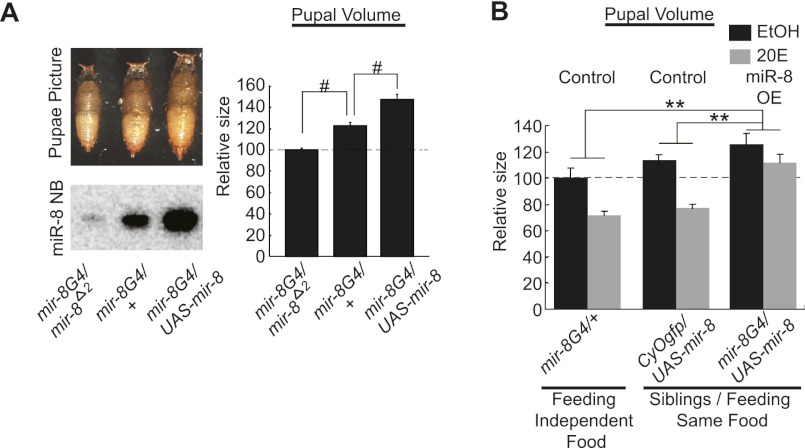
Overexpression of miR-8 makes flies bigger and insensitive to ecdysone effects of growth suppression. (A) Gradually increasing miR-8 progressively increases pupal size. (Top left) Picture of pupae whose genotypes are indicated. (Bottom left) Amounts of miR-8 in larval fat bodies in each of the indicated flies. (Right) Quantification of the pupal volumes in each of the genotypes. Approximately 20 pupae per genotype were measured. (B) Feeding larva with 20E (0.3 mg/mL) decreases final pupal size, while overexpression of miR-8 largely abolishes the suppressive effects of 20E feeding. The flies indicated as either CyOgfp/UAS-mir-8 or mir-8G4/UAS-mir-8 are siblings generated from the same parents and reared in the same vial. Relative repression folds by 20E feedings are compared between the genotypes indicated. Approximately 30 pupae per genotype were measured. (#) P < 1.6 × 10⁻⁴; (**) P < 0.01 compared with respective controls. Error bars denote SEM.
Figure 3.
Figure 3.
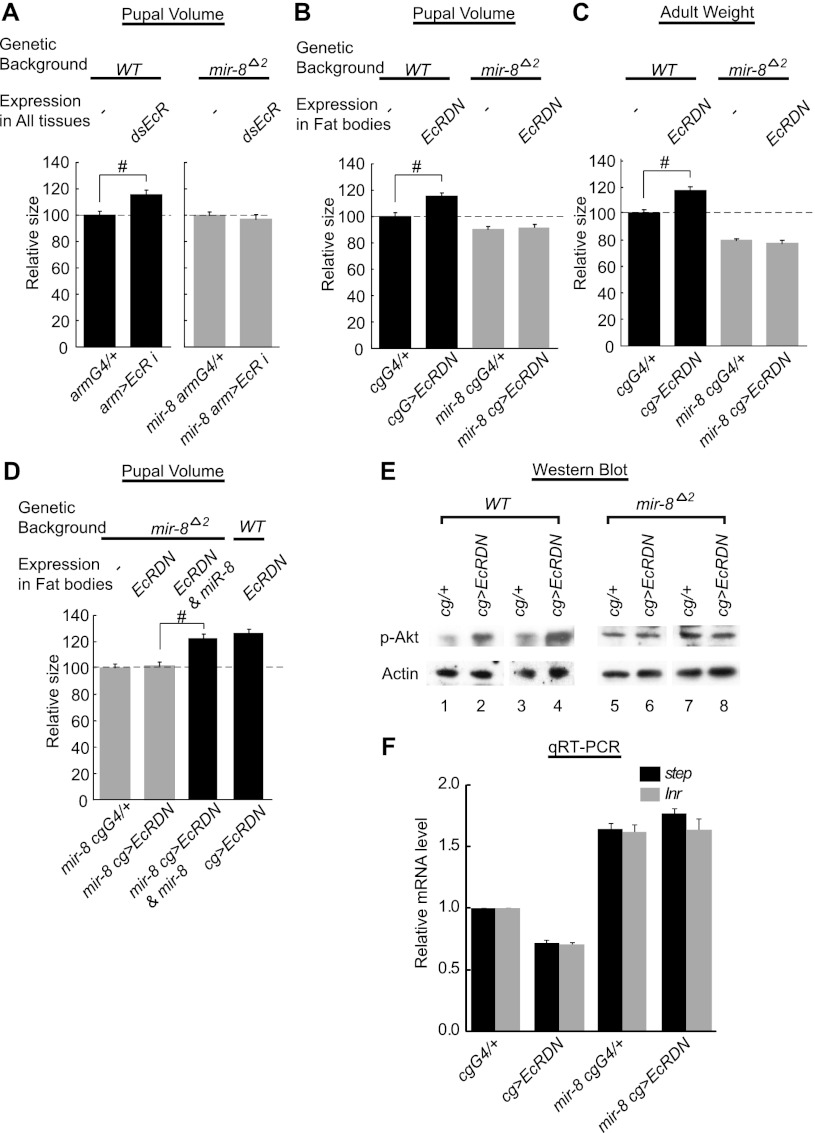
Deletion of miR-8 abrogates the EcR-mediated regulation of fly growth and insulin signaling. (A) Ubiquitous knockdown of EcR by expressing dsRNA targeting EcR using armadillo GAL4 (armG4) increases final pupal size. This effect is abrogated when miR-8 is removed. Knockdown experiment in the wild type or miR-8 mutant was independently performed, so the size was separately normalized in each genetic background. Approximately 25 pupae per genotype were measured. (B) Expression of EcRDN in fat bodies with Cg GAL4 (CgG4) increases final pupal size, the effect of which is abrogated when miR-8 is removed. Approximately 20 pupae per genotype were measured. (C) Expression of EcRDN in fat bodies increases final adult mass, and this genetic manipulation does not increase the final adult mass in the absence of miR-8. More than 33 flies per genotype were measured. (D) Re-expression of miR-8 in the fat body rescues the small body phenotype of the miR-8 mutant in which EcR is inhibited. Approximately 24 pupae per genotype were measured. (E) Expression of EcRDN in the fat bodies of the mid-third instar larva (∼98 h AEL) increases the level of phospho-Akt, while this effect on Akt is abolished when miR-8 is removed. (F) Expression of EcRDN in the fat bodies of the mid-third instar larva (∼98 h AEL) decreases the transcript levels of Inr and step, the target genes of dFOXO, while these effects are abolished when miR-8 is removed. Four biological replicates (six to nine animals from each genotype per replicate) were measured. (#) P < 2 × 10⁻³ compared with respective controls. Error bars denote SEM.
Figure 4.
Figure 4.
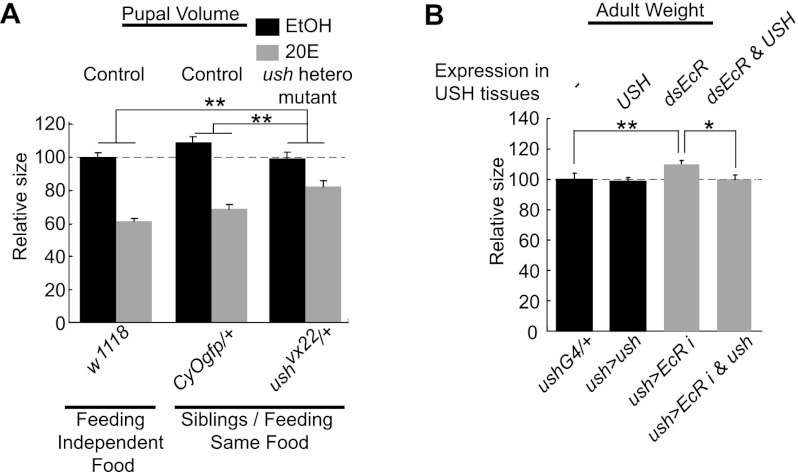
Perturbation of USH expression impedes ecdysone-mediated growth regulation. (A) Heterozygous mutants of USH (ushvx22/+) show significant resistance to the growth-suppressive effect of 20E feeding (0.3 mg/mL). The flies indicated as CyOgfp/+ or ushvx22/+ are siblings generated from the same parents and reared in the same vial. Relative repression folds by 20E feedings are compared between the genotypes indicated. Approximately 44 pupae per genotype were measured. (B) Knockdown of EcR in USH-expressing tissues noticeably increases the adult weight, and this effect is impeded by overexpression of USH. More than 21 flies per genotype were measured. (**) P < 0.01; (*) P < 0.04 compared with respective controls. Error bars denote SEM.
Figure 5.
Figure 5.
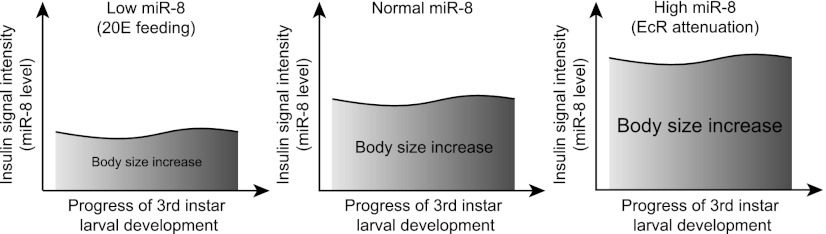
Function of miR-8 in the process of ecdysone-induced fly size determination. Ecdysone signaling continuously influences the miR-8 and, concomitantly, insulin signaling throughout the third instar larval period. When altered levels of miR-8 induced by changes in ecdysone signaling are sustained throughout this period, the effects of miR-8 alteration accumulate, leading to a significant difference in the final body size. In model figures, the increase of body size during the third instar larval period is expressed as the area under the curve (AUC).

Similar articles

Cited by

References

    1. Aravin AA, Lagos-Quintana M, Yalcin A, Zavolan M, Marks D, Snyder B, Gaasterland T, Meyer J, Tuschl T 2003. The small RNA profile during Drosophila melanogaster development. Dev Cell 5: 337–350 - PubMed
    1. Bartel DP 2009. MicroRNAs: Target recognition and regulatory functions. Cell 136: 215–233 - PMC - PubMed
    1. Brennecke J, Stark A, Russell RB, Cohen SM 2005. Principles of microRNA–target recognition. PLoS Biol 3: e85 doi: 10.1371/journal.pbio.0030085 - PMC - PubMed
    1. Britton JS, Lockwood WK, Li L, Cohen SM, Edgar BA 2002. Drosophila's insulin/PI3-kinase pathway coordinates cellular metabolism with nutritional conditions. Dev Cell 2: 239–249 - PubMed
    1. Brogiolo W, Stocker H, Ikeya T, Rintelen F, Fernandez R, Hafen E 2001. An evolutionarily conserved function of the Drosophila insulin receptor and insulin-like peptides in growth control. Curr Biol 11: 213–221 - PubMed

Publication types

LinkOut - more resources