


doi: 10.1007/s11999-012-2454-9.
Classifications in brief: the Neer classification for proximal humerus fractures
Affiliations
- PMID: 22752734
- PMCID: PMC3528923
- DOI: 10.1007/s11999-012-2454-9
Item in Clipboard
Classifications in brief: the Neer classification for proximal humerus fractures
Clin Orthop Relat Res.
2013 Jan.
No abstract available
Figures
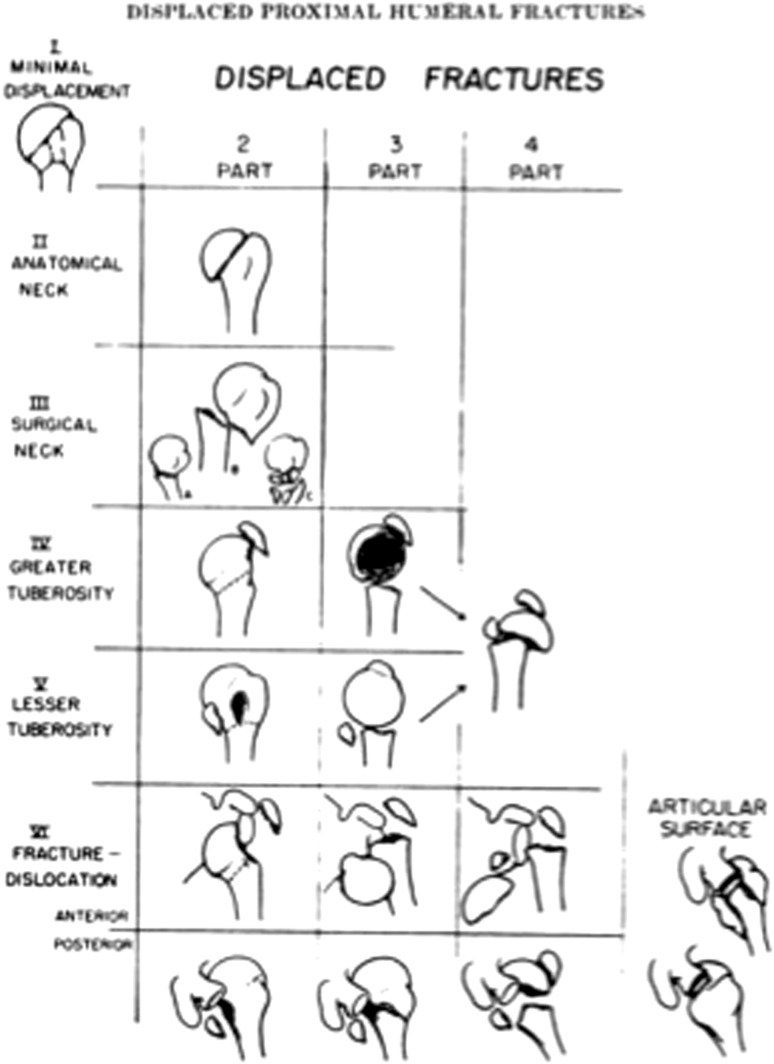
The Neer four-segment classification system for proximal humerus fractures is shown. This diagram includes the valgus impacted four-part fracture (A) and the classic displaced four-part fracture (B). (Reprinted with permission from Neer CS 2nd. Displaced proximal humeral fractures. I. Classification and evaluation. J Bone Joint Surg Am. 1970;52:1077–1089.)

The four-part fracture occurs in two forms. In the (A) classic four-part fracture, the articular surface of the head is no longer in contact with the glenoid. In the (B) valgus impacted fracture, the humeral head is driven down and the tuberosities splay out. (Reprinted with permission from Elsevier from Neer CS 2nd. Four-segment classification of proximal humeral fractures: purpose and reliable use. J Shoulder Elbow Surg. 2002;11:389–400.)
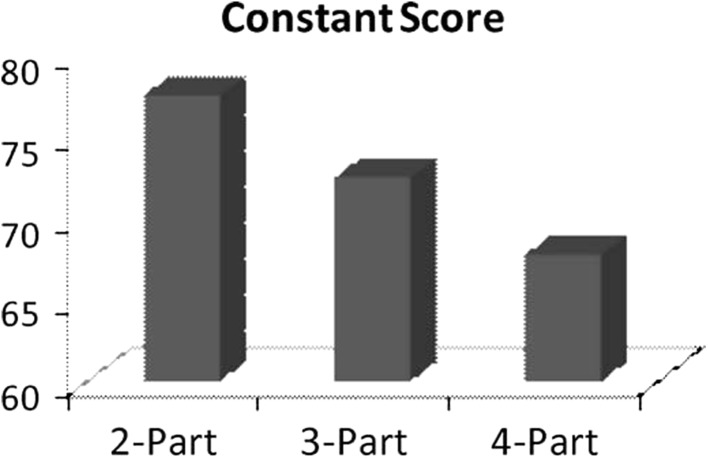
There is a correlation between functional outcome scores and the Neer classification system for patients undergoing open reduction internal fixation. The Constant score decreases with increasing fracture parts. (Reprinted with permission from Elsevier from Sproul RC, Iyengar JJ, Devcic Z, Feeley BT. A systematic review of locking plate fixation of proximal humerus fractures. Injury. 2011;42:408–413.)
References
-
- Bernstein J, Adler LM, Blank JE, Dalsey RM, Williams GR, Iannotti JP. Evaluation of the Neer system of classification of proximal humeral fractures with computerized tomographic scans and plain radiographs. J Bone Joint Surg Am. 1996;78:1371–1375. - PubMed
-
- Bohler L. The Treatment of Fractures. 5. New York, NY: Grune and Stratton; 1956.
MeSH terms
LinkOut - more resources
Full Text Sources
Other Literature Sources
Medical
