X-linked adrenoleukodystrophy presenting as Addison's disease
- PMID: 22753300
- PMCID: PMC3047513
- DOI: 10.1136/bcr.11.2009.2419
X-linked adrenoleukodystrophy presenting as Addison's disease
Abstract
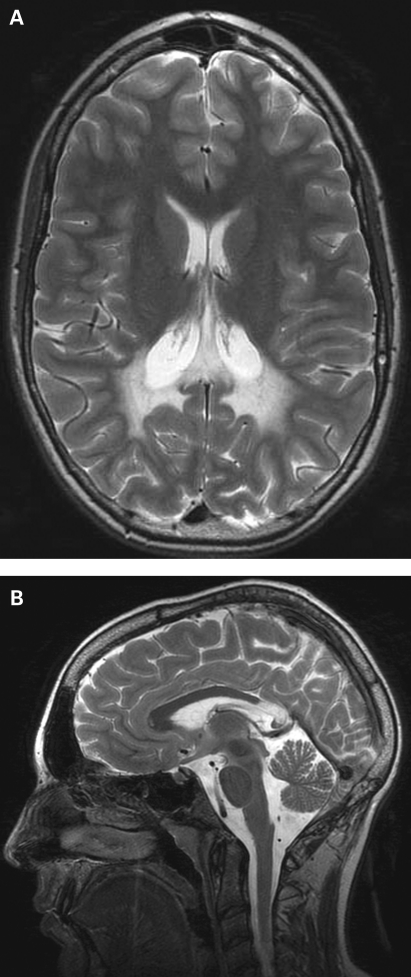
We report the case of a young man with a history of attention deficit/hyperactivity disorder and mild cognitive impairment who presented with chronic fatigue, anorexia and progressive darkening of the skin. On laboratory testing, severely depressed concentrations of morning cortisol, along with highly elevated values of adrenocorticotropic hormone (ACTH) revealed primary adrenal insufficiency as the primary cause of the patient's symptomatology. Imaging of the brain showed altered signal intensities in the parieto-occipital regions of the brain. The demonstration of increased very long chain fatty acids (VLCFA) established the diagnosis of adolescent X-linked adrenoleukodystrophy (X-ALD). Presenting at an advanced yet slowly progressive stage the patient was not a suitable candidate for haematopoietic stem cell transplantation (HSCT), and treatment focused on hormone replacement therapy, family counselling and supportive care. On follow-up visits within the following year, fatigue had diminished and there was no evidence of progressive neurological deficits. However, exacerbation of the psychiatric symptomatology resulted in admittance to a psychiatric ward.
Figures
Similar articles
-
A 29-year-old patient with adrenoleukodystrophy presenting with Addison's disease.Endocr J. 2020 Jun 29;67(6):655-658. doi: 10.1507/endocrj.EJ19-0576. Epub 2020 Feb 26. Endocr J. 2020. PMID: 32101828
-
Easily misdiagnosed X-linked adrenoleukodystrophy.Ital J Pediatr. 2024 Jul 2;50(1):124. doi: 10.1186/s13052-024-01669-y. Ital J Pediatr. 2024. PMID: 38956688 Free PMC article.
-
Adrenoleukodystrophy initially diagnosed as idiopathic Addison's disease in two patients: the importance of early testing.J Formos Med Assoc. 2003 Jul;102(7):510-3. J Formos Med Assoc. 2003. PMID: 14517592
-
The neuropsychiatry of adult-onset adrenoleukodystrophy.J Neuropsychiatry Clin Neurosci. 1999 Summer;11(3):315-27. doi: 10.1176/jnp.11.3.315. J Neuropsychiatry Clin Neurosci. 1999. PMID: 10440007 Review.
-
[X-linked adrenoleukodystrophy].Ann Endocrinol (Paris). 2007 Dec;68(6):403-11. doi: 10.1016/j.ando.2007.04.002. Epub 2007 May 29. Ann Endocrinol (Paris). 2007. PMID: 17532287 Review. French.
Cited by
-
Newborn screening for X-linked adrenoleukodystrophy: further evidence high throughput screening is feasible.Mol Genet Metab. 2014 Jan;111(1):55-7. doi: 10.1016/j.ymgme.2013.10.019. Epub 2013 Nov 9. Mol Genet Metab. 2014. PMID: 24268529 Free PMC article.
-
Defining diagnostic cutoffs in neurological patients for serum very long chain fatty acids (VLCFA) in genetically confirmed X-Adrenoleukodystrophy.Sci Rep. 2020 Sep 15;10(1):15093. doi: 10.1038/s41598-020-71248-8. Sci Rep. 2020. PMID: 32934269 Free PMC article.
References
-
- Moser HW, Mahmoud A, Raymond GV. X-linked adrenoleukodystrophy. Nature Clinical Practice Neurology 2007; 3: 140–51 - PubMed
-
- Moser HW, Moser AB, Smith KD, et al. Adrenoleukodystrophy: phenotypic variability and implications for therapy. J Inherit Metab Dis 1992; 15: 645–64 - PubMed
-
- X-linked Adrenoleukodystrophy Database (www.x-ald.nl)
-
- Asheuer M, Bieche I, Laurendeau I, et al. Decreased expression of ABCD4 and BG1 genes early in the pathogenesis of X-linked adrenoleukodystrophy. Human Molecular Genetics 2005; 14: 1293–303 - PubMed
Publication types
MeSH terms
LinkOut - more resources
Full Text Sources
Medical