siRNA-mediated down-regulation of ceramide synthase 1 leads to apoptotic resistance in human head and neck squamous carcinoma cells after photodynamic therapy
- PMID: 22753704
- PMCID: PMC3934872
siRNA-mediated down-regulation of ceramide synthase 1 leads to apoptotic resistance in human head and neck squamous carcinoma cells after photodynamic therapy
Abstract
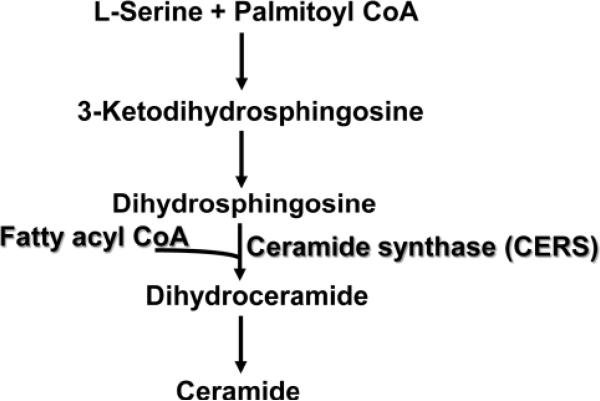
Background: The effectiveness of photodynamic therapy (PDT) for cancer treatment correlates with apoptosis. We previously observed that the knockdown of ceramide synthase 6, an enzyme from the de novo sphingolipid biosynthesis pathway, is associated with marked reduction in C18-dihydroceramide and makes cells resistant to apoptosis post-PDT. Down-regulation of ceramide synthase 1 (CERS1) can also render cells resistant to anticancer drugs.
Aim: To explore the impact of CERS1 knockdown on apoptosis and the sphingolipid profile, post-PDT, with the silicone phthalocyanine Pc 4, in a human head and neck squamous carcinoma cell line.
Materials and methods: Besides siRNA transfection and PDT treatment, the following methods were used: immunoblotting for protein expression, mass spectrometry for sphingolipid analysis, spectroflurometry and flow cytometry for apoptosis detection, and trypan blue assay for cell viability evaluation.
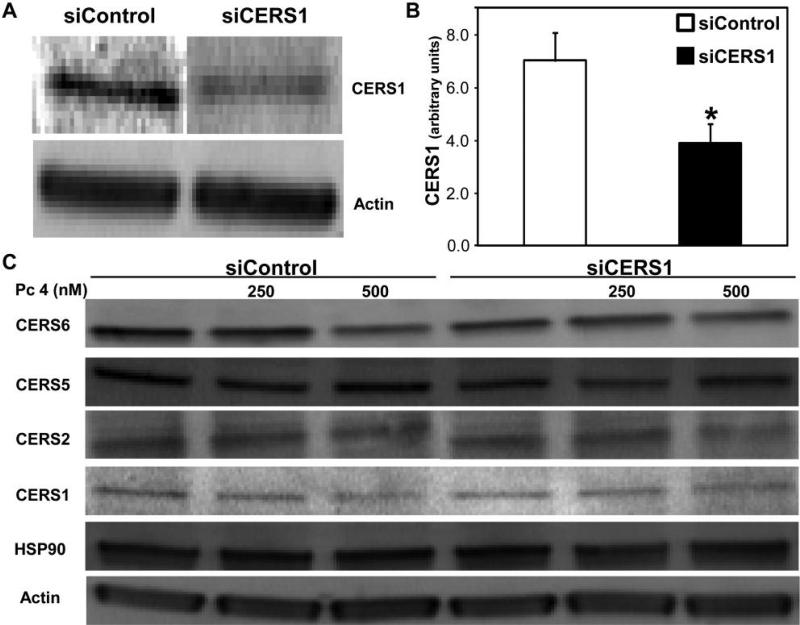
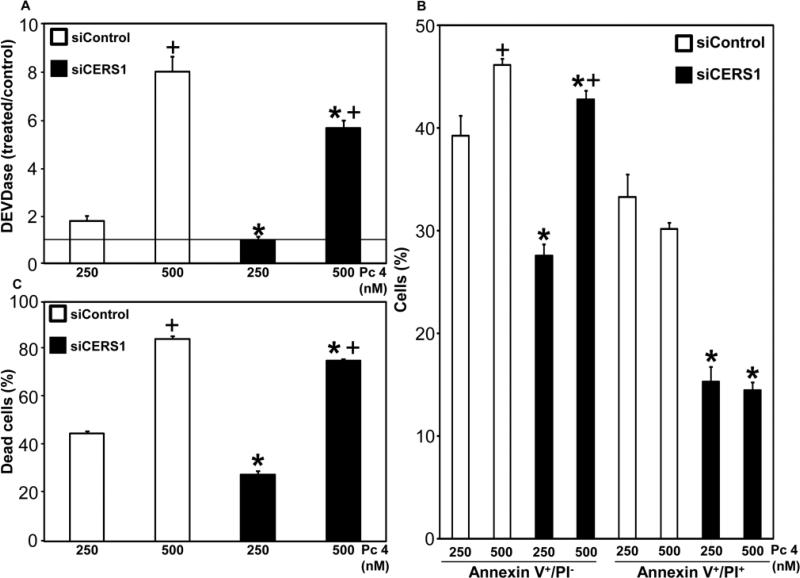
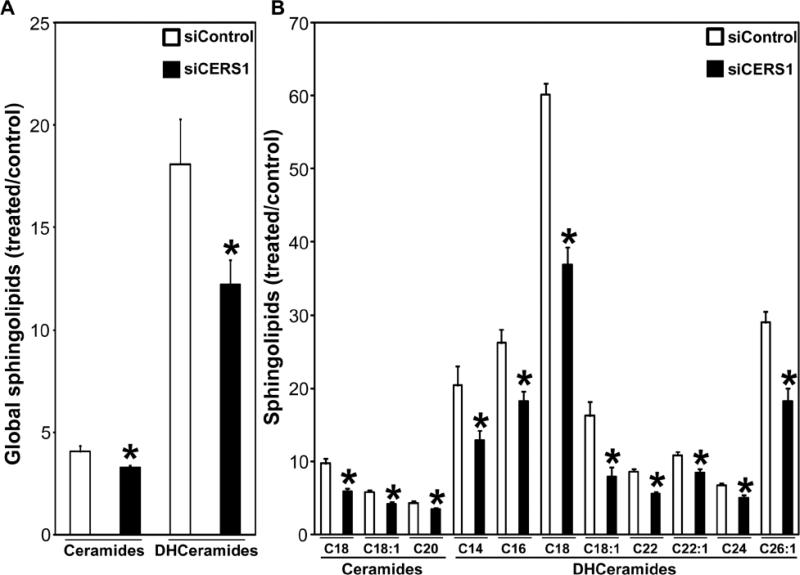
Results: CERS1 knockdown led to inhibition of PDT-induced caspase 3-like (DEVDase) activation, of apoptosis and cell death. CERS1 knockdown was associated with global and selective decreases in ceramides and dihydroceramides, in particular C18-, C18:1- and C20-ceramide post-PDT.
Conclusion: Our novel findings are consistent with the notion that CERS1 regulates apoptotic resistance to PDT, partly via C18- and C20-ceramide, and that CERS1 is a molecular target for controlling resistance to PDT.
Figures
References
-
- Henry B, Moller C, Dimanche-Boitrel MT, Gulbins E, Becker KA. Targeting the ceramide system in cancer. Cancer Lett. 2011 doi: 10.1016/j.canlet.2011.07.010. - PubMed
-
- Riebeling C, Allegood JC, Wang E, Merrill AH, Jr, Futerman AH. Two mammalian longevity assurance gene (LAG1) family members, TRH1 and TRH4, regulate dihydroceramide synthesis using different fatty acyl-CoA donors. J Biol Chem. 2003;278:43452–43459. - PubMed
Publication types
MeSH terms
Substances
Grants and funding
LinkOut - more resources
Full Text Sources
Other Literature Sources
Medical
Research Materials